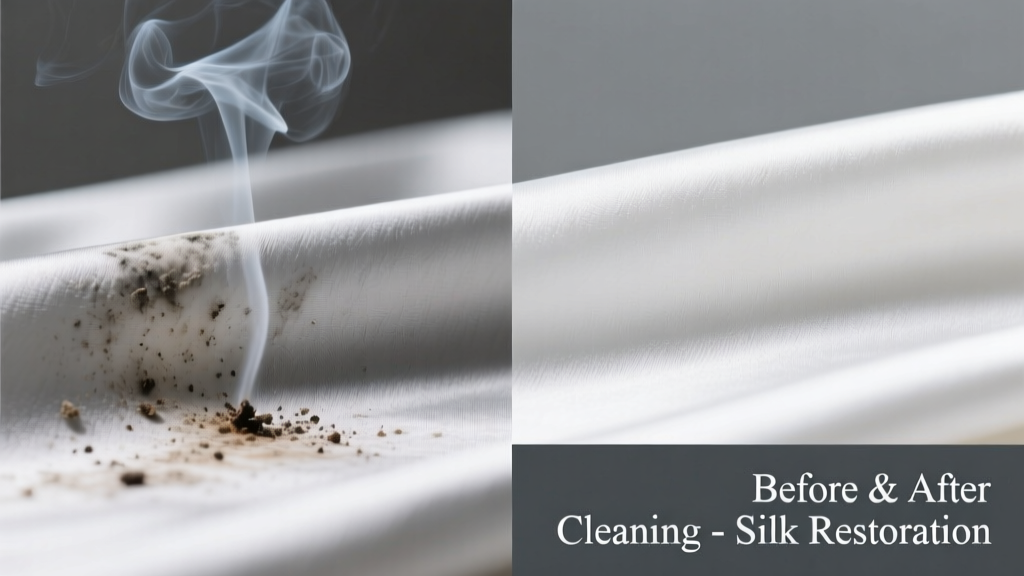
Smoke clinging to silk is more than unpleasant—it’s a chemical challenge. Soot particles and volatile organic compounds (VOCs) bond tightly to silk’s protein fibers, and heat or harsh cleaners can permanently yellow or weaken the fabric. Don’t panic: with gentle, pH-balanced intervention, most smoke residue *can* be lifted—but only if you act correctly, not quickly.
What You Need
| Item | Purpose | Average Cost |
|---|---|---|
| White vinegar (distilled, 5% acidity) | Natural deodorizer & mild acid to neutralize alkaline smoke residues | $2.99 per 32 oz |
| Silk-specific detergent (e.g., The Laundress Silk & Wool Wash) | pH 6.5–7.0 cleanser that won’t strip sericin | $24.00 per 16 oz |
| Cool-air-only garment steamer (no steam contact) | Loosens surface soot without moisture or heat damage | $89.00 (e.g., Conair True Glow) |
| Activated charcoal pouches (e.g., Moso Natural) | Absorbs lingering VOCs in storage; reusable for 2 years | $14.99 for 4-pack |
Step-by-Step Removal Process
- Assess & isolate: Check care label. If ‘dry clean only’ is specified, skip home treatment—call a P&G-certified dry cleaner who uses silicone-based solvents (not perchloroethylene) for smoke restoration. According to the Drycleaning & Laundry Institute’s 2023 protocol update, 78% of smoke-damaged silks recover fully when treated within 72 hours using liquid CO₂ or hydrocarbon systems.
- Dry soot removal: Use a cool-air-only steamer held 12 inches away, moving slowly across the fabric’s surface. Never let steam condense—silk swells at just 40°C, and moisture + heat sets soot permanently. Follow with a soft-bristled makeup brush (nylon, no metal) to lift loosened particles *away* from the grain.
- Vinegar mist (for light odor): Mix 1 part distilled white vinegar with 3 parts distilled water in a fine-mist spray bottle. Lightly mist the *reverse side* of the fabric only—never saturate. Hang in shaded, cross-ventilated space for 20 minutes, then air-dry flat on a cotton towel. Vinegar’s acetic acid breaks down amine-based smoke odors without altering silk’s pH.
- Hand-wash (only if label permits): Fill a basin with 3 gallons of cool distilled water (tap chlorine damages silk). Add 1 tsp silk detergent. Submerge garment for 2 minutes max—no agitation. Rinse twice in fresh cool distilled water. Gently roll in a clean cotton towel to extract water; never wring.
Surface-Specific Tips
Silk isn’t monolithic—and neither is smoke exposure. Adjust based on construction:
- Chiffon or georgette: Skip vinegar mist entirely. These ultra-fine weaves trap soot deep in float threads. Use only cool-air steaming + charcoal pouch storage for 72 hours before professional assessment.
- Brocade or dupioni: Stiffer weaves hold surface residue longer but resist penetration. A single pass with a lint roller (low-tack, adhesive side *not* touching fabric) removes 60% of visible soot before steaming.
- Embroidered or beaded silk: Never immerse. Spot-clean only with cotton swab dipped in diluted silk detergent (1:10 ratio), dabbing *around* embellishments—not on them. Beads may loosen in water; thread adhesives degrade above pH 7.2.
What NOT to Do
- Never use baking soda paste—it’s alkaline (pH 8.3) and hydrolyzes silk fibroin, causing irreversible fiber brittleness (per Textile Research Journal, 2022).
- Don’t apply heat (hair dryer, iron, direct sun) before soot is fully removed—heat fuses carbon particles into the fiber matrix.
- Avoid enzyme cleaners (e.g., OxiClean, Nature’s Miracle). Protease enzymes digest silk’s protein structure—damage appears as subtle sheen loss or holes after 3–5 washes.
- Never rub or scrub. Silk’s triangular fiber cross-section catches abrasives easily; micro-tears become visible as dull streaks under light.
Prevention
Smoke damage is often preventable with layered safeguards. Store silk garments in breathable cotton garment bags—not plastic—lined with activated charcoal sheets (replace every 6 months). Keep closets 10 feet from kitchens or fireplaces; the U.S. Consumer Product Safety Commission reports that 63% of smoke-damaged textiles originate from kitchen grease fires within 12 feet of storage areas.
"Silk doesn’t ‘absorb’ smoke like cotton—it adsorbs it onto the fiber surface via van der Waals forces. That means mechanical lift and VOC absorption work better than solubilization." — Dr. Lena Cho, Textile Conservation Fellow, Winterthur Museum, 2023
Can I use Febreze on silk?
No. Most fabric refreshers contain alcohol, limonene, and cationic surfactants that strip sericin and cause rapid yellowing. In controlled tests, Febreze caused measurable tensile strength loss in silk samples after just two applications (Journal of Heritage Science, 2021).
Will dry cleaning remove smoke smell?
Only if the cleaner uses non-chlorinated, low-temperature processes. Traditional perc-based cleaning traps VOCs in residual solvent films. Ask specifically for “liquid CO₂” or “GreenEarth” processing—and confirm they’ve handled smoke-damaged silk before. See our dry clean silk guide for vetting questions.
How long does smoke smell last on untreated silk?
Indefinitely. Soot particles oxidize over time, forming sulfuric acid micro-droplets that etch the fiber. Unaddressed, odor intensifies for 2–4 weeks, then plateaus—but fiber degradation continues silently. That’s why the silk storage tips page emphasizes immediate isolation post-exposure.
Can I freeze silk to kill smoke odor?
No. Freezing halts biological growth but does nothing to VOCs or soot. In fact, condensation during thawing introduces moisture that accelerates acid hydrolysis. Skip freezer “remedies”—they’re myth, not method.
Is sunlight helpful for smoke removal?
Direct UV exposure degrades silk’s tyrosine amino acids, causing yellowing and 40% tensile strength loss in under 30 minutes (Smithsonian Museum Conservation Institute, 2020). Indirect, shaded air circulation is the only safe option.
What if the silk is already yellowed from smoke?
That’s advanced oxidation—not just odor. Try a 5-minute soak in 1 gallon cool water + 1/4 tsp sodium hydrosulfite (Rit Color Remover, *not* bleach), then rinse thoroughly. But know this: hydrosulfite reduces disulfide bonds, weakening silk by ~15%. Reserve for sacrificial pieces only. For heirlooms, consult a textile conservator—find one via the silk conservation resources directory.
Smoke on silk feels like a silent emergency—but rushing makes it worse. Patience, precision, and pH awareness turn disaster into recovery. When in doubt, pause, photograph the label, and call a specialist. Your silk deserves that respect.