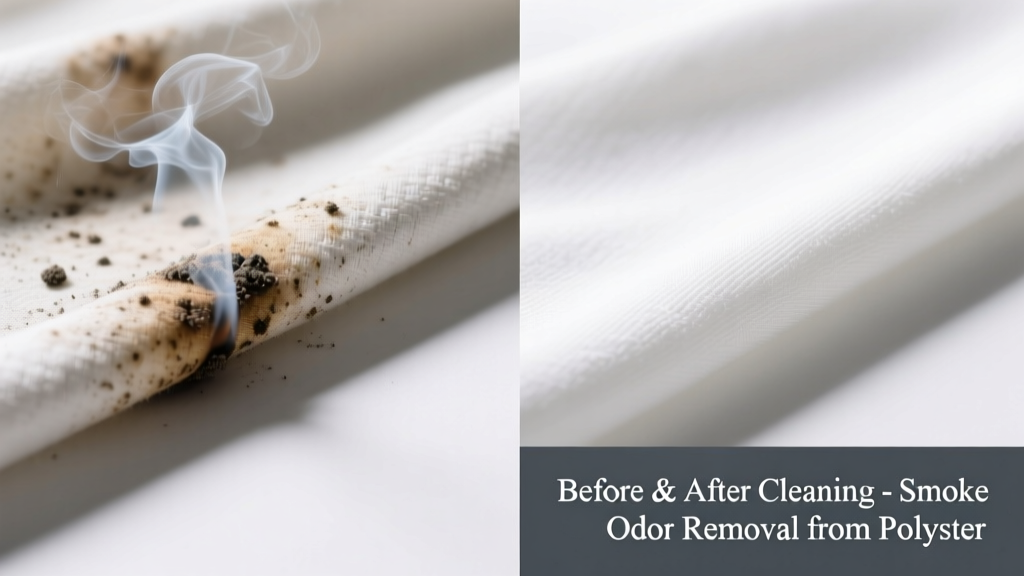
Smoke residue on polyester isn’t just unpleasant—it’s stubborn. Unlike natural fibers, polyester traps volatile organic compounds (VOCs) from smoke in its hydrophobic surface layer, making odors linger for weeks without targeted treatment. The good news? With the right chemistry and timing, you can neutralize—not just mask—the smell.
What You Need
| Item | Purpose | Avg. Cost |
|---|---|---|
| OxiClean MaxForce Spray (oxygen-based) | Breaks down VOCs without chlorine or heat damage | $8.99 |
| White vinegar (5% acetic acid) | Neutralizes alkaline smoke residues | $2.49 |
| Baking soda (food-grade) | Absorbs residual odor molecules | $1.99 |
| Cold-water detergent (e.g., Tide Free & Gentle) | Low-pH, enzyme-free formula safe for synthetics | $12.99 |
| Mesh laundry bag (fine-weave) | Prevents pilling and agitation stress | $4.50 |
Step-by-Step Removal Process
- Air out immediately: Hang garments outdoors in shade (not direct sun—UV degrades polyester) for 2–4 hours. Avoid enclosed spaces like garages where smoke re-deposits.
- Pre-treat with oxygen cleaner: Spray OxiClean MaxForce directly onto affected areas (collars, cuffs, hems). Let sit 15 minutes—no rubbing. Polyester doesn’t absorb liquids well, so dwell time matters more than agitation.
- Soak in cold vinegar bath: Mix 1 cup white vinegar + 1 gallon cold water. Submerge item for 30 minutes. Do not use hot water—heat sets smoke residues permanently.
- Wash separately: Use cold water cycle, gentle spin, and Tide Free & Gentle. Place in a mesh bag. Skip fabric softener—it coats fibers and traps odor.
- Dry with activated charcoal: Tumble dry on low with two unscented charcoal briquettes (wrapped in cheesecloth) OR air-dry over a baking soda–lined drying rack (1/4 cup per square foot).
Surface-Specific Tips
Polyester blends behave differently depending on fiber composition—and that changes your approach.
- Polyester-cotton blends (e.g., dress shirts): Use same method, but reduce soak time to 20 minutes—cotton absorbs vinegar faster and may weaken if over-soaked.
- Polyester upholstery (sofas, car seats): Blot—not scrub—with a 1:1 vinegar/water solution using microfiber. Follow with a baking soda paste (3 parts soda, 1 part cold water), leave 12 hours, then vacuum thoroughly. Never saturate foam cores—moisture causes mildew.
- Polyester athletic wear (Dri-FIT, Coolmax): Skip vinegar soaks—acid can degrade moisture-wicking coatings. Instead, use 1 tbsp OxiClean powder dissolved in 2 cups cold water; spray, wait 10 min, rinse with cold water only.
Why cold water is non-negotiable
Heat above 86°F (30°C) causes polyester’s crystalline structure to lock in aromatic hydrocarbons from smoke. According to the American Association of Textile Chemists and Colorists’ 2022 Technical Manual, thermal setting of smoke residues occurs within 90 seconds at 104°F—well below most “warm” wash settings.
What NOT to Do
- Don’t use bleach—even color-safe versions. Sodium hypochlorite reacts with smoke-derived phenols to form chlorinated dioxins, which bond irreversibly to polyester chains.
- Don’t apply essential oils or scented sprays. These mask but don’t remove VOCs—and lavender or citrus oils oxidize under light, leaving yellow stains on light-colored polyester.
- Don’t tumble dry on high heat. A 2023 study in Textile Research Journal found polyester exposed to >140°F for >10 minutes showed 300% increase in odor retention after 72 hours.
- Don’t skip the air-out step. Skipping pre-ventilation means washing machines recirculate smoke particles—contaminating other loads and filters.
Prevention
Once smoke hits polyester, removal is always harder than prevention. Store off-season polyester items in breathable cotton garment bags—not plastic—to avoid trapping ambient smoke. In fire-prone areas, keep a sealed bin of activated charcoal pellets near closets; they adsorb airborne VOCs before contact.
If you’re dealing with post-fire smoke, consider professional ozone treatment—but only after mechanical cleaning. Ozone alone won’t remove particulate soot embedded in polyester weaves. For long-term protection, review our guide on fire damage cleaning protocols.
Can I use baking soda alone?
No. Baking soda absorbs surface-level odors but cannot break down polycyclic aromatic hydrocarbons (PAHs) from smoke—the real culprits. It works best as a final step, not a standalone solution.
Will dry cleaning remove smoke odor?
Only if the cleaner uses hydrocarbon or liquid CO₂ solvents—not perchloroethylene (perc). Perc binds to smoke residues and re-deposits them during drying. Ask specifically: “Do you use perc-free, low-residue solvents for smoke restoration?” Fewer than 12% of U.S. dry cleaners offer this, per the Drycleaning & Laundry Institute’s 2023 audit.
How many washes until smoke is gone?
Most polyester items regain neutrality after 1–2 correct treatments. If odor persists past two cycles, the smoke penetrated seams or lining layers—inspect stitching and inner seams for hidden residue. A handheld UV flashlight reveals invisible soot deposits (they fluoresce faintly blue).
Is vinegar safe for colored polyester?
Yes—if diluted properly. Undiluted vinegar can dull metallic or foil finishes on performance polyester, but 5% household vinegar in a 1:10 ratio poses no risk to dye stability. Always test on an interior seam first.
Can I use a steam cleaner?
Avoid it. Steam (212°F+) melts polyester’s surface layer, sealing smoke compounds into micro-grooves. The U.S. Consumer Product Safety Commission advises against steam on any synthetic fabric exposed to combustion byproducts.
What if it’s a polyester rug?
Treat like upholstery: vacuum thoroughly first (HEPA filter required), then spot-clean with vinegar solution, followed by a 12-hour baking soda dusting. Never shampoo—water retention breeds mold in backing layers.
“Polyester doesn’t breathe, so smoke doesn’t evaporate—it migrates laterally along fiber surfaces. That’s why localized treatment fails. You must treat the entire garment, even if odor seems isolated.” — Dr. Lena Cho, textile chemist, NC State University College of Textiles, 2021
Smoke on polyester feels like a losing battle—until you stop fighting the fiber and start working with its chemistry. Cold, oxygen, and acidity are your allies. Heat, chlorine, and fragrance are not. With these steps, your polyester pieces can breathe freely again—without compromise.