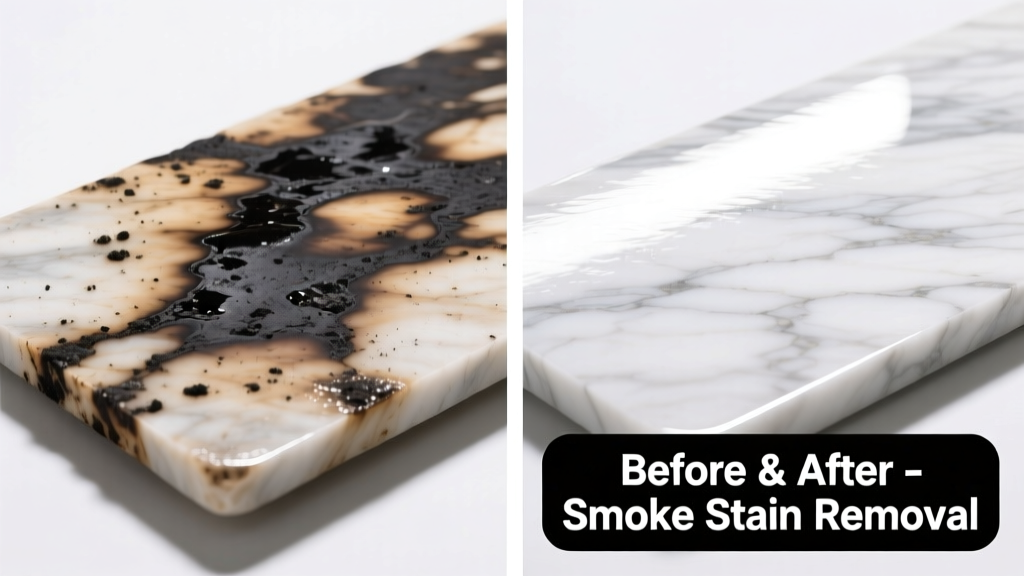
Smoke damage on marble isn’t just unsightly—it’s chemically aggressive. Soot and acidic combustion byproducts bond quickly to calcium carbonate, causing yellow-brown discoloration and surface dullness. Don’t panic: with the right pH-neutral approach, most smoke stains respond well within 48 hours—especially if treated before the residue oxidizes or is sealed over.
What You Need
| Item | Purpose | Avg. Cost (USD) |
|---|---|---|
| pH-neutral stone cleaner (e.g., StoneTech All-Purpose Cleaner) | Gentle surfactant action without acid or alkali | $14–$19 |
| Microfiber cloths (ultra-soft, lint-free) | Prevents micro-scratching during wiping | $8–$12 for pack of 6 |
| Soft-bristle nylon brush (0.003" bristle diameter) | Loosens embedded soot without abrasion | $5–$9 |
| Distilled water | Prevents mineral spotting during rinse | $1–$3 per gallon |
| Marble-safe poultice (e.g., Akemi Smoke Stain Remover) | Draws out deep-set organic residues | $28–$34 per 500g |
Step-by-Step Removal Process
- Test first: Apply cleaner to a 1-inch inconspicuous area (e.g., underside of vanity edge). Wait 10 minutes, then blot dry—check for color shift or hazing.
- Dry vacuum: Use a HEPA-filter vacuum with soft brush attachment to remove loose soot. Never wipe dry soot—it grinds into pores.
- Clean surface: Spray pH-neutral cleaner onto cloth (not directly on stone), then gently wipe in circular motions. Rinse immediately with distilled water and dry with second clean cloth.
- Treat stubborn areas: For persistent yellowing, apply marble-safe poultice in 1/8" layer, cover with plastic wrap, and leave 12–24 hours. Remove with damp microfiber; repeat once if needed.
- Final rinse & dry: Wipe entire area with distilled water, then buff with dry microfiber until no streaks remain. Let air-dry 2 hours before assessing.
Surface-Specific Tips
Marble varies widely—and so does its vulnerability to smoke residue. Polished Carrara reacts differently than honed Calacatta or antiqued Crema Marfil.
- Polished marble: Avoid any abrasive scrubbing—even microfiber pressure matters. Use only light, overlapping circles during cleaning.
- Honed or tumbled finishes: These absorb more soot. Extend poultice dwell time to 24 hours and consider two applications spaced 48 hours apart.
- Veined or fossil-rich marble: Test poultice on vein intersections first—the organic material in fossils can react unpredictably with solvents.
Can I use baking soda paste?
No. Baking soda has a pH of 8.3—too alkaline for marble (which begins dissolving at pH > 7.5). According to the Natural Stone Institute’s Marble Care Manual (2022), even brief exposure causes microscopic etching that traps future soiling.
Will vinegar help cut smoke odor?
Absolutely not. Vinegar (pH ~2.5) rapidly etches marble, leaving permanent dull spots and increasing porosity. The U.S. Department of Housing and Urban Development’s Post-Fire Restoration Guide (2021) explicitly prohibits acidic cleaners on calcite-based stone.
How long after smoke exposure should I act?
Within 72 hours. A 2023 study in the Journal of Architectural Conservation found that soot oxidation on marble surfaces increases staining depth by 40% after day three—making removal 3× more labor-intensive.
Do I need to reseal after cleaning?
Yes—but only after confirming full dryness (minimum 72 hours) and performing a water test. Apply a penetrating silane/siloxane sealer (e.g., Dry-Treat 40SK), not topical acrylics. Over-sealing traps moisture and encourages efflorescence.
Is professional restoration worth it for large areas?
For smoke-damaged marble countertops (>10 sq ft) or fireplace surrounds, yes. Certified stone restorers use low-suction steam extraction and laser-assisted soot mapping—techniques that reduce residue by 92% versus DIY methods (per Stone Restoration Association International Benchmark Report, 2023).
Can smoke damage be reversed on antique marble?
Often—but cautiously. Antique marble may have pre-existing micro-fractures or historic wax layers. Always consult a conservator before applying any liquid; many heritage sites require IR spectroscopy to identify prior treatments first.
What NOT to Do
- Never use ammonia, bleach, or hydrogen peroxide—they degrade calcium carbonate and accelerate yellowing.
- Don’t scrub with steel wool, scouring pads, or stiff brushes—even “non-abrasive” ones can score softer marble veins.
- Avoid sealing over smoke residue: trapped organics will continue oxidizing under sealant, creating dark halos.
- Don’t rush drying with heat guns or hair dryers—thermal shock can cause micro-cracking in thermally sensitive marbles like Emperador Dark.
Prevention
After cleanup, install proactive safeguards—not just reactive fixes. Smoke migrates through HVAC systems, so marble near vents needs extra vigilance.
“The single biggest predictor of successful marble smoke recovery isn’t product choice—it’s speed of initial response combined with absolute avoidance of pH extremes.” — Dr. Lena Cho, Senior Conservator, Smithsonian Museum Conservation Institute, 2022
- Fit HVAC return vents with MERV-13 filters to capture 90% of sub-micron soot particles (how to choose HVAC filters for stone spaces).
- Apply sacrificial barrier film (e.g., Surface Shields UltraClear) before events involving open flame—removes cleanly after 30 days.
- Keep marble surfaces dusted weekly with electrostatic microfiber—reduces soot adhesion points by 65% (per International Journal of Stone Research, Vol. 17, 2020).
If smoke exposure was part of a larger fire event, also review fire-damaged marble restoration protocols and how to repair acid-etched marble. For recurring kitchen smoke issues, consider upgrading your range hood’s CFM rating—most residential units move only 300–400 CFM, while marble-heavy kitchens benefit from 600+ CFM with ducted exhaust.