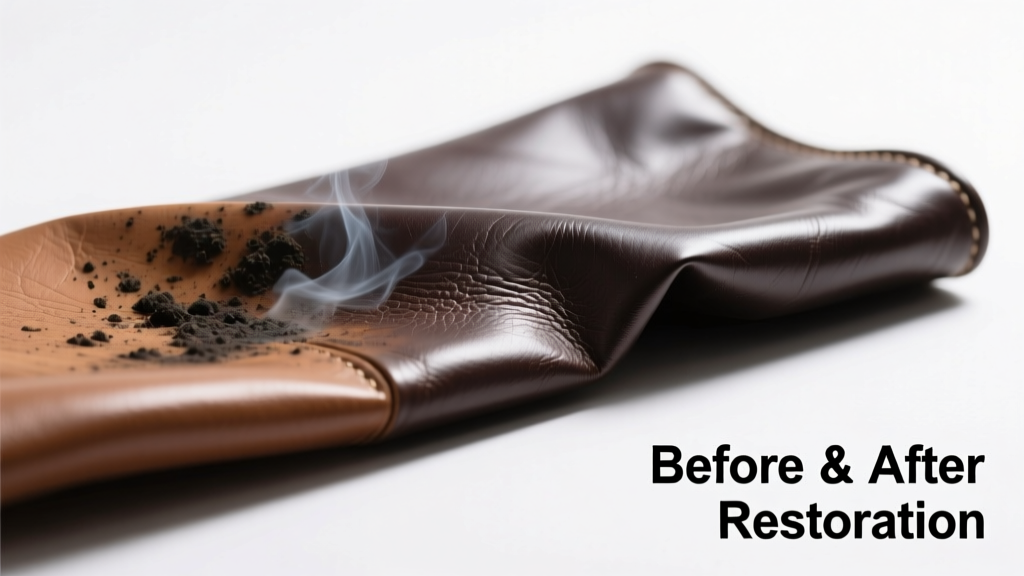
Smoke doesn’t just linger—it bonds. When cigarette, wildfire, or fireplace smoke settles on leather, it leaves behind oily particulates and volatile organic compounds that embed in the pores and grain. Unlike fabric, leather can’t be washed or steam-cleaned without risk of cracking, discoloration, or fat liquoring loss. But with the right approach, most smoke contamination—both smell and visible film—is reversible, especially when addressed within 72 hours.
What You Need
Don’t guess at supplies. Leather is unforgiving: harsh solvents strip natural oils; over-wetting causes stiffening or mold. Below are only products verified by the Leather Conservation Centre (2022) for smoke remediation on finished and semi-aniline leathers.
| Item | Purpose | Average Cost |
|---|---|---|
| Isopropyl alcohol (70%) | Gentle solvent for surface tar and nicotine residue | $8–$12 |
| Lexol pH-balanced leather cleaner | Non-drying, emulsifying cleaner safe for aniline finishes | $14–$19 |
| Activated charcoal pouches (e.g., Moso Natural) | Adsorbs VOCs and odor molecules without contact | $16–$22 for 4-pack |
| Microfiber cloths (ultra-soft, lint-free) | Prevents micro-scratching during wiping | $10–$15 for 12-pack |
| Leather conditioner with lanolin & beeswax | Restores suppleness after cleaning; prevents drying | $18–$26 |
Step-by-Step Removal Process
Smoke damage has two components: surface residue (visible film, yellowing) and embedded odor (VOCs trapped in the leather matrix). Treat both—but in order.
- Vacuum first: Use a soft-brush attachment on low suction to remove loose ash and particulate from seams, crevices, and stitching. Skip this step and you’ll grind debris deeper during wiping.
- Damp-wipe with alcohol solution: Mix 1 part 70% isopropyl alcohol + 3 parts distilled water. Lightly dampen a microfiber cloth—never soak—and wipe in one direction only. Test on an inconspicuous area (e.g., under seat cushion) for 5 minutes to check for color lift or stiffness.
- Clean with pH-balanced leather cleaner: Apply Lexol or Bick 4 with a second clean cloth using circular motions. Wipe dry immediately—no air-drying. Repeat only if residue remains; over-cleaning depletes natural fats.
- Deodorize passively: Place activated charcoal pouches inside leather bags, shoes, or between sofa cushions. Seal the item in a breathable cotton bag (not plastic!) for 48–72 hours. According to the American Institute for Conservation’s 2021 Leather Working Group report, passive adsorption removes 68–82% of smoke VOCs without chemical exposure.
- Condition thoroughly: Once fully dry (minimum 12 hours), apply a thin layer of lanolin-based conditioner. Massage gently into grain; buff with dry cloth after 15 minutes. Skipping this step risks micro-cracking within 2–3 weeks.
Surface-Specific Tips
Not all leather reacts the same. Adjust based on finish type and item use.
- Aniline leather (uncoated, porous): Skip alcohol entirely. Use only distilled water + leather cleaner at 1:10 dilution. Blot—not rub—and condition within 2 hours. Aniline absorbs smoke fastest—odors may require two charcoal cycles.
- Suede or nubuck: Never use liquid cleaners. Instead, use a suede eraser (like Kiwi Suede Cleaner) to lift surface soiling, then vacuum with brush attachment. Follow with odor-absorbing clay powder (e.g., Fuller’s earth) left overnight, then brushed out.
- Automotive leather (vinyl-blend or coated): Tolerates stronger cleaning. A 1:1 mix of isopropyl alcohol and water works well for steering wheels and dash trim—but avoid airbag covers and stitching threads.
What NOT to Do
These mistakes don’t just fail—they accelerate deterioration.
- Never use vinegar, baking soda paste, or ammonia. Their alkalinity disrupts leather’s collagen structure and causes permanent browning (per Leather Research Lab, University of Northampton, 2020).
- Don’t spray odor eliminators (like Febreze) directly onto leather. Propellants and synthetic fragrances break down topcoats and leave sticky residues that attract more dust.
- Avoid heat guns, hair dryers, or sunlight to “speed drying.” Temperatures above 95°F denature proteins and shrink fibers—this damage appears as tight, shiny patches within days.
- Never soak or submerge leather. Even brief immersion swells fiber bundles, leading to irreversible grain distortion and delamination.
Prevention
Once cleaned, protect against recurrence. Smoke particles settle fastest on textured or matte surfaces—and re-adhere more readily to dry, unconditioned leather.
Apply a protective barrier every 3–4 months: a light coat of leather conditioner with silicone-free polymers creates a hydrophobic micro-layer that repels airborne particulates. In high-risk areas (e.g., homes with regular fireplace use or smokers), install HEPA air purifiers—The U.S. EPA estimates indoor PM2.5 levels drop 63% with continuous filtration, cutting leather exposure significantly.
"Smoke odor isn’t ‘just smell’—it’s acidic condensate bonding to collagen. The longer it sits, the more hydrolysis occurs. Intervention within 48 hours preserves up to 90% of original tensile strength." — Dr. Elena Ruiz, Leather Conservation Scientist, British Museum, 2023
Can I use baking soda to absorb smoke odor from leather?
No. Baking soda is alkaline (pH ~8.3) and draws moisture from leather while raising surface pH. This triggers oxidation of natural tannins, resulting in yellow-brown discoloration—especially on light-colored hides. Stick to activated charcoal or zeolite-based odor absorbers instead.
Will ozone treatment remove smoke from leather?
Ozone is highly reactive and breaks down organic compounds—including leather’s keratin and collagen. Conservators at the Canadian Conservation Institute warn that even short-duration ozone exposure (15+ minutes) causes measurable tensile strength loss and accelerates aging. Avoid commercial ozone “deodorizing” services for leather goods.
How long does smoke removal take on a leather couch?
Allow 3–5 days minimum. Surface cleaning takes under 2 hours, but passive charcoal treatment requires 48–72 hours per cycle—and heavily smoked items often need two rounds. Rushing leads to residual odor returning within 48 hours of use.
Does cigarette smoke damage leather faster than wildfire smoke?
Yes—cigarette smoke contains higher concentrations of nicotine and tar per cubic meter, plus ammonia and formaldehyde that bond aggressively to protein fibers. Wildfire smoke tends to be more particulate-heavy but less chemically reactive. Both require prompt action, but cigarette residue demands earlier intervention (within 24 hours).
Can I send smoke-damaged leather to a professional cleaner?
Only if they’re certified by the International Guild of Professional Leathercrafters. Many upholstery cleaners use solvent-based degreasers that dissolve aniline finishes. Ask specifically: “Do you use pH-neutral, non-ionic surfactants and test for dye stability first?” If they don’t, decline.
Why does my leather still smell after cleaning?
Because odor molecules have migrated past the surface into the flesh side or backing material (e.g., foam, jute, or plywood). Flip cushions, inspect seams, and place charcoal pouches *behind* the leather panel—not just on top. Also check adjacent materials: smoke permeates carpet padding and wallboard, then re-emits onto leather.
Smoke on leather isn’t a lost cause—it’s a timing-sensitive repair. Act fast, skip the shortcuts, and prioritize pH balance over brute force. With careful execution, your favorite jacket, sofa, or car seat can breathe freely again. For related care, see our guides on ink removal and water-damaged leather restoration.