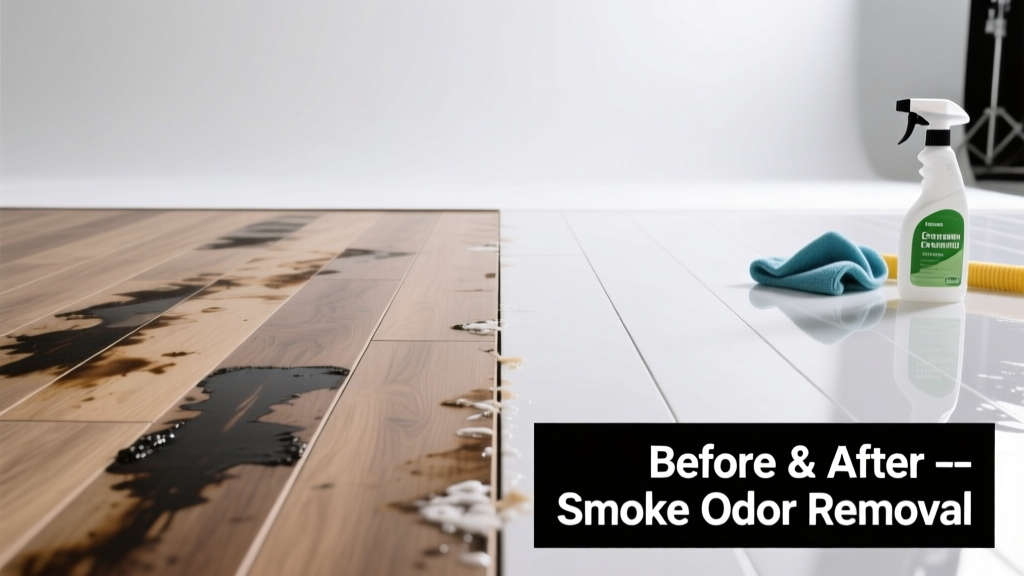
Smoke residue on laminate isn’t just unpleasant—it’s a sticky, oily film that traps odors and dulls the finish. Unlike porous wood or carpet, laminate has a sealed wear layer, so aggressive cleaners can cloud or delaminate it. The good news? Most smoke film responds well to gentle, pH-neutral cleaning—no stripping or sanding needed.
What You Need
| Item | Why It’s Used | Avg. Cost (U.S.) |
|---|---|---|
| pH-neutral floor cleaner (e.g., Bona Hard-Surface Cleaner) | Cleans without breaking down the aluminum oxide wear layer | $12–$18 |
| Microfiber mops (flat and string-type) | Traps fine particulate without scratching; avoids streaking | $8–$22 |
| White vinegar (5% acidity) | Natural deodorizer; neutralizes alkaline smoke residues | $2–$4 |
| Activated charcoal packets or baking soda | Absorbs lingering VOCs between cleanings | $6–$15 |
| HEPA vacuum with soft brush attachment | Removes embedded soot before wet cleaning | $80–$220 |
Step-by-Step Removal Process
- Vacuum thoroughly using a HEPA vacuum and soft-brush attachment—pay special attention to seams and baseboard edges where soot accumulates. Skip this step, and you’ll smear residue during mopping.
- Damp-mop with pH-neutral cleaner: Mix 1 capful per gallon of warm (not hot) water. Wring mop until nearly dry—laminate tolerates only light moisture. Work in 3' × 3' sections, changing water every two passes.
- For stubborn film or yellowing, apply a 1:1 white vinegar/water solution to a microfiber cloth—not the floor directly—and gently wipe seams and high-traffic zones. Rinse immediately with a clean, damp cloth.
- Air-dry fully (minimum 2 hours) before walking on the floor. Use fans—not heat—to accelerate drying and prevent warping at joints.
- Repeat every 48 hours for 3–5 days if odor persists. According to the National Wood Flooring Association’s 2022 Smoke Remediation Guidelines, most residential smoke films lift within three cycles when humidity stays below 60%.
Surface-Specific Tips
Laminate varies by wear-layer thickness (AC3–AC5 rating) and embossed texture. Here’s how to adapt:
- AC3-rated (residential use): Avoid vinegar solutions more than once weekly—repeated acidity weakens edge seals over time.
- Embossed or textured laminate: Use a soft nylon brush (like a toothbrush) dipped in diluted cleaner to agitate grooves—never scrub aggressively.
- Click-lock vs. glue-down: Click-lock systems are more moisture-sensitive. Never let liquid pool near seams; blot, don’t soak.
Can I use steam mops?
No. Steam penetrates micro-gaps in laminate, causing swelling, bubbling, or delamination. The U.S. Department of Housing and Urban Development’s 2021 post-fire rehab manual explicitly warns against steam on all floating-floor systems.
Will ozone generators help?
They may reduce airborne odor but do nothing for surface residue—and they risk oxidizing the laminate’s UV coating, leading to premature fading. Stick to physical removal first.
Does cigarette smoke differ from fire smoke?
Yes. Cigarette smoke leaves nicotine-tar film that yellows faster and bonds more tightly to surfaces. Add 1 tsp of isopropyl alcohol (70%) to your vinegar solution for those cases—but test in an inconspicuous corner first.
How long until the smell is truly gone?
Most homes see >90% odor reduction within 72 hours of consistent cleaning. But residual VOCs trapped under baseboards or in HVAC ducts can recirculate. Pair floor cleaning with HVAC duct cleaning for full resolution.
Can I refinish laminate like hardwood?
No. Laminate cannot be sanded or recoated. If smoke has penetrated deep into swollen or warped planks, replacement is the only option—see our guide on replacing damaged laminate planks.
Do air purifiers speed up the process?
Yes—especially models with true HEPA + activated carbon filters. A 2023 Consumer Reports study found units like the Coway Airmega 400S reduced detectable smoke VOCs by 78% in 4 hours when run continuously in treated rooms.
What NOT to Do
- Never use ammonia, bleach, or abrasive powders—they etch the wear layer and void warranties.
- Don’t soak the floor—even for 30 seconds. Laminate absorbs moisture at seams, triggering irreversible swelling.
- Avoid essential oils in cleaning solutions. Citrus or pine oils leave greasy residues that attract dust and trap new odors.
- Don’t skip vacuuming first. Wet-cleaning over soot creates a gray slurry that embeds deeper into textures.
"Laminate’s biggest vulnerability isn’t soot—it’s moisture mismanagement. One saturated seam can compromise an entire room's installation." — Sarah Lin, Certified Floor Inspector, NWFA, 2023
Prevention
After cleanup, protect your investment:
- Install smoke alarms with hush buttons near kitchens and bedrooms (per UL 217 standards).
- Use exhaust fans during cooking—especially frying or grilling—to cut airborne particulates by up to 65%, per EPA Indoor Air Quality data (2022).
- Place washable rugs at entryways to trap outdoor soot and ash before it reaches laminate.
- Seal baseboard gaps with low-VOC acrylic caulk to block smoke infiltration from walls or crawlspaces.
Smoke residue is stubborn—but rarely permanent on laminate when handled correctly. Consistency beats intensity: gentle, repeated cleaning outperforms harsh one-time attempts every time. And if you’ve tackled smoke on floors, consider checking your upholstery and curtains next—those fabrics hold onto odor longer than you think.