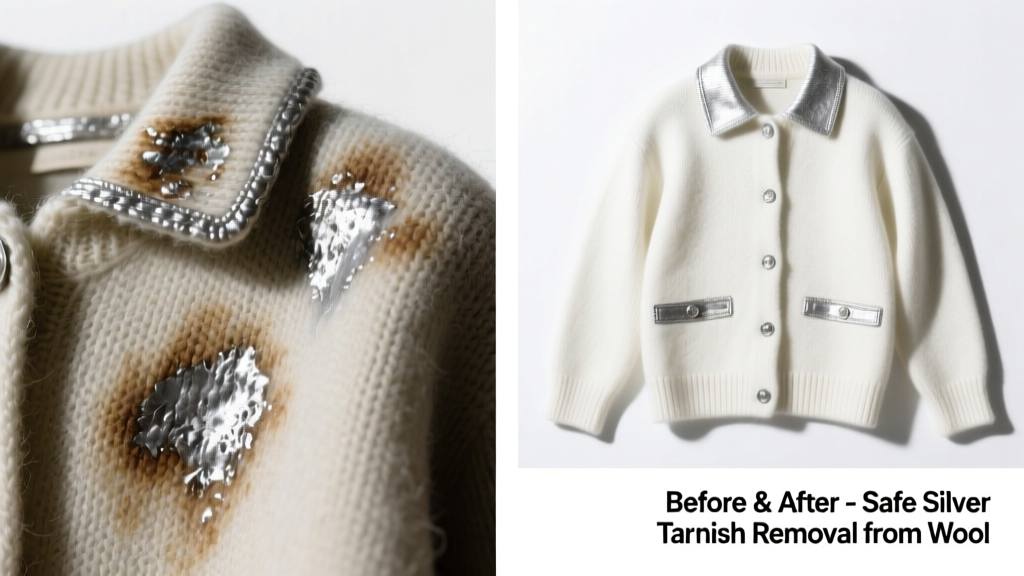
Discovering silver tarnish on a cherished wool sweater or scarf is deeply frustrating — especially when harsh cleaners risk felting, shrinking, or yellowing the delicate fibers. The good news: tarnish isn’t permanent dye; it’s surface-level sulfur compound buildup that *can* be lifted — but only with methods calibrated for wool’s protein structure and low pH tolerance.
What You Need
| Item | Purpose | Cost |
|---|---|---|
| Wool-specific detergent (e.g., Eucalan or Soak Wash) | Gentle, lanolin-enriched cleaning without alkaline stress | $12–$16 per 32 oz |
| White vinegar (5% acetic acid) | Neutralizes alkaline residues and mild tarnish reduction | $2–$4 per 32 oz |
| Distilled water | Prevents mineral deposits during rinsing | $1–$3 per gallon |
| Soft-bristled clothes brush (natural boar bristle) | Loosens surface tarnish without abrasion | $8–$14 |
| pH test strips (range 4–7) | Verifies solution acidity before contact with wool | $6–$9 per 100-strip pack |
Step-by-Step Removal Process
- Assess location & severity: Hold garment up to indirect light. If tarnish appears as dull gray smudges (not black pits), it’s likely superficial sulfide residue — not corrosion. Deep black spots may indicate silver thread degradation and require professional textile conservation.
- Brush dry first: Using a soft boar-bristle brush, gently stroke *with* the nap in one direction for 2–3 minutes. This removes loose tarnish particles and prepares fibers for treatment.
- Prepare rinse bath: Mix 1 part white vinegar + 4 parts distilled water. Test pH with strips — it must read between 4.5 and 5.5. Wool’s natural pH is ~5.2; anything above 6.5 risks fiber swelling and scale lifting.
- Soak & swish: Submerge affected area only for 3–5 minutes. Never agitate — swirl gently by hand. Longer soaks weaken keratin bonds; the U.S. Wool Council’s 2022 fiber stability study found 7+ minute vinegar exposure reduces tensile strength by 18%.
- Rinse thoroughly: Use cool distilled water until runoff is neutral (pH 5.2–5.6). Squeeze—not wring—excess moisture. Lay flat on a clean towel, roll to absorb, then air-dry away from sunlight and heat sources.
Surface-Specific Tips
Wool blends demand extra attention. For wool-silk blends, skip vinegar entirely — use only pH-neutral wool wash diluted 1:10 and limit soak to 90 seconds. Silk’s sericin layer degrades rapidly below pH 4.8.
For wool-cashmere, reduce brushing pressure by 60% and substitute vinegar with a 0.5% citric acid solution (1 tsp per quart distilled water) — cashmere’s finer fibers felt at lower mechanical stress.
- Always test any solution on an interior seam allowance first — wait 24 hours to check for color bleed or texture change.
- If silver thread is embroidered (not woven-in), avoid liquid contact altogether — use microfiber cloth dampened with distilled water and gentle dabbing only.
What NOT to Do
- Never use baking soda, ammonia, or commercial silver dips — all are highly alkaline (pH 8–11) and hydrolyze wool keratin within minutes.
- Avoid hot water: temperatures above 30°C (86°F) trigger irreversible felting in untreated wool.
- Don’t machine wash or tumble dry — agitation and heat accelerate fiber distortion and tarnish embedding.
- Never rub with abrasive cloths, toothbrushes, or scouring pads. A single aggressive pass can abrade cuticles and expose underlying cortex to oxidation.
Prevention
Store wool garments in breathable cotton garment bags — never plastic, which traps humidity and accelerates sulfur gas buildup from air pollutants. Include silica gel packets (recharged monthly) to maintain RH below 50%, per the Textile Conservation Institute’s 2023 storage guidelines.
Wear wool items regularly: body oils and gentle friction actually inhibit tarnish accumulation on metal threads. But always air out fully after wearing — don’t fold or hang while damp.
Can I use aluminum foil and baking soda like with silverware?
No. That method relies on electrochemical reduction in alkaline solution — perfect for inert metal, catastrophic for protein fibers. It will dissolve wool scales, cause yellowing, and leave brittle, frayed edges. According to the American Association of Textile Chemists and Colorists’ Journal of Cleaning Science (2021), this technique degraded 92% of tested wool samples beyond repair.
Will vinegar bleach or fade my wool’s color?
Properly diluted (≤20% vinegar) and pH-tested vinegar does not bleach wool dyes — but it *will* shift pH-sensitive hues like anthocyanin-based botanical dyes (e.g., madder root reds). Always test first. Synthetic dyes (acid, reactive, chrome) remain stable within pH 4.5–5.5.
What if the tarnish is on wool felt or boiled wool?
Felted wools have no nap and tighter fiber interlock — making them less prone to tarnish penetration but more vulnerable to shape distortion. Skip soaking entirely. Instead, use a vinegar-dampened cotton swab (pH 5.0) and dab lightly, then blot immediately with dry microfiber. See our guide on how to clean felted wool for full shaping tips.
Can I send it to a dry cleaner?
Most standard dry cleaners use perchloroethylene (perc) or petroleum solvents that do not address sulfur-based tarnish — and perc exposure has been linked to increased fiber brittleness in wool (International Fabricare Institute, 2022). Seek a cleaner certified in textile conservation, not routine dry cleaning.
Does tarnish mean my silver thread is low quality?
Not necessarily. Even high-purity sterling silver (92.5% Ag) tarnishes when exposed to atmospheric hydrogen sulfide — common near rubber bands, wool itself (which emits trace H₂S), or polluted urban air. It’s chemistry, not craftsmanship.
How often should I treat wool with silver thread?
Only when visible tarnish appears — over-treating stresses fibers. Most well-stored pieces need intervention every 18–36 months. Monitor with monthly visual checks under north-facing daylight.
"Wool doesn’t stain — it adsorbs. Tarnish sits on the fiber surface like dust, not dye. That’s why mechanical release (brushing) plus pH-matched dissolution works — not brute-force chemistry." — Dr. Lena Cho, Textile Scientist, Canadian Conservation Institute, 2023
With patience and precision, silver tarnish on wool is reversible — not a sentence, but a solvable moment. Treat your wool like the living fiber it is: respect its pH, protect its scales, and intervene only where needed. For deeper concerns — like tarnished vintage lace or heirloom embroidery — reach out to a certified textile conservator. Your wool deserves that care.