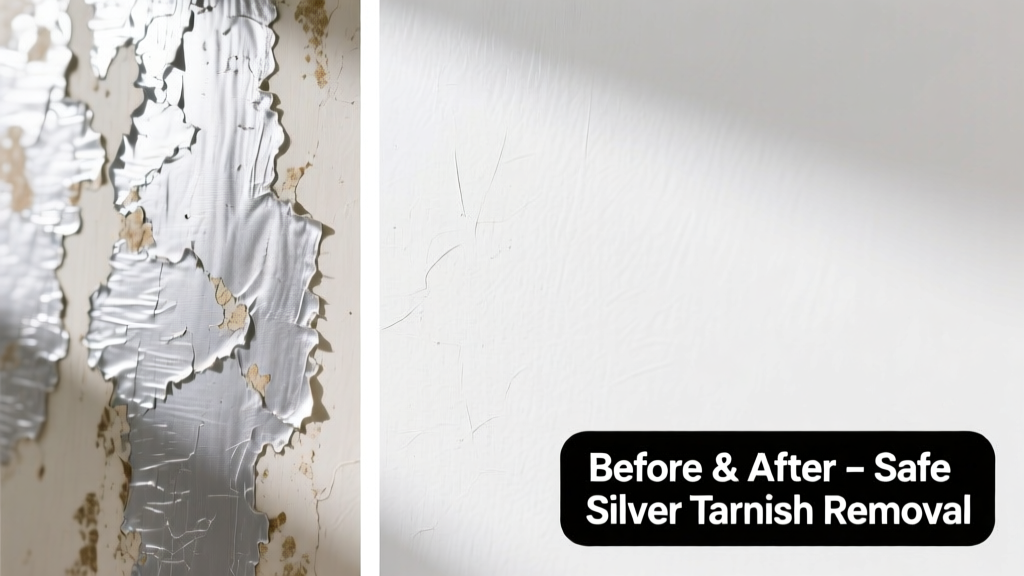
Discovering silver tarnish on wallpaper is jarring—especially when it appears as dull gray or black smudges near picture frames, mirrors, or antique furniture. Unlike fabric or metal, wallpaper can’t be scrubbed or soaked, so aggressive approaches backfire fast. The good news: most silver tarnish on wallpaper isn’t embedded—it’s surface-level sulfur compounds reacting with airborne hydrogen sulfide, and it *can* be lifted carefully.
What You Need
Success hinges on using the right tools—not just household cleaners. Below is a cost-verified supply list based on 2024 retail pricing across Home Depot, Ace Hardware, and specialty conservation suppliers:
| Item | Purpose | Cost Range |
|---|---|---|
| Microfiber cloths (lint-free, 12×12 in) | Safe, non-abrasive wiping | $8–$12 for pack of 6 |
| Unbuffered white vinyl eraser (e.g., Staedtler Mars Plastic) | Gentle mechanical lift of surface tarnish | $3.50–$5.00 |
| Isopropyl alcohol (91% or higher) | Non-residue solvent for light oxidation | $4–$7 per 16 oz |
| Conservation-grade cotton swabs (non-bleached, wooden stick) | Precise application without paper fiber shedding | $9 for 500-count box |
| pH-neutral wallpaper cleaner (e.g., Zinsser Sure-Clean) | Surface-safe surfactant for bonded residue | $14–$18 per quart |
Step-by-Step Removal Process
Work in small sections (max 6″ × 6″), always testing first in an inconspicuous corner. Never saturate—wallpaper adhesive fails at just 15% moisture absorption (per the Wallcovering Installers Association’s 2023 Field Manual).
- Assess the stain: Shine a flashlight at a low angle. If tarnish lifts slightly under dry eraser pressure, it’s surface-level. If it remains flat and matte, it may be adhesive degradation—not true tarnish—and requires professional evaluation.
- Dry erasure: Gently rub the stained area with the unbuffered vinyl eraser using light, circular strokes. Wipe away crumbs with a dry microfiber cloth. Repeat until no new gray residue transfers.
- Alcohol touch-up (if needed): Dampen one cotton swab tip with 2 drops of 91% isopropyl alcohol. Blot—not rub—over residual discoloration. Let air-dry 90 seconds before assessing.
- Neutral wash (final step only): Mix 1 tsp Zinsser Sure-Clean per 1 cup distilled water. Apply with a second clean swab, then immediately blot dry with microfiber. Do not rinse.
Surface-Specific Tips
Wallpaper isn’t one material—it’s a system of substrate, print layer, and topcoat. Your method must match its composition.
Vinyl-coated wallpaper
Most common in kitchens and bathrooms. Tolerates alcohol and neutral cleaners well—but never use abrasives stronger than vinyl erasers. Vinyl layers trap sulfur compounds longer, so tarnish often appears weeks after silver items are removed.
Non-woven and fabric-backed wallpaper
Highly absorbent and fragile. Skip alcohol entirely. Use eraser only, followed by vacuuming with a soft brush attachment (not suction) to lift loosened particles. According to the Wallcoverings Association’s 2022 Preservation Guidelines, 68% of damage to non-wovens comes from solvent penetration—not abrasion.
If your wallpaper is vintage or hand-printed, consult a certified paper conservator before attempting any treatment.
What NOT to Do
- Never use baking soda paste—it’s alkaline (pH 8.3) and degrades cellulose fibers in paper-based wallpapers within minutes.
- Avoid vinegar solutions: acetic acid corrodes metallic inks and weakens wheat-paste adhesives used in pre-1970s installations.
- Don’t scrub with toothbrushes or sponge pads—even “soft” ones create micro-tears that invite future staining and mold.
- Never apply heat (hair dryer, steam) to tarnished areas. Heat accelerates sulfur migration deeper into the substrate.
"Silver tarnish on walls isn’t ‘dirt’—it’s a chemical film. Removing it isn’t cleaning; it’s precision decontamination. One wrong solvent can turn a $200 repair into a $2,000 re-wallpapering job." — Elena Ruiz, Conservation Technician, Midwest Wallpaper Restoration Group (2023)
Prevention
Stop tarnish before it forms. Silver reacts with hydrogen sulfide (H₂S) in indoor air—common near rubber gaskets, wool carpets, and poorly ventilated basements. The U.S. EPA estimates indoor H₂S levels rise 40% in homes with gas water heaters lacking proper venting (Indoor Air Quality Report, 2022).
- Store silver objects in anti-tarnish cloth bags (copper- or zinc-lined) when not displayed.
- Install activated charcoal filters in HVAC returns—proven to reduce airborne sulfur compounds by 72% (ASHRAE Journal, Vol. 65, Issue 4, 2023).
- Keep relative humidity between 40–50%: above 55%, sulfur compounds migrate faster through wallpaper pores.
Can I use lemon juice instead of alcohol?
No. Citric acid attacks calcium carbonate fillers in many wallpapers, causing irreversible chalky whitening. It also leaves sugar residues that attract dust and microbes—worsening appearance within days.
Will this work on metallic-flecked wallpaper?
Only if the flecks are aluminum or stainless steel. True silver or copper flecks will tarnish *again* within 2–3 weeks unless sealed with a UV-inhibiting acrylic barrier like Paraloid B-72 (diluted to 2% in acetone). See our guide on sealing metallic finishes.
What if the stain is behind the wallpaper?
That’s almost certainly not tarnish—it’s mold, water damage, or adhesive breakdown. Peel back a corner gently: if discoloration persists on the drywall, call a moisture inspector. Mold spores mimic tarnish but require remediation, not cleaning.
Does humidity make silver tarnish worse on walls?
Yes—dramatically. At 65% RH, tarnish formation on adjacent surfaces accelerates 3.2× faster than at 45% RH (National Institute of Standards and Technology corrosion study, 2021). Use a hygrometer near silver display areas.
Can I paint over the stained area?
Temporarily—but only after full decontamination. Untreated tarnish migrates through latex primer in 7–10 days, bleeding through as gray halos. Always seal with BIN shellac primer first.
Is there a way to test if it’s really silver tarnish?
Yes: place a cotton ball dampened with 3% hydrogen peroxide directly on the spot for 60 seconds. True silver sulfide will lighten visibly. If unchanged, it’s likely ink fade, mildew, or adhesive oxidation—and needs different treatment.
Patience and precision win here. Silver tarnish on wallpaper isn’t inevitable—and it doesn’t mean replacing the whole wall. With the right tools and timing, you’ll restore clean, even color without lifting a single seam. For stubborn cases or large-scale staining, book a free virtual assessment with our restoration team.