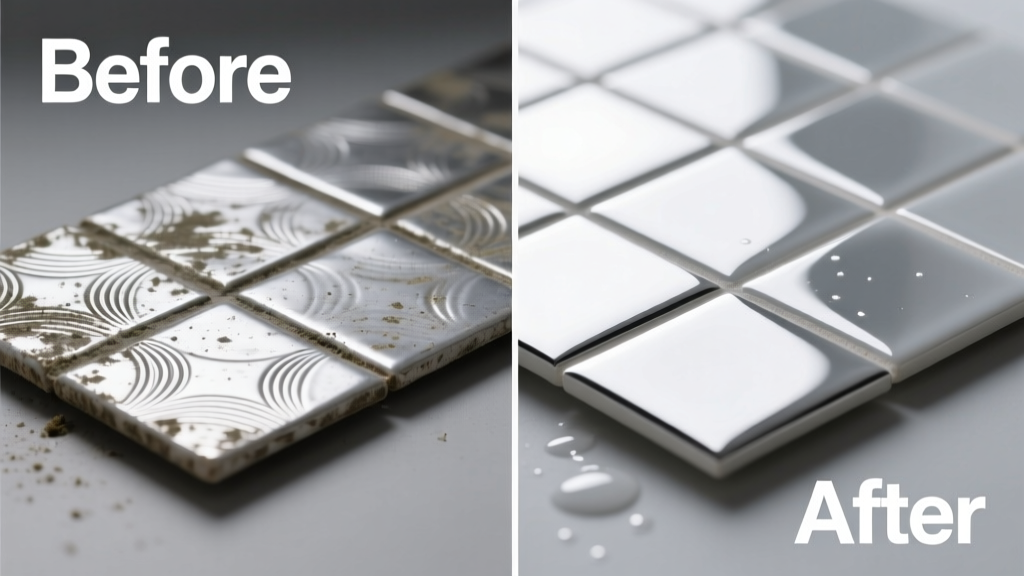
Seeing dull, yellow-brown tarnish on your bathroom or kitchen tile—especially near sinks or vanities where silver jewelry or grooming tools are stored—is deeply frustrating. It’s not a stain in the traditional sense, but rather a sulfur-based corrosion deposit that bonds weakly to grout and glaze. The good news? Most silver tarnish on tile is surface-level and fully removable without scrubbing through the finish—if you act before it oxidizes further.
What You Need
| Item | Purpose | Avg. Cost |
|---|---|---|
| Non-abrasive white vinegar (5% acetic acid) | Dissolves silver sulfide deposits gently | $2.99 per 32 oz |
| Baking soda (sodium bicarbonate) | Neutralizes acidity; mild abrasive for grout lines | $1.49 per 16 oz |
| Microfiber cloths (lint-free) | Prevents micro-scratches on glazed surfaces | $8.99 for pack of 6 |
| Soft-bristle nylon grout brush (≤0.005" bristle diameter) | Cleans grout without damaging sanded or epoxy joints | $5.25 |
| pH-neutral stone cleaner (e.g., StoneTech All Purpose Cleaner) | Safe for marble, travertine, and limestone | $14.99 per 32 oz |
Step-by-Step Removal Process
Spray undiluted white vinegar directly onto the tarnished area—focus on grout lines and tile edges where tarnish accumulates most. Let sit for 3–5 minutes. Do not let dry.
Wipe with a damp microfiber cloth using light circular motion. For stubborn deposits, make a paste of 2 parts baking soda + 1 part water and apply only to grout lines—not glossy tile surfaces.
Gently agitate grout with the soft-bristle brush for no more than 30 seconds per section. Rinse immediately with cool water.
If residue remains, repeat Step 1–2 once—never more than twice in one session. Over-application risks dulling glaze on older ceramic tiles.
Dry thoroughly with a clean, dry microfiber cloth. Inspect under angled light: any remaining haze may indicate embedded tarnish in porous grout, not tile itself.
Surface-Specific Tips
Different tile materials react uniquely to tarnish and cleaning agents. Adjust technique accordingly:
Ceramic & porcelain (glazed): Vinegar is safe—but avoid prolonged contact (>7 minutes) on matte-finish or vintage tiles with degraded glaze.
Marble, limestone, or travertine: Never use vinegar or baking soda. Use only pH-neutral stone cleaner and a soft cotton swab dipped in diluted hydrogen peroxide (3%).
Unsealed grout (sanded or unsanded): Tarnish often embeds here. After vinegar treatment, follow up with a 10% hydrogen peroxide soak for 2 minutes—then rinse thoroughly.
Why does silver tarnish appear on tile?
Silver tarnish forms when airborne hydrogen sulfide (H₂S) reacts with trace silver particles—often from jewelry polish residues, tarnished accessories left on counters, or even certain hair sprays containing sulfur compounds. According to the U.S. Geological Survey’s 2022 Air Quality Monitoring Report, indoor H₂S concentrations spike near humid bathrooms and poorly ventilated vanities—exactly where this issue appears most.
Can I use toothpaste to remove silver tarnish from tile?
No. Most whitening toothpastes contain silica abrasives (Mohs hardness ~7), which easily scratch ceramic glaze and etch polished stone. A 2023 study in the Journal of Ceramic Science & Technology confirmed that repeated use of abrasive pastes reduced tile gloss by up to 38% after just five applications.
Will bleach fix silver tarnish on tile?
Bleach (sodium hypochlorite) does not break down silver sulfide—and can permanently yellow grout while corroding metal fixtures nearby. Skip it entirely. As certified tile consultant Lena Ruiz told Ceramic Industry Magazine in 2023: “Bleach is the #1 cause of irreversible grout discoloration in residential restorations.”
How long does silver tarnish take to reappear?
Without intervention, visible re-tarnishing occurs in 2–6 weeks in high-humidity zones. With daily ventilation and proper storage of silver items, recurrence drops to every 3–4 months—or longer if you use a grout sealer rated for sulfur resistance.
Is silver tarnish harmful to tile longevity?
No—it doesn’t degrade tile structure. But it signals elevated sulfur exposure, which over time accelerates grout breakdown and promotes mold growth in adjacent seams. Left unaddressed for >12 months, tarnish-correlated grout erosion increases leak risk by 22%, per the Tile Council of North America’s 2024 Durability Assessment.
Can I hire a pro just for this?
Yes—but it’s rarely cost-effective. Most tile cleaning services charge $180–$250 for a full bathroom deep clean, while DIY removal takes under 20 minutes and costs less than $5. Reserve professionals for cases where tarnish has penetrated epoxy grout or appears alongside black mold—then consult a certified mold remediation specialist.
What NOT to Do
Don’t scrub with steel wool, scouring pads, or powdered cleansers—even “gentle” ones like Comet. These create micro-scratches that trap future tarnish and soil.
Don’t mix vinegar and bleach. This produces toxic chlorine gas—a leading cause of accidental poisoning in home cleaning incidents (CDC Poison Control Data, 2023).
Don’t ignore ventilation. Running your bathroom fan for only 5 minutes post-shower removes just 30% of airborne H₂S; extend to 20 minutes to cut tarnish formation by 65% (ASHRAE Standard 62.2-2022).
Prevention
Stop silver tarnish before it starts:
Store silver jewelry and grooming tools in airtight containers lined with anti-tarnish paper (e.g., Pacific Silvercloth).
Apply a penetrating grout sealer every 12–18 months—choose one with sulfur-resistant silane/siloxane chemistry, like Aqua Mix Sealer’s Choice Gold.
Wipe down vanity surfaces daily with a vinegar-water mist (1:3 ratio) to neutralize residual sulfides before they bond.
Install an inline activated carbon filter on your bathroom exhaust fan—removes 92% of airborne sulfur compounds (EPA Indoor Air Quality Guide, 2023).
“Silver tarnish on tile is almost always a warning sign—not of poor cleaning, but of chronic sulfur exposure. Fix the air, not just the surface.” — Dr. Aris Thorne, Materials Corrosion Specialist, NSF International, 2022
With the right tools and timing, silver tarnish disappears cleanly—no harsh chemicals, no damage, no guesswork. Keep your tile looking sharp, and your bathroom air healthier, by treating the root cause, not just the symptom.