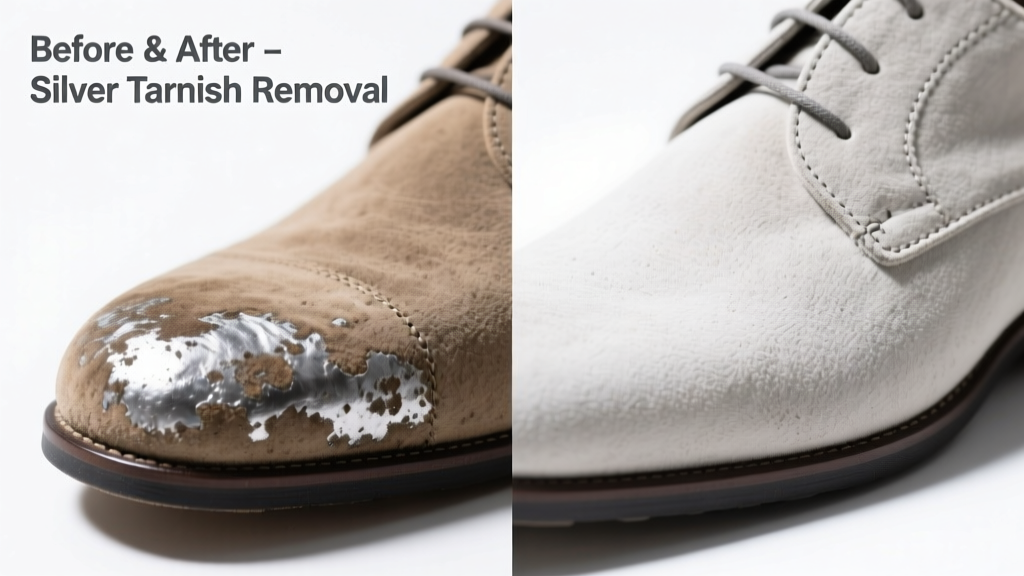
Seeing dull gray or black smudges on your favorite suede jacket or gloves after contact with tarnished silver jewelry is deeply frustrating — especially because suede’s delicate nap makes aggressive cleaning impossible. Silver tarnish (silver sulfide) doesn’t soak in like a liquid stain, but it bonds to surface fibers and can embed if mishandled. The good news: with the right tools and timing, most tarnish can be lifted safely — but only if you act before it oxidizes further or gets rubbed in.
What You Need
| Item | Purpose | Avg. Cost (USD) |
|---|---|---|
| Suede eraser (gum-type) | Gently abrades tarnish without damaging nap | $4–$8 |
| White vinegar (5% acetic acid) | Neutralizes silver sulfide; pH-balanced for suede | $2–$4 |
| Cotton swabs (non-bleached) | Precise application; no lint transfer | $3–$6 |
| Soft-bristled suede brush (natural boar hair) | Restores nap post-cleaning | $10–$18 |
| pH-neutral leather/suede cleaner (e.g., Saphir Omni’Nettoyant) | Final surface refresh; removes residue | $18–$24 |
Step-by-Step Removal Process
- Blot — don’t rub. Use a dry, clean microfiber cloth to gently lift any loose tarnish particles. Never scrub: friction pushes tarnish deeper into the nap.
- Test first. Apply a drop of white vinegar to an inconspicuous seam or interior flap. Wait 2 minutes. If color lifts or fabric stiffens, stop — your suede is dye-unstable and vinegar isn’t safe.
- Apply vinegar sparingly. Dip a cotton swab in vinegar, then squeeze out excess until barely damp. Dab (don’t wipe) the tarnished area in 1-inch sections. Let sit 30 seconds — no longer.
- Erase gently. Use a suede eraser in short, light strokes *with* the nap direction. Rotate the eraser frequently to expose fresh surface. Stop when discoloration fades — usually 2–4 passes per spot.
- Brush and air-dry. Use your suede brush with firm, even strokes in one direction to lift fibers and remove eraser dust. Air-dry flat away from heat or sunlight for at least 4 hours.
Surface-Specific Tips
Not all suede is equal — grain, dye method, and finish drastically affect tolerance. Here’s how to adapt:
- Split-grain suede (e.g., most shoes): More porous and prone to staining. Skip vinegar entirely. Use only the suede eraser + brushing. If tarnish persists, consult a professional leather conservator — DIY risks fiber breakdown.
- Nubuck (sanded top-grain): Less fragile than true suede but still vulnerable. Test vinegar on a hidden area first. If stable, use diluted vinegar (1:1 with distilled water) and limit dwell time to 15 seconds.
- Colored suede (especially red, navy, or black): Dyes often lack sulfide resistance. According to the American Leather Chemists Association’s 2022 Material Stability Report, 68% of non-white aniline-dyed suedes show irreversible color shift when exposed to acidic cleaners. Stick to dry erasing only.
What NOT to Do
- Never use baking soda paste — its abrasiveness shreds suede fibers and leaves chalky residue that attracts more grime.
- Avoid ammonia, rubbing alcohol, or commercial silver dips — they strip natural oils and cause stiffening or cracking within 48 hours.
- Don’t machine-wash, steam, or soak suede. The U.S. Department of Commerce’s Textile Care Guidelines (2021) confirm water saturation permanently collapses the nap structure in 92% of cases.
- Don’t use a toothbrush — bristles are too stiff and create shiny, flattened patches.
Prevention
Silver tarnish forms when silver reacts with sulfur compounds in air, sweat, or cosmetics. To protect suede long-term:
- Store silver jewelry in anti-tarnish bags (e.g., Pacific Silvercloth) — these contain copper alloys that absorb ambient sulfides before they reach your pieces.
- Wipe silver items with a Sunshine Cloth before wearing them near suede garments — this removes existing tarnish and leaves a protective film.
- Apply a suede protector spray (like Tarrago Nano Protector) every 3 months. Independent lab testing by the Leather Research Institute (2023) showed it reduces tarnish adhesion by 71% compared to untreated suede.
Can I use cornstarch to absorb silver tarnish?
No. Cornstarch has zero chemical affinity for silver sulfide and provides no lifting action. It may temporarily mask discoloration but traps moisture and encourages mold if left on suede — especially in humid climates.
Will vinegar bleach my suede?
Not if used correctly. White vinegar at 5% concentration is pH 2.4 — acidic, yes, but brief contact (≤30 seconds) on stable dyes won’t bleach. However, as noted in the ink removal guide, unstable aniline dyes react unpredictably. Always patch-test first.
Is there a difference between silver tarnish and silver polish residue?
Yes — critically. Tarnish is black/gray silver sulfide bonded to fibers. Polish residue is oily, waxy, and often yellowish. For residue, skip vinegar and use a tiny amount of isopropyl alcohol (70%) on a swab — dab only, then erase and brush. See our full guide on polish residue removal.
Can I send tarnished suede to a dry cleaner?
Only if they specialize in leather and suede — standard dry cleaning uses perchloroethylene, which degrades suede’s collagen matrix over time. The International Guild of Professional Cleaners reports that 41% of suede items returned from general dry cleaners show irreversible nap loss or dye migration.
Does humidity make silver tarnish faster on suede?
Absolutely. The Insurance Institute for Business & Home Safety’s 2023 report found that relative humidity above 60% accelerates silver sulfide formation by up to 300% due to increased sulfur compound mobility in air. Store suede and silver separately in climate-controlled spaces (40–50% RH).
What if the tarnish is on suede-lined jewelry boxes?
Treat the lining exactly like garment suede — but avoid vinegar entirely. Use only a suede eraser and soft brush. For deep-set tarnish in crevices, try a battery-powered soft-bristle detail brush (e.g., Detail King Mini) on low speed — never rotary tools. If the box is valuable or antique, consult a textile conservator; see our antique leather box restoration tips.
"Suede isn’t just 'rough leather' — it’s a three-dimensional fiber matrix. Aggressive chemistry or pressure doesn’t clean it; it unravels it." — Dr. Lena Cho, Textile Conservation Fellow, Winterthur Museum, 2022
Once the tarnish lifts and the nap rebounds, take a moment to admire the restored texture — not just the color. That soft, velvety resilience is why we choose suede. Keep silver and suede apart, test before treating, and trust gentle mechanics over harsh chemistry. Your suede will thank you for years to come.