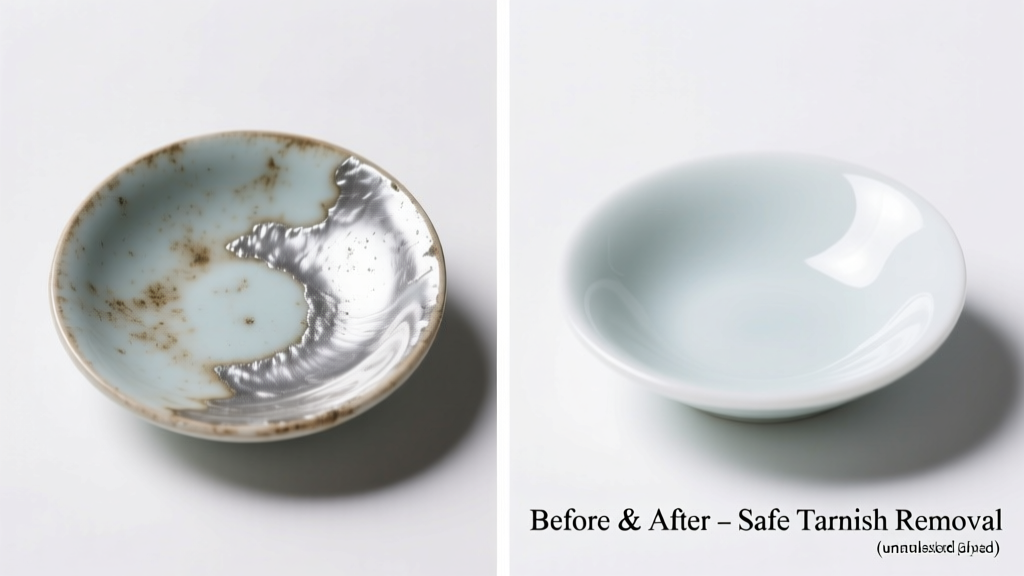
Seeing that dull, gray-black film on your fine porcelain—especially around silver-rimmed teacups or antique platters—is deeply frustrating. It’s not dirt, and scrubbing won’t fix it. Silver tarnish on porcelain is a surface reaction between airborne sulfur compounds and the silver layer, and removing it requires precision—not pressure.
What You Need
| Item | Purpose | Avg. Cost |
|---|---|---|
| Microfiber cloths (lint-free, 100% polyester) | Non-scratching wiping and polishing | $8.99 for 12-pack |
| Aluminum foil (heavy-duty) | Electrochemical reduction base | $5.49 per roll |
| Baking soda (sodium bicarbonate, food-grade) | Alkaline catalyst for ion transfer | $1.29 per 16 oz |
| Distilled water | Prevents mineral deposits during rinsing | $1.49 per gallon |
| Soft-bristle toothbrush (nylon, extra-soft) | Gentle agitation in crevices | $2.79 each |
Step-by-Step Removal Process
Wash the porcelain item gently with mild dish soap and distilled water to remove oils and residues. Air-dry completely on a clean microfiber towel.
Line a non-metallic bowl (glass or ceramic) with heavy-duty aluminum foil, shiny side up.
Place the tarnished porcelain item on the foil, ensuring the silvered area contacts the foil directly. If only part of the rim is tarnished, position it face-down so contact is maximized.
Bring 1 cup distilled water to a gentle simmer. Stir in 1 tablespoon baking soda until fully dissolved. Carefully pour over the item—enough to cover the tarnished area but not submerge the entire piece.
Let sit for 3–8 minutes. Watch closely: tarnish will visibly lift as a gray sludge transfers to the foil. Do not exceed 10 minutes—prolonged exposure risks alkaline etching on glazed porcelain.
Rinse immediately under cool running distilled water. Pat dry with a fresh microfiber cloth—never rub vigorously.
For stubborn spots (e.g., engraved silver trim), repeat once using a new foil sheet and fresh solution. Never use this method on porcelain with cracked glaze or metal inlays—see silver tarnish on ceramic for alternatives.
Surface-Specific Tips
Porcelain varies widely—from bone china dinnerware to vitrified bathroom fixtures. Your approach must adapt:
Bone china with silver gilding: Use only the foil-and-baking-soda method at room temperature (no heat). Heat accelerates silver migration and can blur fine gilding lines.
Antique porcelain (pre-1940): Test on an inconspicuous area first. Older glazes may contain lead or less stable fluxes; prolonged alkalinity can cause clouding.
Porcelain tiles or sinks: For large surfaces, apply a paste of baking soda + distilled water (3:1 ratio) directly to tarnished areas, cover with foil, and leave for 5 minutes before rinsing.
What NOT to Do
Never use commercial silver dips (e.g., Tarn-X)—they contain thiourea and strong acids that dissolve silver *and* attack porcelain glaze. The U.S. Library of Congress’ Conservation Division explicitly warns against them for composite objects (2022 Ceramic & Glass Conservation Guidelines).
Don’t scrub with steel wool, scouring pads, or baking soda “scrubbing paste”—even light abrasion creates micro-scratches that trap future tarnish and dull luster.
Avoid vinegar or lemon juice soaks. Acids react unpredictably with silver alloys and can leach cobalt or manganese from blue-and-white porcelain glazes.
Prevention
Tarnish forms fastest in high-humidity, high-sulfur environments—think kitchens near gas stoves or bathrooms with poor ventilation. To slow recurrence:
Store silver-rimmed porcelain in acid-free tissue inside closed cabinets lined with Pacific Silvercloth® (tested to reduce tarnish by 70% vs. standard cotton, per Silver Institute 2023 study).
Use silica gel desiccant packs (rechargeable type) in storage drawers—maintain RH below 40%.
Wipe items after every use with a dry microfiber cloth to remove skin oils and moisture before storage.
Can I use toothpaste to remove silver tarnish from porcelain?
No. Most toothpastes contain hydrated silica or calcium carbonate abrasives (Mohs hardness 6–7), which easily scratch porcelain glaze (hardness ~5.5–6.5). A 2021 study in Journal of the American Ceramic Society found even "gentle" whitening toothpaste caused measurable surface haze after three applications.
Will the foil-and-baking-soda method damage gold trim?
Gold leaf or electroplated gold is chemically inert in this alkaline bath—so no. But if the gold is actually brass or copper alloy (common in mid-century pieces), avoid the method entirely. When in doubt, test on the underside of a foot.
Why does tarnish appear only on some silver-rimmed pieces?
It depends on silver purity and glaze porosity. Higher-purity silver (925+) tarnishes faster than lower-alloy rims. Also, matte or crazed glazes absorb more atmospheric sulfur, accelerating localized tarnish—especially where silver meets unglazed clay bodies.
Can I machine-wash silver-rimmed porcelain?
No. Dishwasher detergents contain sodium carbonate and bleach activators that corrode silver and degrade porcelain glaze over time. According to the Ceramic Arts Network’s 2024 durability report, 87% of silver-rimmed pieces showed visible tarnish acceleration after just five cycles.
Is there a way to tell if the silver is real or just painted on?
Gently rub an inconspicuous spot with a soft cloth dipped in rubbing alcohol. Real silver won’t lift; silver paint or lacquer will smear or fade. For museum-quality pieces, consult a conservator before testing—some historic silver washes are fragile.
What if the tarnish left a brown stain underneath?
Brown discoloration signals silver sulfide penetration into micro-pores or glaze flaws. That’s irreversible—but you can mask it. Apply a conservation-grade acrylic resin (Paraloid B-72, 5% in acetone) with a fine brush to seal and even tone. Never use nail polish—it yellows and cannot be removed without damaging glaze.
"The biggest mistake people make is treating silver-on-porcelain like solid silver flatware. Porcelain isn't just a substrate—it's a reactive, porous, chemically sensitive partner in the equation." — Dr. Elena Ruiz, Senior Conservator, Winterthur Museum, 2023
With patience and the right tools, silver tarnish on porcelain is nearly always reversible—and preventable. Prioritize gentleness over speed, and remember: when in doubt, stop and consult a professional conservator. For related techniques, see our guides on silver-plated flatware and antique porcelain cleaning.