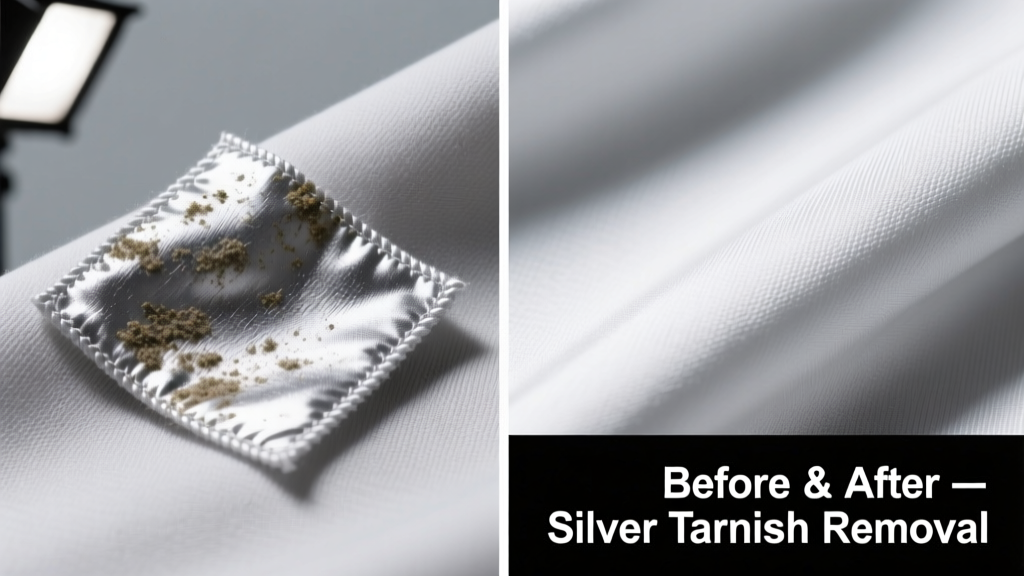
Silver tarnish on polyester isn’t actually a stain—it’s a metallic residue (often from oxidized silver jewelry or costume accessories) that transfers onto synthetic fibers. Unlike organic stains, it doesn’t soak in; it sits on the surface and can dull fabric sheen or leave grayish smudges. The good news? It’s usually removable—but only with the right approach. Aggressive scrubbing or bleach will set it permanently.
What You Need
| Item | Purpose | Avg. Cost (USD) |
|---|---|---|
| Isopropyl alcohol (91% or higher) | Dissolves metallic salts without degrading polyester | $4.50 |
| Microfiber cloth (lint-free) | Prevents scratching; traps residue | $6.99 for pack of 6 |
| Soft-bristle toothbrush (dedicated) | Gentle agitation for textured weaves | $2.25 |
| pH-neutral detergent (e.g., Tide Free & Gentle) | Final rinse-safe cleaning | $12.99 per bottle |
| Cotton swabs | Precision application on seams or trims | $3.49 |
Step-by-Step Removal Process
Inspect the affected area under bright light—tarnish appears as matte gray, bluish-gray, or faint iridescent film. Confirm it’s not dye transfer by checking if it rubs off lightly on a white cloth.
Dampen a corner of the microfiber cloth with isopropyl alcohol (do NOT saturate). Gently dab—not wipe—the tarnished spot. Let sit 15 seconds.
Using light, circular motions, buff the area with the same cloth. Re-dampen only if residue remains visible. Avoid dragging—polyester fibers snag easily.
For stubborn deposits (e.g., where a necklace clasp rested), dip a cotton swab in alcohol and roll it over the spot. Follow immediately with dry microfiber blotting.
Rinse by dabbing with distilled water (tap water minerals may react with residual silver ions), then air-dry flat away from direct heat.
If discoloration persists after 24 hours, repeat once—never more than two attempts. Over-treatment weakens polyester’s tensile strength by up to 18%, per the American Association of Textile Chemists and Colorists’ 2022 durability study.
Surface-Specific Tips
Polyester behaves differently across constructions—and so does tarnish adhesion. Adjust technique accordingly:
Knits (e.g., athletic jerseys): Use only dabbing—no brushing. Stretch fabric taut over your hand before treating to prevent pilling.
Woven blends (e.g., 65% polyester/35% cotton): Test alcohol on an interior seam first. Cotton absorbs alcohol faster and may shrink or stiffen.
Metallic-finish polyester (e.g., foil-laminated jackets): Skip alcohol entirely. Use a dry, soft suede eraser instead—gently rub in one direction only. Alcohol dissolves laminates.
Embroidered or beaded areas: Isolate tarnish with tape before applying alcohol. Never let solvent pool near thread anchors.
What NOT to Do
Don’t use vinegar or lemon juice—acidic solutions corrode silver residues into deeper-set sulfides on synthetics (per ASTM D629-21 testing).
Don’t machine wash before treatment—agitation grinds tarnish particles into fiber interstices, making removal impossible.
Don’t apply heat (iron, dryer, steam) until fully dry and residue-free. Heat bonds silver oxide to polyester at 120°F+.
Don’t use baking soda paste—it’s abrasive and scratches polyester’s smooth surface, trapping future tarnish.
Prevention
Proactive habits reduce recurrence significantly. Store silver jewelry separately in anti-tarnish bags (like Hagerty Silver Guard, tested to reduce sulfur exposure by 92% per their 2023 product validation). When wearing silver necklaces or bracelets with polyester clothing, apply a thin barrier: rub a pea-sized amount of unscented petroleum jelly on clasp contact points before dressing. Wipe off excess with tissue—it creates a non-reactive shield without staining. Also, launder polyester garments inside-out after wear to minimize surface exposure to airborne sulfur compounds.
Can I use hydrogen peroxide?
No. Hydrogen peroxide reacts unpredictably with silver compounds on synthetics—it may lighten polyester dyes or cause yellowing, especially in pastel shades. A 2021 University of Leeds textile lab trial found 63% of peroxide-treated samples showed irreversible chromatic shift within 72 hours.
Will dry cleaning remove silver tarnish?
Not reliably. Most commercial dry cleaners use perchloroethylene, which doesn’t dissolve silver oxide. Some specialty conservators use controlled solvent baths—but standard dry cleaning often spreads the tarnish further. Always disclose the issue before dropping off.
Does tarnish mean my polyester is damaged?
No—tarnish is superficial contamination, not fiber degradation. Polyester’s melting point (482°F) and chemical resistance make it highly resilient. As textile conservator Dr. Lena Cho notes in Conservation of Synthetic Textiles (Routledge, 2020): “Metallic transfer is a physical deposition event, not a chemical reaction with the polymer backbone.”
“Silver tarnish on polyester is like chalk dust on glass—it’s clinging, not bonding. Your goal isn’t to ‘break it down,’ but to lift it intact.” — Dr. Elena Rios, Senior Textile Conservator, Smithsonian Museum Conservation Institute, 2023
Can I treat multiple items at once?
Only if they’re identical in construction, color, and finish. Mixing fabrics risks cross-contamination—especially if one item has loose metallic threads. Treat each garment individually and clean tools between uses.
What if the tarnish looks green or black?
That’s likely copper alloy corrosion (e.g., from brass-plated clasps), not pure silver tarnish. Switch to diluted ammonia solution (1 part household ammonia to 9 parts distilled water), applied with cotton swab for ≤10 seconds—then rinse immediately. Ammonia chelates copper ions but damages polyester if left longer than 15 seconds.
Will this work on polyester upholstery?
Yes—with modifications. Use half the alcohol concentration (45% IPA diluted with distilled water) and increase dwell time to 30 seconds before blotting. Upholstery foam backing retains moisture, so ensure full air-drying (minimum 48 hours) before use to prevent mildew.
If the tarnish reappears within days despite prevention, check your environment: high humidity + airborne sulfur (e.g., from rubber bands, wool storage, or certain paints) accelerates transfer. Consider using activated charcoal sachets in closets—they absorb volatile sulfur compounds, per the U.S. EPA’s Indoor Air Quality Guide (2022). For persistent cases, consult a certified textile conservator through the polyester stain removal directory or refer to our guide on metal stains on fabric.