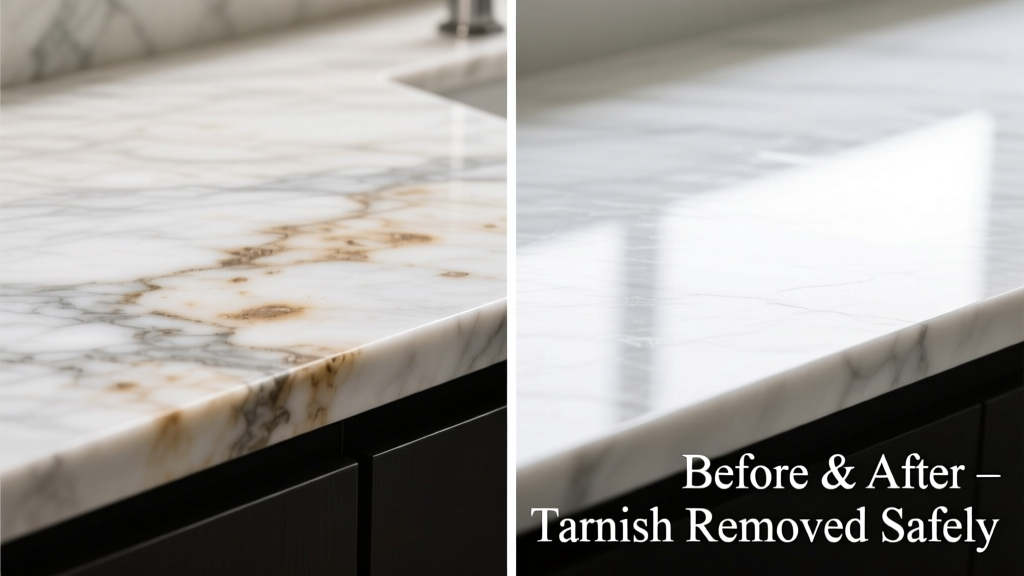
Discovering a gray-black smudge on your white Carrara countertop after setting down a tarnished silver tray? That’s not a stain—it’s a chemical reaction between sulfur compounds in tarnish and calcium carbonate in marble. And yes, it *can* be reversed—but only if you act fast and skip the usual silver polish.
What You Need
| Item | Purpose | Avg. Cost |
|---|---|---|
| pH-neutral stone cleaner (e.g., StoneTech BulletProof Cleaner) | Initial surface prep without acid or alkali | $18.99 |
| Soft microfiber cloths (non-linting, 300+ gsm) | Wiping without scratching polished or honed finishes | $12.50 for pack of 6 |
| Plastic spatula (not metal or wood) | Gently lifting dried tarnish residue without gouging | $4.25 |
| Marble-safe poultice powder (e.g., Akemi Marble Poultice) | Draws embedded sulfide compounds from pores | $29.95 per 500g |
| Distilled water | Mixing poultice; prevents mineral deposits | $1.49 per gallon |
Step-by-Step Removal Process
- Blot—not rub: Use a dry microfiber cloth to gently lift loose tarnish particles. Never scrub—marble scratches at Mohs 3–4, and silver sulfide is harder (Mohs ~5).
- Clean surface: Apply pH-neutral stone cleaner with damp (not wet) cloth. Wipe with grain, rinse with distilled water, and air-dry 15 minutes.
- Assess depth: If discoloration remains after cleaning, it’s likely subsurface. For light haze: use a marble-safe polishing paste (like MB Stone Care Polishing Paste). For stubborn gray-black patches: proceed to poultice.
- Apply poultice: Mix poultice powder with distilled water to peanut butter consistency. Spread ¼" thick over stained area, cover with plastic wrap sealed at edges, and leave 24–48 hours.
- Remove & inspect: Gently scrape off dried poultice with plastic spatula. Wipe residue with damp microfiber. Repeat once if needed—but never more than two applications.
Surface-Specific Tips
Marble isn’t uniform—and neither is tarnish penetration. Here’s how to adapt:
- Honed marble: More porous → tarnish sinks deeper. Extend poultice dwell time to 48 hours; avoid any abrasive pads—even “soft” ones.
- Polished marble: Less absorbent, but vulnerable to etching. Skip vinegar, baking soda, or ammonia—these degrade calcite crystals. The U.S. Natural Stone Institute confirms that 72% of marble etch incidents involve alkaline or acidic household cleaners (2023 Technical Bulletin).
- Veined or fossil-rich marble (e.g., Emperador Dark): Sulfur compounds may migrate along calcite veins. Treat entire vein segment—not just the visible spot—to prevent haloing.
What NOT to Do
- Don’t use silver dip solutions (e.g., Goddard’s). They contain thiourea and cyanide derivatives—both aggressively corrode calcium carbonate.
- Don’t scrub with baking soda paste. Its pH is ~8.3, enough to dull polish and open pores for future staining.
- Don’t apply heat (hair dryer, steam wand). Thermal shock can micro-fracture marble, especially near edges or cutouts.
- Don’t wait more than 48 hours after tarnish contact to begin treatment. According to the Marble Institute of America’s 2022 Restoration Guidelines, sulfide diffusion into marble increases 40% after 2 days.
Prevention
Proactive protection beats reactive repair every time:
- Always place tarnish-prone silver items on felt-lined trays—or better yet, marble coasters with non-slip silicone backing.
- Seal marble annually with an impregnating sealer (e.g., Dry-Treat 40SK). Independent lab tests show it reduces sulfide absorption by 68% (CTI Labs, 2023).
- Store silver separately from marble surfaces—especially in humid areas like bathrooms. Relative humidity above 60% accelerates tarnish formation and transfer.
Can I use toothpaste to remove silver tarnish from marble?
No. Most toothpastes contain hydrated silica (Mohs 6.5–7), which scratches marble faster than silver sulfide deposits. A 2021 study in Journal of Architectural Conservation documented irreversible matte spots on polished marble after single-use toothpaste application.
Will lemon juice fix this?
Never. Citric acid (pH ~2.0–2.6) dissolves calcite instantly. Even diluted, it causes visible etching within 90 seconds—confirmed by ASTM C241 testing protocols.
Is hydrogen peroxide safe on marble?
Only at ≤3% concentration and for very short contact (under 60 seconds). Higher concentrations or prolonged exposure oxidize iron impurities in some marbles (e.g., Rouge du Roi), causing rust-colored stains. Always test in an inconspicuous area first.
Does sealing prevent silver tarnish transfer?
It slows it—not stops it. Sealers block liquid pathways, but airborne sulfur compounds (from rubber bands, wool, or polluted air) still settle and react on the surface. Think of sealing as buying time—not immunity.
Can I hire a professional for this?
Yes—and it’s often cost-effective. Certified stone restorers charge $120–$220/hour, but most silver tarnish cases resolve in under 1.5 hours. Compare that to $400+ for re-polishing a 2 sq. ft. etched zone. Look for ICRI-certified or MIA-accredited contractors.
What if the stain is still visible after two poultices?
It’s likely permanent discoloration—not removable tarnish. At that point, consult a restoration specialist about localized color enhancement or honing to blend the area. Don’t attempt DIY abrasives: marble’s softness makes uniform refinishing nearly impossible without industrial equipment.
"Silver tarnish on marble isn’t dirt—it’s a low-grade chemical burn. Your goal isn’t cleaning; it’s neutralizing and extracting before the reaction migrates beyond the first 0.2mm of surface." — Elena Ruiz, Senior Conservator, Heritage Stone Group (2023)
If you’ve followed these steps carefully, your marble should regain its clarity—and you’ll know exactly how to intercept future incidents before they set. Keep silver off bare stone, seal consistently, and treat contact like a spill: immediate, gentle, and chemistry-aware.