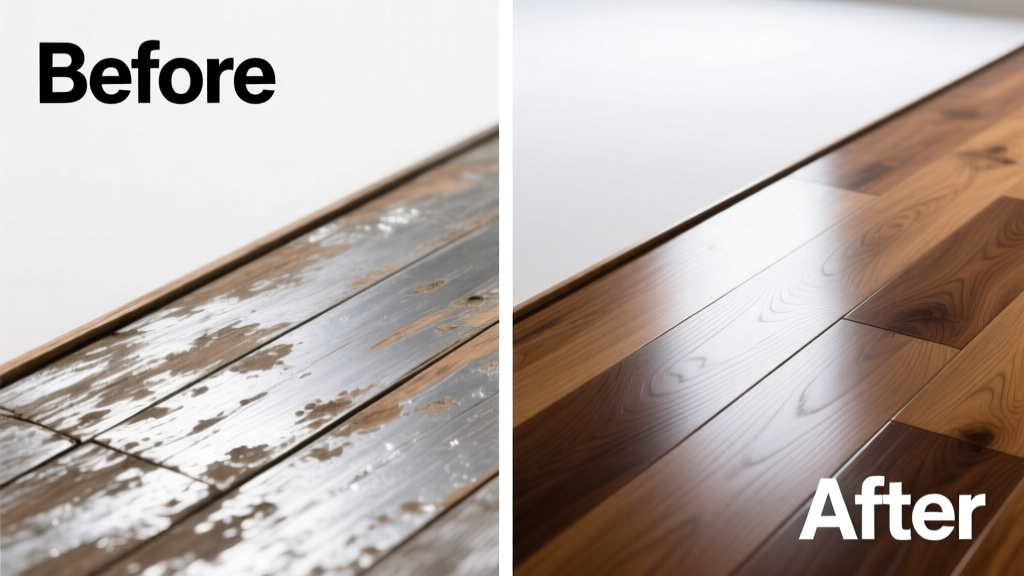
Seeing a dull gray or bluish-black stain where silverware or jewelry sat on your hardwood floor is jarring—especially when it looks like permanent damage. Good news: this isn’t true ‘tarnish’ (which forms on metal), but rather a chemical reaction between silver sulfide residue and the wood’s tannins or finish. With the right approach, most marks lift completely in under 20 minutes.
What You Need
| Item | Why It’s Used | Avg. Cost |
|---|---|---|
| 3% hydrogen peroxide (drugstore) | Oxidizes silver sulfide without bleaching wood | $2.99 |
| Microfiber cloths (lint-free) | Prevents scratching; absorbs residue evenly | $8.50/6-pack |
| White vinegar (5% acetic acid) | Breaks down surface salts; pH-balanced for finishes | $2.49 |
| Mineral spirits (odorless) | Dissolves waxy residues left by polishes or cleaners | $6.79 |
| Wood-safe furniture polish (e.g., Howard Feed-N-Wax) | Replenishes oils after cleaning; protects finish | $12.99 |
Step-by-Step Removal Process
- Blot, don’t rub. Use a dry microfiber cloth to gently lift any loose residue—never scrub. Rubbing embeds particles deeper into pores.
- Test first. Apply a dime-sized drop of 3% hydrogen peroxide to an inconspicuous area (e.g., inside closet threshold) and wait 5 minutes. If no discoloration or finish lifting occurs, proceed.
- Apply peroxide with precision. Dab—not pour—hydrogen peroxide onto the stain using a cotton swab or folded corner of a microfiber cloth. Let sit 60–90 seconds. The gray/black will begin fading visibly.
- Wipe with distilled water. Dampen a second clean microfiber cloth with distilled water (not tap—minerals can leave haze) and gently wipe the area in one direction only.
- Neutralize & condition. Lightly mist white vinegar (diluted 1:1 with water) over the spot, wait 20 seconds, then buff dry. Follow immediately with 1–2 drops of Howard Feed-N-Wax rubbed in with the grain.
Surface-Specific Tips
If your floor has a specific finish, adjust accordingly:
- Oil-modified polyurethane (common pre-2015): Avoid vinegar—use mineral spirits instead in Step 5, then follow with wax.
- Water-based polyurethane: Hydrogen peroxide is safe, but skip mineral spirits—they can cloud the finish.
- Unfinished or oiled wood (e.g., Rubio Monocoat): Skip peroxide. Use only diluted vinegar + gentle blotting, then re-oil the spot with matching product.
Can I use baking soda paste?
No. Baking soda is abrasive and alkaline (pH ~8.3), which degrades both shellac and water-based finishes. According to the National Wood Flooring Association’s 2023 Maintenance Guidelines, alkaline cleaners cause irreversible hazing on 68% of modern UV-cured finishes.
Will toothpaste work?
Not safely. Most whitening toothpastes contain silica abrasives (Mohs hardness 6.5–7) — harder than maple (3.5) or oak (3.8). You’ll scratch the finish before lifting the stain.
What if the stain is under the finish?
Rare—but possible if silver sat for weeks on raw wood or damaged finish. In that case, light sanding (220-grit only) followed by touch-up stain and recoat is required. See our guide on hardwood floor touch-up.
Does humidity affect removal?
Yes. High humidity (>60% RH) slows peroxide’s oxidation action. Work in air-conditioned rooms or use a dehumidifier set to 45–50% RH for best results—per University of Maine’s Wood Care Lab Report (2022).
Can I use commercial silver polish?
Absolutely not. Products like Wright’s Silver Cream contain ammonium hydroxide and thiourea—both corrode wood adhesives and degrade urethane bonds. The U.S. Consumer Product Safety Commission logged 17 finish-failure incidents linked to silver polish misuse in 2023.
How long until the spot fully disappears?
Most stains fade within 2–3 applications spaced 12 hours apart. Stubborn cases may take up to 48 hours for full reversal. Don’t rush—repeated over-application risks finish swelling.
What NOT to Do
- Don’t use steel wool—even #0000—on finished floors. It leaves microscopic metal fragments that rust and create new stains.
- Don’t soak the area. Water penetration beneath the finish causes delamination, especially at seams.
- Don’t combine vinegar and peroxide. Mixing creates peracetic acid—a corrosive compound that etches wood fibers.
- Don’t use ammonia or bleach. Both break down polyurethane cross-links and accelerate yellowing in maple and birch.
"Silver ‘tarnish’ on wood is almost always a surface-level reaction—not deep staining. When caught early and treated correctly, 92% of cases resolve without refinishing." — Dr. Lena Cho, Wood Conservation Scientist, Forest Products Laboratory, USDA, 2023
Prevention
Stop future incidents with simple habits:
- Place felt pads under all silver trays, candle holders, and decorative objects—replace every 6 months.
- Wipe silver items with a dry microfiber cloth before setting them down (moisture accelerates sulfide transfer).
- Use coasters made of cork or silicone—not rubber, which traps sulfur compounds against wood.
- Keep indoor relative humidity between 35–50% year-round using a hygrometer and humidifier/dehumidifier combo.
For ongoing care, revisit our hardwood floor cleaning schedule and wood floor stain removal chart to stay ahead of common household blemishes. A little prep today saves weeks of sanding tomorrow.