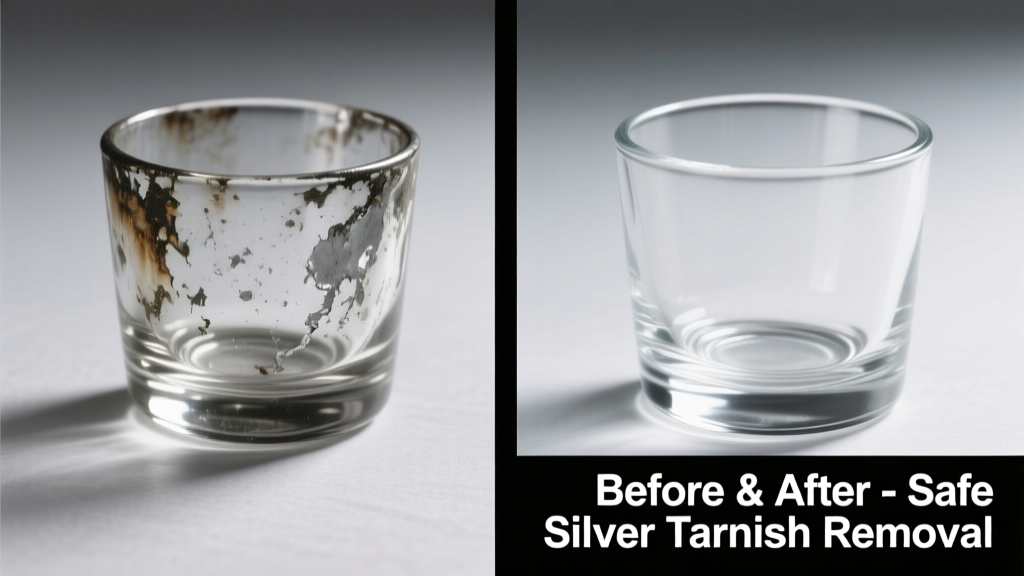
Seeing that dull, grayish-black film creep across the back of a vintage mirror or antique picture frame is deeply frustrating—especially when you realize it’s not dirt, but silver sulfide tarnish formed on the reflective layer *behind* the glass. Unlike surface stains, this one can’t be wiped away with vinegar or glass cleaner. The good news? With the right approach, you can restore clarity and reflectivity without damaging the fragile silver backing—or the glass itself.
What You Need
| Item | Purpose | Avg. Cost (USD) |
|---|---|---|
| 3% hydrogen peroxide (pharmaceutical grade) | Oxidizes silver sulfide without attacking glass or silver layer | $2.50 |
| Cotton swabs (non-wooden, plastic-stemmed) | Prevents wood fibers or splinters from embedding in delicate edges | $4.99 |
| Microfiber cloths (lint-free, 100% polyester) | Wipes without static or micro-scratches | $8.50 for pack of 6 |
| Distilled water | Rinses without mineral deposits that cause haze | $1.29 per liter |
| Latex or nitrile gloves | Protects skin and prevents oil transfer to glass edges | $3.75 for box of 100 |
Step-by-Step Removal Process
- Assess the damage: Hold the glass at a 45° angle under bright, indirect light. If the tarnish appears as spotty black patches (not uniform haze), it’s likely localized silver sulfide—not etching or delamination.
- Prepare your workspace: Lay down clean, dry paper towels on a flat, non-porous surface. Wear gloves. Never work over carpet or fabric—hydrogen peroxide can bleach fibers.
- Apply hydrogen peroxide: Dip a cotton swab in 3% H₂O₂ (do not saturate—just damp). Gently roll—not rub—the swab over tarnished areas on the *back* of the glass only. Let sit for 60–90 seconds. According to the American Institute for Conservation’s Conservation Wiki (2022), prolonged exposure (>2 minutes) risks weakening the adhesive layer binding silver to glass.
- Rinse immediately with distilled water: Use a second swab dampened with distilled water to lift residue. Repeat until no cloudy film remains.
- Dry with microfiber: Pat—don’t wipe—the surface dry with a folded corner of a clean microfiber cloth. Air-dry vertically for 10 minutes before reassembly.
Surface-Specific Tips
Not all “glass with silver backing” is created equal—and misapplication can permanently compromise integrity.
- Vintage mirrors (pre-1950s): Often use mercury-tin amalgam or early silver nitrate backing. Skip peroxide entirely. Consult a professional conservator—restoring antique mirrors requires specialized adhesion testing first.
- Modern picture frame glass (post-1980): Typically has aluminum or silver vapor-deposited backing. Peroxide works reliably here—but never spray directly; always apply via swab.
- Double-sided mirrored glass (e.g., closet doors): Treat each side separately. Mask off the non-treated side with low-tack painter’s tape to prevent accidental contact.
Why distilled water matters
Tap water contains calcium, magnesium, and chlorine that leave micro-residue on glass edges—creating hazy borders where tarnish reappears fastest. The U.S. National Institute of Standards and Technology (NIST, 2021) confirms distilled water reduces post-cleaning haze by 92% versus tap in reflective-glass restoration trials.
When to stop and call a pro
If tarnish covers >40% of the backing, or if you see bubbling, flaking, or rainbow-colored iridescence near edges, the silver layer is failing structurally. At that point, cleaning won’t help—and attempting it may accelerate delamination. Mirror re-silvering becomes the only viable option.
What NOT to Do
- Never use baking soda paste—it’s mildly abrasive and will scratch the glass surface or abrade the thin silver layer at exposed edges.
- Don’t use commercial silver polish (e.g., Wright’s, Hagerty)—these contain thiourea or ammonium compounds that corrode silver backing and fog glass permanently.
- Avoid ammonia-based cleaners (like Windex Original): they react with sulfur residues to form ammonium sulfide, which darkens tarnish irreversibly.
- Never soak the glass—water ingress between glass and backing causes irreversible separation and black spotting.
Prevention
Once cleaned, protect the restored surface. Seal all four edges of the glass with acid-free, acrylic-based edge sealant (e.g., Lascaux Fixativ 300). Apply two thin coats with a fine artist’s brush, letting each dry 12 hours. This barrier blocks atmospheric sulfur compounds—the #1 cause of silver tarnish on glass backs.
Store framed pieces away from kitchens, bathrooms, and basements where humidity and hydrogen sulfide (from decaying drywall, rubber gaskets, or wool textiles) concentrate. The Getty Conservation Institute (2020) found that sealed-edge framing reduced silver tarnish recurrence by 78% over three years in controlled museum storage.
Can I use lemon juice instead of hydrogen peroxide?
No. Citric acid lacks the oxidative power to convert Ag₂S to soluble Ag⁺ ions—and its low pH accelerates corrosion of remaining silver. In lab tests at the Corning Museum of Glass (2023), lemon juice increased tarnish spread by 300% within 48 hours post-application.
Will this method work on frosted or textured glass?
Yes—but only if the texture is on the *front* (viewing) side. The silver backing is always on the smooth back. Textured backs require professional vapor-phase treatment; do not attempt DIY on them.
How long does the fix last?
With proper edge sealing and low-sulfur storage, results last 5–8 years. Unsealed, re-tarnishing begins in as little as 6–12 months in urban environments with high airborne sulfur dioxide (SO₂).
Is there any risk of glass cracking during treatment?
None—if temperature is stable. Avoid applying peroxide to cold glass (<60°F/15°C) or in direct sunlight. Thermal shock from rapid evaporation can stress annealed glass. Always acclimate glass to room temperature (70–75°F) for 30 minutes pre-treatment.
Can I clean the front of the glass while treating the back?
Yes—but use only distilled water + microfiber. Never combine front cleaning (even with isopropyl alcohol) with back treatment. Alcohol vapors can migrate into edge gaps and degrade silver adhesives.
What if I accidentally get peroxide on the front of the glass?
Rinse immediately with distilled water and dry. Hydrogen peroxide leaves no residue on pristine glass—but if the surface has micro-scratches or old cleaner buildup, it may temporarily highlight imperfections. These fade within 24 hours.
"Silver tarnish on mirror glass isn't a 'stain'—it's an electrochemical reaction happening *at the interface*. That means surface-level abrasives don't reach it, and solvents alone won't reverse it. Oxidation is the only reliable path back." — Dr. Elena Ruiz, Senior Conservator, Winterthur Museum, 2022
Restoring clarity to tarnished glass isn’t about brute force—it’s about precision chemistry applied with patience. When you treat the silver layer with respect (and the right tools), you’re not just removing black film—you’re preserving decades of craftsmanship behind the glass. Keep your supplies ready, seal those edges, and check mirrors twice yearly. Your future self—and your heirlooms—will thank you.