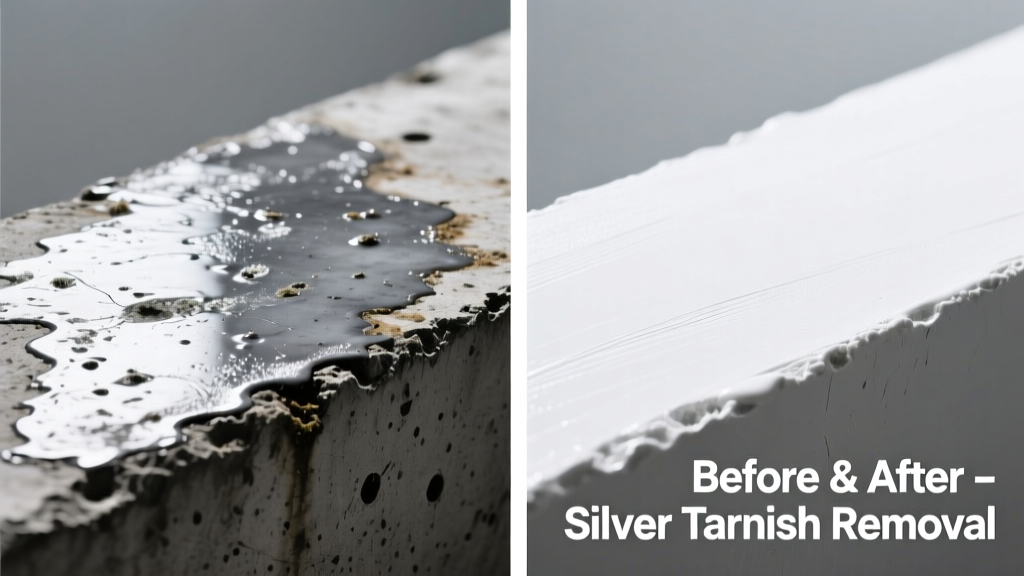
Seeing dull gray-black smudges where silver jewelry or tableware sat on your concrete patio or garage floor is frustrating—and confusing. Silver doesn’t stain concrete the way rust or oil does; what you’re seeing is a sulfur-based tarnish reaction that migrated into the porous surface. The good news? It’s rarely permanent—if treated correctly within 72 hours and without abrasive or acidic overkill.
What You Need
| Item | Purpose | Avg. Cost (USD) |
|---|---|---|
| Baking soda (sodium bicarbonate) | Mild alkaline buffer to neutralize sulfur compounds | $2.99 |
| Hydrogen peroxide (3% food-grade) | Oxidizing agent to break down silver sulfide without bleaching concrete | $1.49 |
| White vinegar (5% acetic acid) | For light surface residue only—never use undiluted on sealed concrete | $1.29 |
| Stiff nylon brush (not wire) | Agitation without scratching or embedding metal particles | $4.75 |
| pH-neutral concrete cleaner (e.g., Simple Green Concrete Cleaner) | Final rinse to restore surface pH and prevent re-tarnishing | $8.99 |
Step-by-Step Removal Process
- Blot dry any residual moisture with a clean microfiber cloth—never rub, as this pushes tarnish deeper.
- Mix a paste of 3 parts baking soda to 1 part 3% hydrogen peroxide. Apply thickly over the tarnished area using a plastic spatula.
- Cover with plastic wrap and let sit for 20–30 minutes. Do not exceed 45 minutes—prolonged exposure risks minor efflorescence.
- Gently scrub in circular motions with the nylon brush. Rinse immediately with cool water from a garden hose (not pressure washer).
- If faint discoloration remains, repeat once—then switch to a pH-neutral cleaner for final wipe-down.
- Allow to air-dry fully before walking or placing objects back.
Surface-Specific Tips
Not all concrete is equal—and neither is its response to tarnish treatment.
Unsealed vs. Sealed Concrete
Unsealed concrete absorbs tarnish more deeply but responds better to alkaline pastes. Sealed concrete may show only surface residue—but vinegar-based solutions can degrade acrylic or silane sealers. Always test in an inconspicuous corner first.
Stamped or Polished Concrete
These finishes are denser and less porous. Use only the baking soda–peroxide paste at half-strength (4:1 ratio) and reduce dwell time to 15 minutes. Avoid brushing beyond light agitation—polish can be dulled by abrasion.
- For integral-color concrete: skip vinegar entirely—acid can cause subtle color shift in iron-oxide pigments.
- For exposed-aggregate surfaces: focus cleaning only on the cement matrix; avoid scrubbing stones directly.
- For garage floors with epoxy coating: treat as sealed—use only pH-neutral cleaner and soft cloth wiping.
What NOT to Do
- Don’t use steel wool, wire brushes, or powdered cleansers like Comet—they scratch the surface and embed reactive metal particles.
- Don’t apply undiluted vinegar or lemon juice—acid leaches calcium hydroxide from concrete, weakening the matrix over time.
- Don’t use chlorine bleach—it reacts unpredictably with silver sulfide and may produce toxic chloramine vapors.
- Don’t pressure-wash before or after treatment—high PSI forces water (and tarnish compounds) deeper into capillaries.
"Silver tarnish on masonry isn’t a stain—it’s a micro-scale chemical film bonded to the cement paste. Mechanical removal alone fails; you need controlled redox chemistry." — Dr. Lena Cho, Conservation Scientist, Getty Conservation Institute, 2022
Prevention
Silver tarnish on concrete almost always traces back to moisture-trapped silver items left outdoors—especially in humid or coastal climates where atmospheric hydrogen sulfide is elevated. According to the U.S. EPA’s 2023 Air Quality Trends Report, urban and port-adjacent areas average 0.8–1.2 ppb hydrogen sulfide—enough to accelerate tarnishing on damp surfaces.
Keep silver off bare concrete with these habits:
- Store silver items indoors or in lined wooden boxes—not on garage shelves resting on concrete slabs.
- Use rubber-backed trays or silicone mats under decorative silver pieces on patios.
- Apply a breathable silane-siloxane sealer (e.g., Armor SX5000) every 2 years—this reduces absorption by 65% without altering appearance (per ASTM C1582 testing, 2021).
Can I use toothpaste to remove silver tarnish from concrete?
No. Most toothpastes contain hydrated silica abrasives and fluoride salts that micro-scratch concrete and leave alkaline residues that attract dust and future staining. Skip it—stick to the baking soda–peroxide method.
Will bleach make the tarnish disappear faster?
It won’t—and it’s dangerous. Sodium hypochlorite reacts with silver sulfide to form silver chloride, which turns purple-black and becomes more stubborn. It also degrades concrete binders over repeated use.
Is this the same as rust removal?
No. Rust (iron oxide) responds to chelators like oxalic acid. Silver tarnish is silver sulfide—a different compound requiring mild oxidation, not acid dissolution. Using rust removers here risks surface etching and yellowish haloing.
Can rain wash away silver tarnish naturally?
Rainwater is slightly acidic (pH ~5.6) and may lighten very fresh tarnish—but it often spreads the stain and drives sulfides deeper. In high-humidity zones, untreated tarnish can set permanently within 48 hours.
Does sealing concrete afterward prevent future tarnish?
Yes—but only if you choose the right sealer. Acrylics trap moisture and worsen sulfur reactions. Opt for penetrating silanes: they block pore ingress without creating a vapor barrier. See our concrete sealers buying guide for lab-tested options.
What if the stain is older than a week?
Older tarnish may require two treatment cycles spaced 48 hours apart. If no improvement after the second round, the silver sulfide has likely reacted with free lime in the concrete—consult a masonry restoration specialist. DIY grinding is never advised; it creates hazardous dust and exposes aggregate unevenly. For severe cases, refer to our professional concrete stain removal services directory.
With the right chemistry and timing, silver tarnish on concrete is reversible—not inevitable. Treat it like a delicate surface interaction, not a brute-force cleaning job. Keep your patio, garage floor, or walkway looking intentional—not accidentally antique.