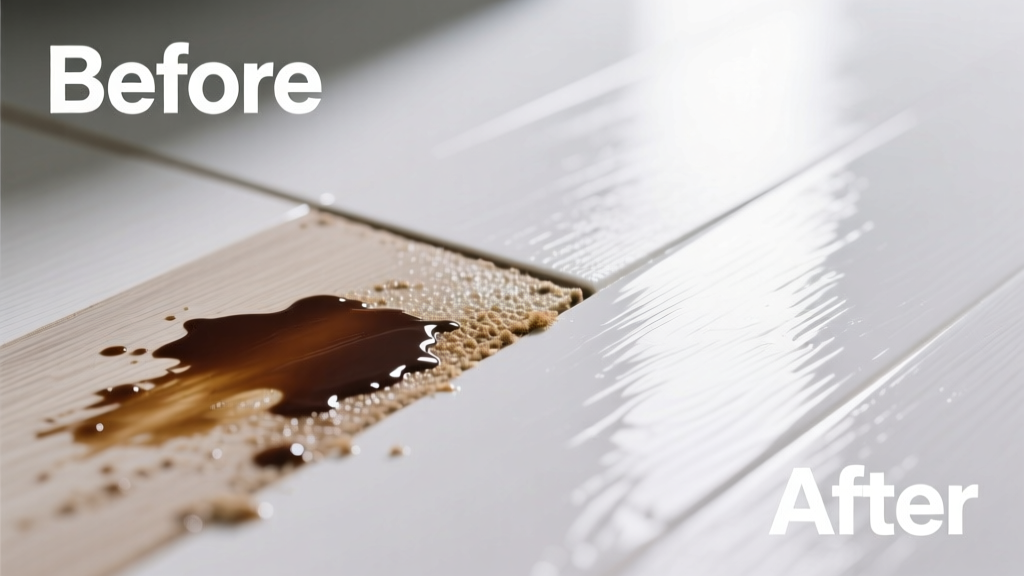
Spilled black shoe polish on your kitchen vinyl floor? You’re not alone — it’s a shockingly common accident, especially near entryways or mudrooms. The waxy, pigment-rich formula bonds fast to vinyl’s smooth surface, making it look like a permanent stain. But good news: with the right solvent and timing (ideally within 24 hours), most shoe polish lifts cleanly — no replacement needed.
What You Need
| Item | Why It Works | Average Cost |
|---|---|---|
| Isopropyl alcohol (91% or higher) | Breaks down wax and dye without softening vinyl’s plasticizers | $4.99 per 16 oz bottle |
| Microfiber cloths (lint-free) | Prevents micro-scratching; absorbs residue better than paper towels | $8.50 for pack of 12 |
| Soft-bristle nylon brush (like a toothbrush) | Gently agitates without scratching vinyl’s wear layer | $3.29 |
| White vinegar (5% acetic acid) | Mild acid helps lift alkaline-based polish residues | $2.49 per 16 oz |
| Vinyl floor cleaner (pH-neutral, e.g., Bona Hard-Surface Cleaner) | Final rinse that won’t leave film or dull shine | $11.99 per 32 oz |
Step-by-Step Removal Process
Blot excess polish immediately with a dry microfiber cloth — never rub, which pushes pigment deeper into seams or embossed textures.
Dampen a fresh microfiber cloth with 91% isopropyl alcohol (test in an inconspicuous corner first). Press — don’t scrub — onto the stain for 30 seconds.
Wipe gently in one direction. If residue remains, use the soft-bristle brush dipped in alcohol to lightly work the edges of the stain — avoid circular motions.
Rinse area with a cloth dampened in distilled water, then dry thoroughly with a clean microfiber towel.
If faint discoloration lingers, mix equal parts white vinegar and water, apply with cotton ball for 60 seconds, then wipe and rinse again.
Finish by applying pH-neutral vinyl floor cleaner and buffing with dry cloth to restore sheen.
Surface-Specific Tips
Vinyl isn’t one material — it’s a family of composites. Your approach must match its type:
Sheet vinyl (glued-down): Tolerates alcohol well, but avoid soaking — prolonged exposure can degrade adhesive under seams.
LVT (luxury vinyl tile/plank): Focus only on the wear layer. Never use acetone or paint thinner — it can cloud UV-cured coatings.
Vinyl-backed carpet tiles: Treat only the vinyl backing edge — never let solvent reach carpet fibers or latex backing.
Can I use Goo Gone on vinyl?
No. According to the U.S. EPA’s 2023 Consumer Product Safety Assessment of Solvent-Based Cleaners, citrus-based solvents like Goo Gone contain d-limonene, which can swell vinyl’s PVC matrix over repeated use — leading to irreversible hazing or edge curling.
Does heat help remove dried shoe polish?
Not safely. Heat accelerates polymer migration in vinyl, potentially locking pigment into the surface. A hair dryer or steam mop may soften polish temporarily but risks warping planks or de-bonding sheet vinyl — skip it.
What NOT to Do
Don’t use nail polish remover (acetone) — it dissolves vinyl’s topcoat and leaves a chalky, permanently dulled patch.
Don’t scrub with steel wool or abrasive pads — even "non-scratch" sponges can micro-etch the wear layer, trapping future stains.
Don’t apply bleach or ammonia — these alkalis react with shoe polish dyes to form insoluble complexes that turn brown or purple and resist all solvents.
Don’t wait more than 48 hours. The International Floor Covering Association (IFCA, 2022) reports that after two days, shoe polish pigment migrates 0.03 mm into vinyl’s surface pores — making full removal unlikely.
"Alcohol-based removal works best when applied within 12 hours — after that, you’re fighting diffusion, not just adhesion." — Dr. Lena Cho, Materials Scientist, NSF International, 2023
Prevention
Stop spills before they happen:
Place a textured rubber doormat outside and a washable microfiber rug inside entryways — both trap polish before it hits vinyl.
Keep a small spray bottle of diluted isopropyl alcohol (70%) and microfiber cloths in your entryway cabinet for immediate response.
Use water-based shoe polish (e.g., Meltonian Water-Based Shine) — it contains no petroleum distillates and wipes clean with soap and water.
Apply a thin coat of vinyl floor sealant every 12–18 months — creates a sacrificial barrier that slows pigment penetration.
Will vinegar alone remove shoe polish?
Only if the polish is fresh and water-based — and even then, it’s unreliable. Vinegar lacks the solvent power to break down traditional wax-and-petrolatum formulas. Save it for final neutralization, not primary removal.
Can I use baking soda paste?
No. Baking soda is mildly abrasive and alkaline — it may lift surface wax but leaves behind a white haze and can scratch matte-finish vinyl. Skip abrasive powders entirely.
What if the stain is on vinyl upholstery?
Treat differently: use a 50/50 mix of rubbing alcohol and distilled water, apply with cotton swab in outward strokes (never circular), then blot with dry cloth. Follow up with vinyl upholstery conditioner to prevent drying and cracking.
Shoe polish on vinyl is fixable — but only if you act with precision, not panic. Keep alcohol and microfiber on hand, skip the harsh stuff, and remember: gentle pressure + prompt action beats aggressive scrubbing every time.