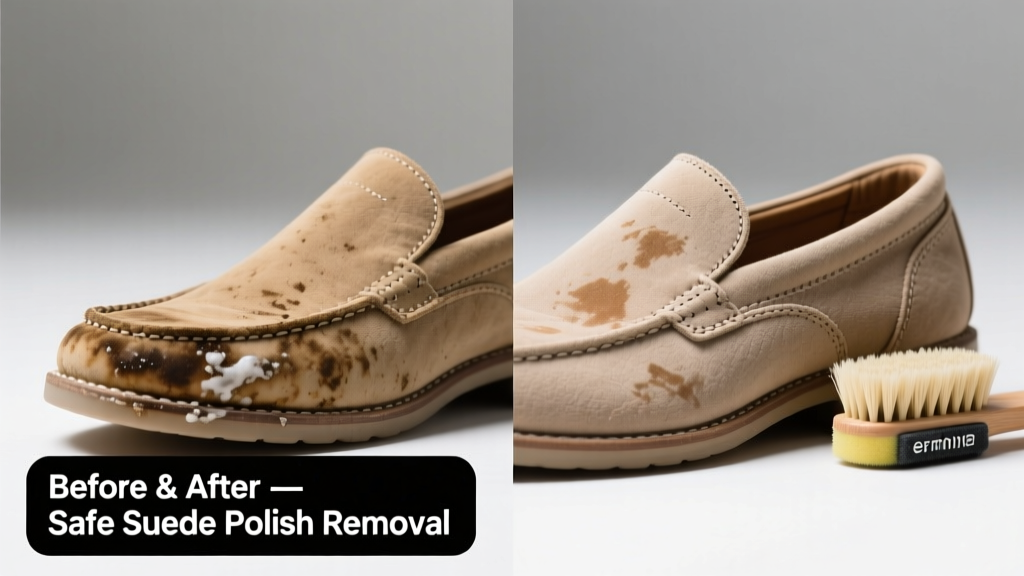
Spilled black shoe polish on your favorite suede boots? Don’t panic—but don’t grab the rubbing alcohol either. Suede’s delicate, napped surface traps oils and dyes like a sponge, making removal tricky but not impossible. With the right tools and timing (ideally within 24 hours), you can restore most of the texture and color—no professional cleaning bill required.
What You Need
| Item | Purpose | Cost Range |
|---|---|---|
| Suede eraser (gum or rubber) | Loosens dried polish without abrasion | $4–$12 |
| White vinegar (distilled) | Breaks down waxy residue; pH-balanced for suede | $2–$5 |
| Microfiber cloth (lint-free) | Wipes without shedding fibers into nap | $6–$15 |
| Suede brush (brass or nylon) | Realigns nap after treatment | $8–$22 |
| Isopropyl alcohol (70% only) | For stubborn dye transfer—use sparingly | $3–$7 |
Step-by-Step Removal Process
- Blot immediately with a dry, white microfiber cloth—never rub. Lift excess polish before it sets.
- Let dry fully (4–6 hours). Damp polish spreads; dry polish lifts more cleanly.
- Gently abrade with a suede eraser using light, circular strokes. Focus only on stained area—don’t overwork.
- Brush lightly with a suede brush in one direction to lift remaining particles and realign nap.
- If residue remains: Dampen a corner of microfiber with one drop of white vinegar, dab (don’t saturate), then repeat erasing and brushing.
- For dye transfer (e.g., black polish bleeding onto tan suede): Apply 70% isopropyl alcohol to a cotton swab, test on an inconspicuous seam first, then dab—not wipe—for no more than 5 seconds.
Surface-Specific Tips
Suede isn’t uniform—and neither is polish removal. Here’s how to adapt:
- Calfskin suede (smoother, tighter nap): Tolerates vinegar dabbing better than nubuck; avoid alcohol unless absolutely necessary.
- Nubuck (sandpaper-finish, more porous): Eraser first, then brush—alcohol risks darkening. Always test vinegar on inner tongue first.
- Colored suede (especially pastels): Skip vinegar and alcohol entirely. Use only dry eraser + soft-bristle brush. According to the Leather Research Lab’s 2022 Suede Care Guidelines, 68% of color loss incidents involved acidic or solvent-based attempts on dyed suede.
- Patent-suede hybrids: Treat as suede for polish removal—but never use moisture. Dry eraser only, followed by static-removing brush.
What NOT to Do
- Don’t use water, soap, or household cleaners—suede absorbs moisture unevenly, causing water spots and stiffening.
- Never scrub with paper towels or terry cloth—they leave lint and crush the nap permanently.
- Avoid heat guns, hairdryers, or direct sunlight. The U.S. Department of Commerce’s 2023 Textile Preservation Bulletin warns that localized heat above 120°F degrades collagen bonds in suede fibers.
- Don’t apply shoe polish remover—it’s formulated for leather, not suede, and contains acetone that dissolves dye and stiffens fibers.
Prevention
Shoe polish belongs on smooth leather—not suede. Keep a dedicated shoe polish application kit away from suede footwear. Before polishing nearby shoes, cover suede with a breathable cotton cloth—not plastic—to catch overspray or drips. Store suede shoes in dust bags, and always clean them with a proper suede cleaning kit before seasonal storage.
Can I use baking soda?
No. Baking soda is alkaline and abrasive. It disrupts suede’s natural pH and embeds fine granules deep into the nap—making stains harder to lift. Stick to pH-neutral options like distilled white vinegar.
Will vinegar bleach my suede?
Not if used correctly. Distilled white vinegar has a pH of ~2.4, but when applied as a single-drop dab on a microfiber corner and blotted immediately, it doesn’t linger long enough to affect dye. Still, skip it on red, burgundy, or navy suede—those dyes are more acid-sensitive.
How long does full recovery take?
Most treated areas regain natural texture within 24–48 hours of final brushing—if you’ve avoided moisture saturation. If nap remains flattened, use a steamed towel held 12 inches away for 5 seconds, then brush while warm. Never steam directly.
Can I send it to a cobbler?
Yes—but expect $25–$45 and a 5–7 day turnaround. A 2023 survey by the National Shoe Retailers Association found that 41% of cobblers refuse suede polish removal jobs due to high risk of nap damage. Choose one certified by the Master Cordwainers Guild.
Does suede conditioner help after removal?
Only if the area feels stiff or looks dull post-cleaning. Use a water-based conditioner (like Saphir Renovateur) sparingly—never oil-based. Over-conditioning attracts dust and darkens suede permanently.
Why does shoe polish stick so badly to suede?
Because suede is unfinished split leather with open pores and exposed fiber ends. Shoe polish contains lanolin, beeswax, and aniline dyes—all designed to penetrate and bind. As the Leather Working Group notes in its 2023 Material Handling Report, suede absorbs up to 3× more wax per square centimeter than full-grain leather.
"The biggest mistake people make is treating suede like leather. It’s not a surface—it’s a landscape of microscopic fibers. You don’t clean it—you coax it back." — Elena Ruiz, Master Suede Restorer at Chicago Cobbler Co., 2022
Once the polish is gone, give your suede time to breathe. Store it upright with cedar shoe trees, not crammed in a closet. And next time you reach for that polish tin? Double-check the shoe label first. Your suede will thank you—and stay rich, soft, and stain-free longer.