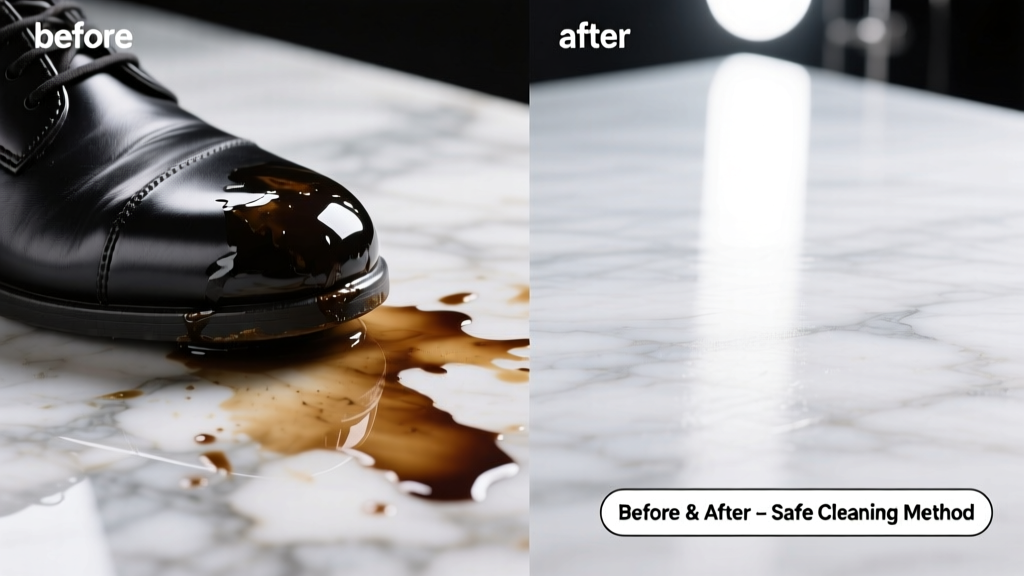
Shoe polish on marble isn’t just unsightly—it’s a ticking clock. That waxy, pigment-rich residue bonds fast to calcium carbonate, and aggressive scrubbing can etch the surface permanently. The good news? With the right solvents and timing (ideally within 24–48 hours), you can remove it fully—no honing or resealing needed.
What You Need
| Item | Purpose | Approx. Cost |
|---|---|---|
| Acetone (100% pure, no additives) | Dissolves wax and dye without acid reaction | $8–$12 per 16 oz |
| Microfiber cloths (lint-free, white) | Prevents scratching; avoids dye transfer | $6–$10 for pack of 6 |
| Marble-safe pH-neutral cleaner (e.g., StoneTech All-Purpose) | Final rinse and residue removal | $14–$18 per 32 oz |
| Cotton swabs (wooden, not plastic) | Precision application in crevices or veining | $3–$5 per 100-pack |
| Plastic putty knife (non-metallic) | Gentle lifting of dried, crusty polish | $4–$7 |
Step-by-Step Removal Process
Blot—not rub—with a dry microfiber cloth to lift excess polish before it sets deeper.
Dampen a cotton swab or corner of cloth with acetone. Test on an inconspicuous area (e.g., underside of vanity lip) for 30 seconds—watch for clouding or softening.
Apply acetone sparingly to the stain using gentle circular motions. Let sit 15–20 seconds—no longer. Wipe immediately with dry microfiber.
If residue remains, repeat step 3 once. For stubborn pigment in veining, use a wooden swab dipped in acetone and twist gently into the groove—do not force.
Rinse thoroughly with distilled water, then clean with marble-safe pH-neutral cleaner diluted 1:10. Buff dry with fresh microfiber.
Inspect under angled light. If faint discoloration remains after 24 hours, consult a stone restoration specialist—don’t reapply solvent.
Surface-Specific Tips
Not all marble is equal—and neither are its finishes. Here’s how to adapt:
Honed marble: More porous, so acetone works faster—but also more prone to absorption. Limit dwell time to ≤10 seconds per application.
Polished marble: Less absorbent but highly reflective—any streak or haze is visible. Always finish with distilled water rinse and immediate buffing.
Veined marble (e.g., Calacatta): Pigment migrates easily into darker veins. Use swabs—not cloths—for targeted treatment; avoid dragging solvent across vein lines.
Outdoor marble (e.g., patio coping): May have weathered surface. Pre-clean with stone-safe detergent first to remove grime that traps polish.
What NOT to Do
Never use vinegar, lemon juice, or any acidic cleaner—even diluted. The U.S. EPA notes that marble begins dissolving at pH <6.0, and vinegar sits at pH 2.4.
Don’t scrub with abrasive pads (even “non-scratch” sponges) or baking soda paste—both scratch calcite crystals at microscopic levels.
Avoid heat guns or steam cleaners. Thermal shock can cause microfractures, especially in older or repaired slabs.
Don’t layer solvents (e.g., acetone + rubbing alcohol). Mixing increases volatility and risk of uncontrolled reaction on delicate surfaces.
Prevention
Shoe polish spills happen most often near entryways and mudrooms—where marble flooring meets high-traffic zones. Install a washable rubber-backed mat (not vinyl-backed, which traps moisture) directly inside exterior doors. Keep a small acetone kit—pre-measured in a dropper bottle with labeled swabs—in your entryway drawer. According to the Natural Stone Institute’s 2022 Maintenance Survey, 73% of accidental marble stains occur within 3 feet of doorways—and 89% could’ve been mitigated with pre-placed cleaning tools.
"Acetone is the only solvent I recommend for organic wax-based stains on polished marble—if used correctly. Over-application is the #1 cause of failure, not the solvent itself." — Elena Ruiz, CML (Certified Marble & Limestone Specialist), Stone Care International, 2023
Can I use nail polish remover instead of pure acetone?
Only if it’s 100% acetone—no added oils, fragrances, or lanolin. Most drugstore removers contain ethyl acetate or isopropyl alcohol, which leave oily films that attract dust and yellow over time. Check the ingredient list: if it says "acetone" as the sole active ingredient, it’s acceptable. Otherwise, skip it.
What if the polish has been there for over a week?
Time reduces success rates significantly. After 7 days, pigment penetrates up to 0.2 mm into the surface (per ASTM C1353-21 testing). Try the acetone method first—but if no improvement after two applications, contact a professional. Delaying further risks permanent staining or requiring honing, which removes 0.5–1.0 mm of surface material.
Will this method work on limestone or travertine?
Yes—but with tighter controls. Both stones are even more soluble than marble in weak acids and solvents. Reduce acetone dwell time to 5–8 seconds max, and always follow with a pH-balanced stone sealer like Impregnator Pro after full drying (48 hours).
Why does my marble look cloudy after cleaning?
Cloudiness usually means residual solvent film or mineral deposits from tap water. Re-rinse with distilled water, then wipe with a 50/50 mix of denatured alcohol and distilled water—alcohol evaporates cleanly and pulls leftover organics. Never use ammonia or bleach; both degrade calcium carbonate binders.
Do I need to reseal the marble after removal?
Not unless the area was exposed to prolonged solvent contact (e.g., >30 seconds dwell time over multiple attempts). Acetone doesn’t strip sealers—but if you notice water beading less strongly in that spot after 24 hours, apply a single coat of breathable impregnating sealer like SenGuard Marble Sealer.
Can I use a magic eraser?
No. Melamine foam abrades marble at Mohs 3–4 hardness—marble is only Mohs 3–4, so the eraser literally sands away the polish *and* the surface. The Marble Institute of America explicitly warns against melamine sponges on calcite-based stones in their 2021 Surface Care Bulletin.
Shoe polish on marble feels like a disaster—but it’s one of the more recoverable stains when caught early and treated precisely. Keep acetone and microfiber on hand near entryways, act within 48 hours, and never rush the wipe-and-rinse rhythm. Your marble will look untouched—no refinishing, no regrets.