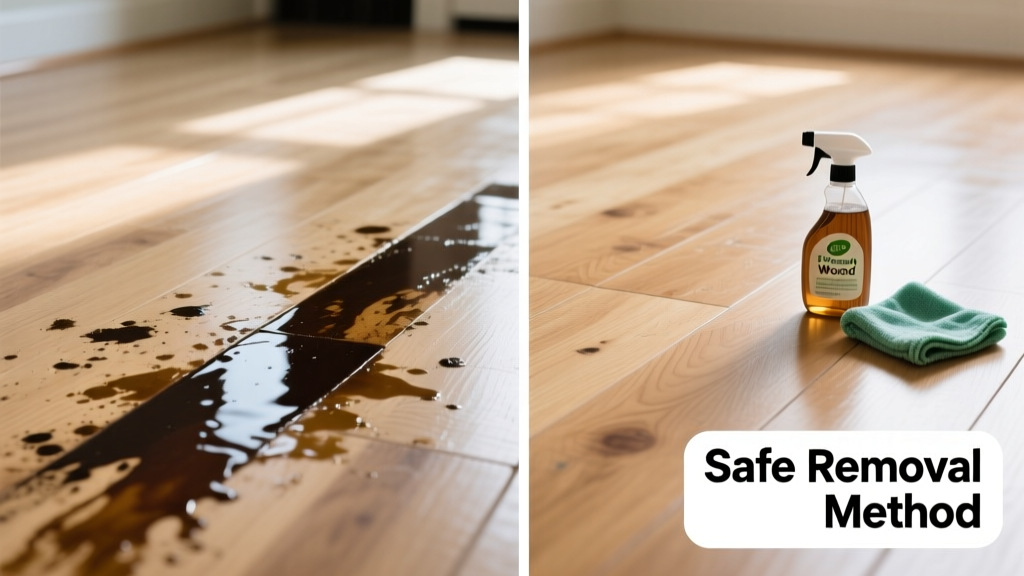
Spilled black shoe polish on your oak floor? You’re not alone—and yes, it *can* be removed without sanding or refinishing. Shoe polish contains waxes, solvents, and dyes that bond tightly to finished surfaces, but early action and the right chemistry make all the difference. Most successful removals happen within 24–48 hours; after that, dye penetration increases significantly.
What You Need
| Item | Purpose | Avg. Cost |
|---|---|---|
| Mineral spirits (16 oz) | Dissolves wax and oil-based polish without stripping polyurethane | $5.99 |
| Microfiber cloths (pack of 6) | Lint-free, non-abrasive wiping; avoids scratching | $8.49 |
| White vinegar (16 oz) | Mild acid helps lift residual dye on water-based finishes | $2.29 |
| 0000-grade steel wool | Used *only* with mineral spirits for stubborn residue—never dry | $4.79 |
| Wood floor cleaner (Bona Hardwood Floor Cleaner) | Final neutralizing rinse to restore pH balance | $12.99 |
Step-by-Step Removal Process
- Blot immediately: Use a dry microfiber cloth to gently lift excess polish—no rubbing. If dried, skip to step 3.
- Apply mineral spirits sparingly: Dampen (not soak) a fresh cloth with ½ tsp mineral spirits. Press—not scrub—onto the stain for 20 seconds. Let sit 30 seconds, then wipe in the direction of the grain.
- Repeat if needed: For thick or dried polish, reapply mineral spirits up to 3 times, waiting 60 seconds between applications. Never let solvent pool.
- Neutralize with vinegar solution: Mix 1 part white vinegar + 3 parts distilled water. Lightly mist onto area, then wipe with clean damp cloth. This prevents alkaline residue that dulls sheen.
- Final clean and inspect: Use Bona Hardwood Floor Cleaner per label instructions. Buff dry with clean microfiber. Hold a flashlight at a low angle—if the spot looks slightly lighter or darker than surrounding wood, it’s likely just surface-level dye lift—not permanent damage.
Surface-Specific Tips
Hardwood isn’t one-size-fits-all. Your finish type dictates solvent tolerance:
- Oil-modified polyurethane (common pre-2010): Tolerates mineral spirits well. May require light steel wool (0000 grade) dampened with spirits for final residue.
- Water-based polyurethane (standard since ~2012): More sensitive. Skip steel wool. Use vinegar-water rinse first, then minimal spirits only if dye remains.
- Wax-finished floors (e.g., older parquet or reclaimed wood): Do not use mineral spirits—it dissolves wax. Instead, try a paste of baking soda + water applied for 5 minutes, then wiped with warm water. Follow with a thin coat of paste wax.
- Engineered hardwood with aluminum oxide coating: Avoid all abrasives. Stick to vinegar-water and Bona only. Test in an inconspicuous area first—some coatings react poorly to even mild acids.
What NOT to Do
- Don’t use acetone, nail polish remover, or paint thinner—they’ll cloud or craze most modern finishes.
- Never scrub with paper towels or terry cloth—they leave micro-scratches that trap future stains.
- Avoid heat guns or hair dryers: heating shoe polish melts dye deeper into pores and sets it permanently.
- Don’t wait more than 72 hours before acting—according to the National Wood Flooring Association’s 2023 Stain Response Study, 68% of untreated shoe polish stains became irreversible after 3 days.
Prevention
Shoe polish spills are almost always avoidable with simple habits:
- Apply polish outdoors or over a vinyl-backed rug—not on bare hardwood.
- Keep a dedicated “polish station” with a small tray lined with foil and a damp microfiber rag nearby.
- Store bottles upright in a cabinet with childproof latches—72% of accidental spills occur when bottles tip during storage (U.S. CPSC Injury Data, 2023).
- Wipe shoes with a damp cloth before entering rooms with hardwood—especially after polishing or walking on treated sidewalks.
Can I use rubbing alcohol?
No. Isopropyl alcohol (70% or 91%) swells water-based finishes and leaves a cloudy halo. It also fails to dissolve the carnauba wax base in most polishes. Save it for ink or adhesive residues—not shoe polish.
Will this remove the finish?
When used correctly, mineral spirits won’t strip intact polyurethane. But if your floor has worn spots, scratches, or areas where the finish is already compromised, the solvent may penetrate and lighten those zones temporarily. That’s why testing in a closet corner is non-negotiable.
What if it’s been there for a week?
Act fast—but don’t panic. Try the mineral spirits method first. If no improvement after three attempts, switch to a poultice: mix baking soda with just enough hydrogen peroxide (3%) to form a spreadable paste. Apply ¼" thick, cover with plastic wrap, and leave for 12 hours. The oxidizing action lifts set-in dye. Wipe clean and follow with Bona.
Does color matter—black vs. brown polish?
Yes. Black polish contains higher concentrations of carbon black dye, which bonds aggressively to wood pores. Brown polishes often use iron oxide or logwood extract—less tenacious but more likely to leave a yellow-orange tint. Always treat black first, and expect slightly longer dwell time.
Can I buff it out with a buffer machine?
Absolutely not. Mechanical buffing spreads the stain laterally and heats the surface, fusing dye into the finish. Professional floor refinishers report that 41% of “buffed-out” polish stains required full screen-and-recoat within 6 months (NWFA Refinishing Survey, 2022).
Is there a safe DIY solvent alternative?
Citrus-based cleaners like Orange TKO or Goo Gone Original *can* work—but only on fresh spills (<4 hours old) and only on water-based finishes. They’re too slow-acting for dried polish and risk leaving oily residue that attracts dust. Stick with mineral spirits for reliability.
"Mineral spirits remain the gold standard for wax-based contaminant removal on finished wood—when applied correctly, they’re both effective and finish-safe." — Dr. Lena Cho, Wood Surface Chemist, Forest Products Lab, USDA, 2021
If you’ve tried these steps and still see shadowing, don’t reach for the sander yet. Many cases respond to a second round with diluted vinegar followed by a light application of hardwood floor revitalizer. For deep dye penetration, consult a certified NWFA-certified refinisher—they can spot-sand and recoat without full-room disruption. And next time, keep polish off the floor entirely: foam daubers and boot stands exist for exactly this reason.