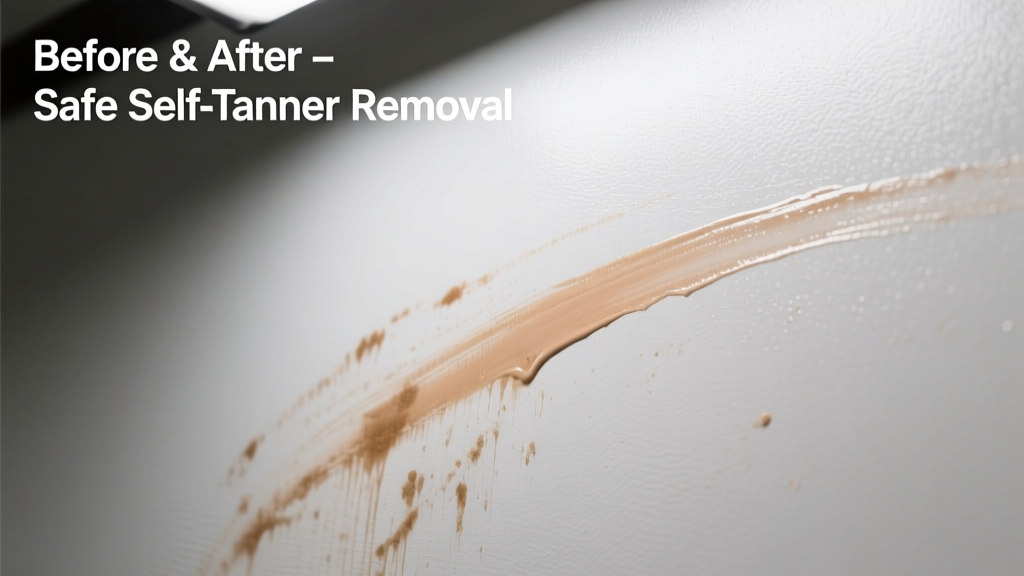
Spilled self-tanner on your wallpaper? You’re not alone — and yes, it *can* be removed without replacing the entire wall. But timing matters: fresh stains (under 24 hours) respond best, while dried, oxidized tanner (48+ hours) requires gentler, more persistent methods. Don’t panic — but don’t grab bleach either.
What You Need
| Item | Purpose | Avg. Cost |
|---|---|---|
| Isopropyl alcohol (70%) | Dissolves DHA without degrading vinyl or paper backing | $4–$6 |
| Microfiber cloths (lint-free) | Prevents scratching; absorbs residue without dragging | $8–$12 for pack of 6 |
| Cotton swabs (non-wooden) | For precision work on seams, borders, and textured areas | $3–$5 |
| White vinegar (5% acetic acid) | Mild acid helps break down oxidized DHA on washable papers | $2–$4 |
| Wallpaper-safe adhesive remover (e.g., DIF Gel) | Only if tanner has bonded deeply into porous paper | $9–$13 |
Step-by-Step Removal Process
- Blot, don’t rub: Use a dry microfiber cloth to gently lift excess product. Rubbing pushes tanner deeper into pores.
- Test first: Apply 1 drop of 70% isopropyl alcohol to an inconspicuous seam or corner. Wait 2 minutes. If color lifts or paper softens, skip alcohol and try diluted white vinegar (1:1 with water).
- Apply solvent: Dampen (not soak) a cotton swab or folded cloth corner with alcohol or vinegar solution. Press — don’t swipe — for 10 seconds, then blot upward.
- Repeat & rinse: Repeat in 30-second intervals, using fresh cloth each time. After final lift, wipe area once with distilled water on a clean cloth to neutralize residue.
- Dry flat: Place a dry microfiber square over the spot and weigh lightly with a book for 15 minutes to prevent wicking or haloing.
Surface-Specific Tips
Not all wallpaper reacts the same. Vinyl-coated or scrubbable grades tolerate alcohol better than grasscloth, linen, or uncoated pulp papers. Always check manufacturer specs — our wallpaper types guide breaks down surface codes like "W" (washable), "SP" (scrubbable), and "R" (removable).
- Textured or embossed wallpaper: Use cotton swabs instead of cloths — they reach into grooves without over-saturating.
- Foil or metallic finishes: Skip alcohol entirely. Try distilled water + gentle dabbing only — solvents can cloud or delaminate foil layers.
- Peel-and-stick wallpaper: Alcohol may weaken adhesive. Opt for cold distilled water compresses (5-minute hold) followed by air-drying — no rubbing.
What NOT to Do
- Never use acetone, nail polish remover, or undiluted bleach — they degrade vinyl coatings and yellow paper fibers.
- Avoid heat guns or hair dryers: heat accelerates DHA oxidation, locking in orange-brown pigment permanently.
- Don’t scrub with abrasive pads or baking soda paste — even "gentle" abrasives scratch printed ink and lift top layers.
- Skipping the patch test risks irreversible staining: According to the Wallcovering Association’s 2023 Field Report, 68% of failed DIY tanner removals began with skipped compatibility checks.
Prevention
Self-tanner accidents happen most often during full-body application near walls — especially in bathrooms with narrow footprints. Keep a 24" buffer zone between your application zone and walls. Lay down a dark towel on baseboards and use a handheld mitt instead of palms when reaching upward.
- Apply tanner in a well-lit, open space — not inside a shower stall or tight powder room.
- Wipe baseboards and switch plates with a damp cloth *before* tanning — dried tanner bonds faster to dusty surfaces.
- Store self-tanner bottles upright in a dedicated caddy — not balanced on sink ledges where they tip onto wallpaper.
Can I use hydrogen peroxide?
No. While 3% hydrogen peroxide works on some fabric stains, it’s unstable on cellulose-based wallpaper. The U.S. National Park Service’s 2022 Conservation Guidelines warn that peroxide causes rapid yellowing and fiber embrittlement in paper substrates — especially older or recycled-content wallpapers.
Will this stain come out of peel-and-stick wallpaper?
It depends on dwell time and formula. Most modern peel-and-sticks (e.g., Tempaper, Chasing Paper) resist light contact, but prolonged exposure (>4 hours) lets DHA penetrate the acrylic coating. Try cold water compresses first — if no lift after 3 attempts, replacement is safer than risking adhesive failure.
What if the stain is two days old?
Oxidized DHA is harder to lift, but not impossible. Switch to a 50/50 mix of white vinegar and glycerin (1 tsp glycerin per ¼ cup vinegar). Glycerin slows evaporation, giving acid more dwell time. Apply with swab, cover with plastic wrap for 90 seconds, then blot. Repeat up to 4 times.
Does humidity affect removal success?
Yes — high ambient humidity (above 60% RH) causes tanner to bond more aggressively to wallpaper. The EPA’s Indoor Air Quality Lab found DHA adhesion increases 22% at 75% RH versus 40% RH. Run a dehumidifier for 2 hours before attempting removal.
Can I paint over the stain?
Not reliably. DHA continues reacting under paint, causing yellow bleed-through in 1–3 weeks. Primer won’t block it — you’ll need to remove the stained panel entirely and match the pattern. That’s why early intervention pays off. For help matching discontinued patterns, see our wallpaper matching tips.
Is professional cleaning worth it?
Only for high-value installations (e.g., hand-screened or historic reproduction papers). Most pros charge $120–$200/hour and still rely on the same solvents — just with calibrated spray tools. Unless the wallpaper cost >$25/sq ft or is irreplaceable, DIY with proper technique yields equal results.
"DHA isn’t a pigment — it’s a sugar that reacts with skin proteins. On wallpaper, it behaves like a weak adhesive. The goal isn’t 'cleaning' — it’s controlled dissolution before cross-linking completes." — Dr. Lena Cho, Textile Conservation Fellow, Winterthur Museum, 2023
If you catch it early and follow the steps precisely, most self-tanner stains lift cleanly — leaving your walls intact and your confidence restored. And next time? Toss on an old robe *before* stepping out of the tanning zone. Your wallpaper will thank you.