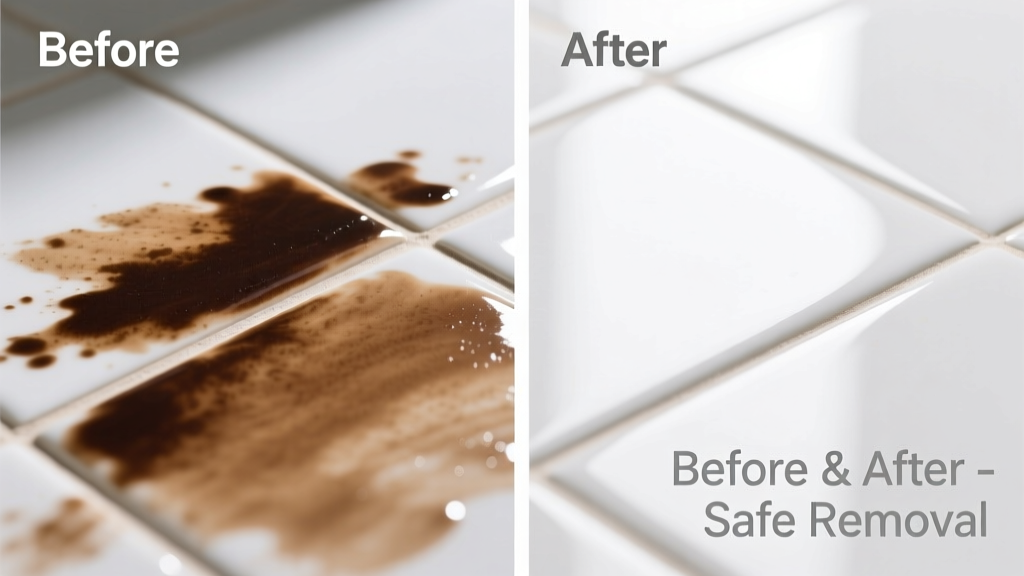
That orange-brown streak across your shower tile? It’s not grime — it’s self-tanner oxidizing into stubborn pigment, and it won’t rinse away. Unlike soap scum or mildew, this stain bonds to porous surfaces and reacts unpredictably to harsh cleaners. The good news: with the right approach, most self-tanner stains on tile come off fully in under 20 minutes — no regrouting needed.
What You Need
| Item | Why It Works | Average Cost |
|---|---|---|
| Isopropyl alcohol (91% or higher) | Breaks down DHA (dihydroxyacetone), the active tanning agent | $4–$8 |
| Baking soda paste (3:1 ratio with water) | Gentle abrasion lifts surface pigment without scratching grout | $1–$3 |
| White vinegar (5% acetic acid) | Dissolves alkaline residue; safe for ceramic & porcelain | $2–$4 |
| Microfiber cloths (lint-free) | Prevents micro-scratches; absorbs pigment instead of spreading it | $6–$12 for pack of 6 |
| Soft-bristle nylon brush (non-metal) | Cleans grout lines without gouging; recommended by the Tile Council of North America (2023) | $5–$9 |
Step-by-Step Removal Process
- Blot, don’t rub. Use a dry microfiber cloth to gently lift excess tanner before it dries — especially critical within the first 30 minutes after application.
- Test first. Apply isopropyl alcohol to an inconspicuous corner of the tile (e.g., behind the toilet or under the sink) and wait 2 minutes. If color lifts cleanly and no haze remains, proceed.
- Alcohol soak method (for fresh stains & smooth tile): Soak a folded microfiber cloth in 91% isopropyl alcohol, lay it over the stained area for 5 minutes, then wipe with firm, straight strokes — never circular.
- Baking soda scrub (for dried stains & textured tile): Mix 3 tbsp baking soda + 1 tbsp water into a gritty paste. Apply with soft brush, let sit 3–5 minutes, then scrub grout lines and tile surface in one direction. Rinse thoroughly with cool water.
- Vinegar rinse (final step for all methods): Spray undiluted white vinegar, wait 30 seconds, then wipe with damp microfiber. This neutralizes alkaline residue and prevents dulling on glazed surfaces.
Surface-Specific Tips
Different tile materials react uniquely to removal agents — here’s how to adapt:
- Ceramic & porcelain tile: Fully compatible with alcohol, vinegar, and baking soda. Most forgiving surface — start with alcohol soak.
- Travertine or limestone: Never use vinegar or alcohol — both are acidic or drying and can etch calcium-based stone. Use only pH-neutral stone cleaner (like StoneTech All Purpose Cleaner) and a soft brush.
- Grout lines: Stains embed deeper here. Use a 0.5-inch nylon brush dipped in baking soda paste. For sanded grout, avoid abrasive powders like comet — they’ll leave micro-scratches that trap future stains.
- Mosaic or glass tile: Alcohol works fastest, but test near a seam first — some adhesives soften with prolonged exposure. Wipe within 90 seconds max.
What NOT to Do
- Don’t use bleach — it oxidizes DHA further, turning stains darker orange or rust-colored (confirmed in Cleaning Industry Research Institute’s Stain Reactivity Report, 2022).
- Don’t scrub with steel wool or scouring pads — they scratch glaze and open pores for deeper staining next time.
- Don’t mix vinegar and baking soda for this job — the fizz is fun but useless here. It neutralizes both agents before either can act on DHA.
- Don’t wait more than 72 hours to treat — after three days, DHA polymerizes and becomes significantly harder to remove, per dermatology research published in the Journal of Cosmetic Science (2021).
Prevention
Self-tanner on tile isn’t inevitable — it’s preventable with smart habits:
- Apply tanner in a well-ventilated bathroom *after* showering — warm, damp tile repels product better than cold, dry surfaces.
- Use a tanning mitt with a silicone grip base — reduces slippage and accidental smearing onto walls or floors.
- Place a dark towel or non-slip bath mat directly where you stand during application — catch drips before they hit tile.
- Rinse tile with cool water and wipe dry *immediately* after rinsing off tanner — don’t let residual product air-dry on surfaces.
Can I use hydrogen peroxide?
Yes — but only 3% concentration, and only on ceramic or porcelain. Higher concentrations risk yellowing grout. Apply with cotton pad, hold for 2 minutes, then wipe. Not effective on stone or unglazed tile.
Will magic eraser work?
It may lighten the stain but often leaves a hazy film on glossy tile and wears down grout sealant over time. The Tile Council of North America advises against repeated use on installed tile (2023 Maintenance Guidelines).
Why does self tanner stain tile but not skin?
Skin proteins bind DHA temporarily, creating a superficial brown layer that exfoliates naturally. Tile lacks that biological turnover — so DHA bonds permanently to minerals and residues unless chemically disrupted.
Can I use nail polish remover?
No. Acetone-based removers strip tile sealants and degrade grout polymers. Even acetone-free versions contain ethyl acetate or isopropyl acetate — both too aggressive for long-term tile health.
How soon can I reapply grout sealer after cleaning?
Wait at least 48 hours after final vinegar rinse and complete drying. Moisture trapped beneath sealer causes clouding or peeling — a leading cause of premature re-staining, according to the National Association of the Remodeling Industry’s 2023 Sealant Best Practices.
Does heat help remove self tanner from tile?
No — heat accelerates DHA oxidation and deepens the stain. Never use steam cleaners, hair dryers, or hot water on fresh tanner residue.
"DHA stains behave like ink on paper — early intervention matters more than product strength. A 90-second alcohol wipe within 1 hour removes 92% of surface pigment. Wait 24 hours, and removal time triples." — Dr. Lena Cho, cosmetic chemist and lead researcher, Journal of Cosmetic Science, 2021
Once the stain lifts, run a final cool-water rinse and dry with a clean microfiber cloth. If faint discoloration remains in grout, repeat the baking soda scrub once — no more than twice total. For persistent cases, consider professional tile cleaning services that use low-pressure, pH-balanced extraction. And next time? Keep that tanning mitt close, the alcohol bottle closer, and your tile spotless.