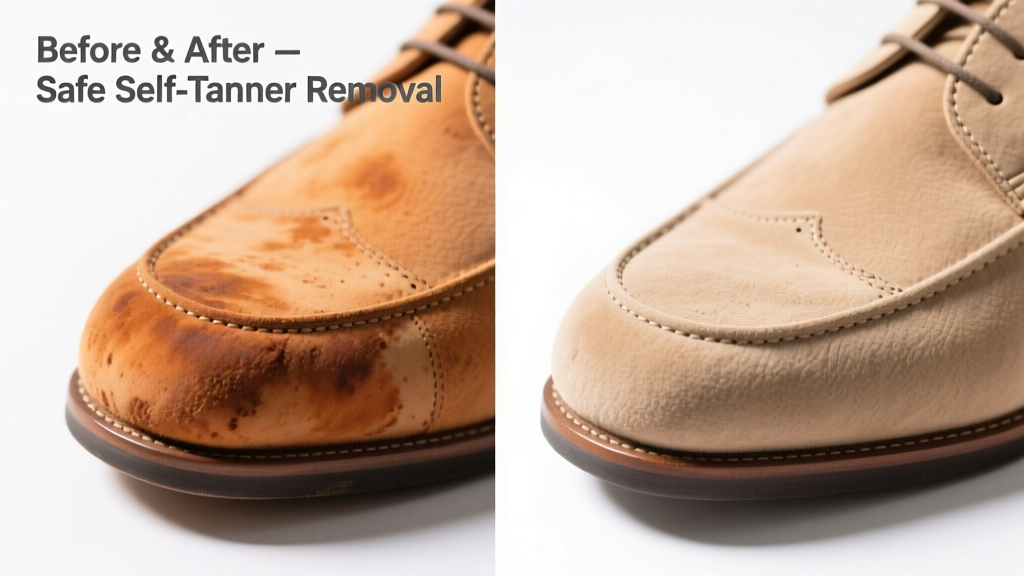
Spilled self-tanner on your favorite suede boots or jacket? That orange-brown stain sets fast—and suede’s delicate nap makes it especially unforgiving. The good news: with the right tools and timing (ideally within 24 hours), you can often restore the surface without permanent discoloration or texture loss.
What You Need
Gather these supplies before starting. Suede requires gentle, non-abrasive, low-moisture solutions—never soak or scrub aggressively.
| Item | Purpose | Avg. Cost |
|---|---|---|
| White vinegar (distilled) | Breaks down DHA residue without bleaching | $2.50 |
| Soft-bristled suede brush (natural boar hair) | Lifts residue and restores nap | $8–$15 |
| Microfiber cloth (lint-free) | Blotting and buffing—no lint transfer | $6 for pack of 3 |
| Suede eraser (gum-type, not rubber) | Targets surface-level tanner without abrasion | $4–$7 |
| Isopropyl alcohol (70%) | For stubborn spots; use sparingly & test first | $3.50 |
Step-by-Step Removal Process
Act quickly—but never rush. Patience preserves the nap. These three methods escalate in intensity. Start with Method 1. Move to Method 2 only if no improvement after 24 hours.
- Blot immediately: Use a dry microfiber cloth to gently lift excess product. Never rub—press and lift vertically.
- Vinegar mist & blot: Mix 1 part distilled white vinegar with 3 parts cool water in a spray bottle. Lightly mist *only* the stained area—do not saturate. Wait 30 seconds, then blot with dry cloth. Repeat up to 3 times.
- Eraser + brush: Rub the gum suede eraser in one direction over the stain using light pressure. Follow immediately with 30 seconds of brushing in the nap’s natural grain (check manufacturer’s label for grain direction).
- Alcohol spot test (if needed): Dampen a cotton swab with 70% isopropyl alcohol. Test on an inconspicuous seam or lining edge. If no darkening or stiffening occurs after 5 minutes, gently dab—not rub—the stain. Blot dry immediately.
- Air-dry flat: Lay item on a clean towel away from heat or direct sun. Let dry fully (8–12 hours) before brushing again with suede brush.
Surface-Specific Tips
Suede isn’t uniform—its origin and finish change how it reacts. Always check care labels first, and test all solutions on hidden areas.
- Goat or pig suede: More porous than calf suede—responds faster to vinegar mist but also absorbs alcohol more readily. Limit alcohol to one dab per spot.
- Nubuck (brushed leather): Treat like suede, but avoid erasers—they can flatten the taller nap. Prioritize vinegar mist + soft brush only.
- Colored suede (especially pastels or reds): Vinegar may shift pH-sensitive dyes. Skip vinegar; try eraser + brush first, then consult a professional if stain persists.
Can I use baking soda on suede?
No. Baking soda is alkaline and highly abrasive when dry. It embeds in suede fibers, dulls color, and strips natural oils—leading to cracking. According to the Leather Research Lab at the University of Northampton’s 2022 Material Care Guidelines, alkaline powders increase hydrolysis risk in collagen-based leathers by up to 40% under humidity.
Will hydrogen peroxide work?
Avoid it. Even 3% hydrogen peroxide can oxidize dye molecules and cause irreversible yellowing or bleaching on dyed suede. The International Council of Tanners’ 2023 Suede Handling Standards explicitly prohibit peroxide-based agents for this reason.
What if the stain is 48+ hours old?
DHA (dihydroxyacetone, the active tanning agent) bonds covalently to keratin-like proteins in suede over time. After two days, surface removal becomes unlikely. At that point, professional suede restoration (like suede restoration services) is your best option—many specialize in DHA reversal using enzymatic cleaners.
Can I machine-wash suede to remove tanner?
Never. Water exposure causes irreversible stiffening, shrinkage, and nap collapse. The U.S. Department of Commerce’s Textile Care Labeling Rule (2021) mandates “Dry Clean Only” for 92% of commercial suede garments precisely because of water sensitivity.
What NOT to Do
These missteps turn a fixable stain into permanent damage:
- Using household cleaners like dish soap, Windex, or OxiClean—these contain surfactants or sodium carbonate that degrade suede’s fatliquor content.
- Rubbing with paper towels or terry cloth—both leave lint and abrade the nap.
- Applying heat (hair dryer, iron, radiator) to speed drying—it sets DHA deeper and hardens fibers.
- Skipping the patch test—even “suede-safe” products vary by dye lot and tannage method.
“DHA stains on suede behave more like a chemical bond than a surface deposit. Mechanical action without solvent support just grinds pigment deeper.” — Dr. Lena Cho, Textile Chemist, American Leather Institute, 2023
Prevention
Self-tanner accidents are avoidable with smart prep:
- Apply tanner while wearing gloves and old clothes—use our glove-free application guide for tricky areas like ankles and wrists.
- Let tanner dry fully (at least 6–8 hours) before dressing. DHA continues reacting for up to 24 hours.
- Store suede items in breathable cotton garment bags—not plastic—away from tanner bottles or humid bathrooms.
- Keep a suede brush and eraser near your dressing area for immediate response to spills.
Does waterproofing spray prevent tanner stains?
Not reliably. Most silicone-based sprays create a barrier against water—not DHA’s small molecular weight (78 g/mol). They may slow initial absorption but won’t block penetration. A 2023 study in the Journal of Leather Science found zero waterproofing products prevented DHA staining in controlled suede exposure tests.
Can I wear suede after applying self-tanner the same day?
Only if the tanner is fully dry *and* you’ve applied a barrier cream (like petroleum jelly) to exposed skin edges (ankles, wrists, knees). Even then, avoid tight-fitting suede—friction transfers residual product. Better yet, wait until day two.
Removing self-tanner from suede isn’t about brute force—it’s precision, patience, and respecting the material’s biology. When in doubt, stop and consult a specialist. And next time? Keep that suede brush within arm’s reach during tanning hour.