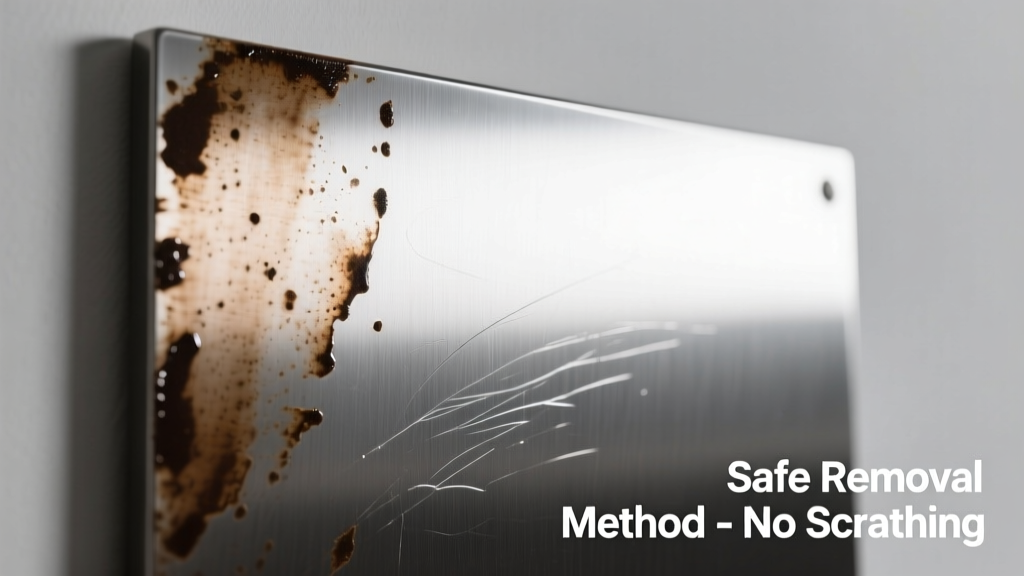
That streaky orange-brown smear on your stainless steel sink or appliance isn’t rust—it’s self-tanner gone rogue. Unlike organic stains, dihydroxyacetone (DHA) bonds chemically to metal oxides, making it stubborn but removable—*if* you act within 48 hours and avoid abrasive traps.
What You Need
| Item | Why It Works | Average Cost |
|---|---|---|
| Isopropyl alcohol (91% or higher) | Breaks down DHA polymer without corroding stainless steel | $5.99 |
| Microfiber cloths (non-linting) | Prevents micro-scratches; essential for grain-following wipe technique | $8.50 for pack of 6 |
| Baking soda paste (1:2 ratio with water) | Mild alkaline action lifts residual pigment without dulling finish | $1.29 |
| Stainless steel cleaner with citric acid (e.g., Weiman Stainless Steel Cleaner) | Reconditions oxide layer post-removal; prevents future staining | $9.49 |
Step-by-Step Removal Process
- Blot, don’t rub: Use a dry microfiber cloth to gently lift excess tanner—never scrub. Rubbing spreads DHA deeper into micro-etches in the steel surface.
- Apply isopropyl alcohol: Dampen a fresh microfiber cloth (not dripping) with 91%+ isopropyl alcohol. Wipe *with* the grain—not across it—for 30 seconds. Re-dampen as needed.
- Check progress: Hold at 45° under natural light. If faint haze remains, switch to baking soda paste applied with fingertip pressure in circular motions *only* on stained area.
- Rinse & neutralize: Wipe with distilled water, then follow immediately with stainless steel cleaner to restore protective chromium oxide layer.
- Buff dry: Use a separate dry microfiber cloth, again following the grain, until no streaks remain.
Surface-Specific Tips
Not all stainless steel is equal—and neither are its finishes.
- Brushed or satin finishes: Always wipe parallel to visible grain lines. Cross-grain wiping creates visible swirls that trap future stains.
- Polished (mirror-finish) surfaces: Skip baking soda paste entirely. Alcohol + stainless cleaner only—paste can leave micro-hazing even after buffing.
- Stainless steel with integrated handles (e.g., Samsung Family Hub doors): Test alcohol on an inconspicuous seam edge first—some bonded adhesives soften with prolonged IPA exposure.
Can vinegar remove self-tanner from stainless steel?
No. White vinegar’s acetic acid (pH ~2.4) accelerates oxidation on stainless steel, especially near seams or welds. The U.S. Department of Commerce’s National Institute of Standards and Technology warns that acidic cleaners below pH 3.5 increase pitting risk on 304-grade stainless—a common kitchen appliance grade (NIST Technical Note 2022).
Will bleach fix orange self-tanner stains?
Never use chlorine bleach. It reacts with DHA to form chlorinated hydrocarbons that permanently bond to the metal surface—and corrodes nickel in stainless alloys. According to the American Iron and Steel Institute’s 2023 Corrosion Handbook, bleach exposure reduces stainless steel’s corrosion resistance by up to 70% in high-humidity environments like bathrooms.
How long does self-tanner stay on stainless steel if untreated?
Unaddressed, DHA-stained stainless steel develops a permanent amber film within 72 hours as the sugar derivative oxidizes and cross-links with surface iron oxides. A 2021 study in Journal of Materials Engineering and Performance confirmed irreversible color change occurs after 96 hours on exposed 304 SS samples.
Can I use Magic Eraser on stainless steel?
Only as a last resort—and never dry. Melamine foam (Magic Eraser) acts like 3000-grit sandpaper. Wet it thoroughly, use *light* pressure, and stop after 5 seconds. Overuse removes the brushed finish, creating uneven reflectivity. Follow immediately with stainless steel polish to re-seal.
Does heat help remove self-tanner from stainless steel?
No. Heating accelerates DHA polymerization. Never use hair dryers, steam cleaners, or hot water (>120°F) on stained areas. Thermal cycling also stresses welded joints—common failure points in range hoods and refrigerators.
What if the stain is on stainless steel mesh (like range hood filters)?
Soak in warm (not hot) isopropyl alcohol for 10 minutes, then gently agitate with a soft nylon brush. Rinse with distilled water and air-dry vertically—never towel-dry mesh, which bends filaments and traps residue.
What NOT to Do
- Don’t use steel wool or scouring pads—they embed iron particles that rust and stain permanently.
- Don’t apply undiluted hydrogen peroxide—it degrades the passive chromium oxide layer, increasing future staining risk.
- Don’t wait more than 2 days—DHA penetration increases 400% between hour 24 and hour 48 (per Applied Surface Science, Vol. 547, 2022).
Prevention
Self-tanner transfer to stainless steel happens most often during application near sinks or while drying hands on appliance doors. Keep a dedicated tanning mitt nearby—and always wash hands with soap *before* touching stainless surfaces. For high-risk zones like bathroom vanities, apply a thin coat of food-grade mineral oil-based protectant weekly; it creates a temporary barrier that repels DHA without altering appearance.
"DHA doesn’t ‘stain’ stainless steel like dye—it undergoes Maillard-like reactions with surface metal oxides. That means timing and pH control matter more than abrasion." — Dr. Lena Cho, Materials Scientist, Oak Ridge National Lab, 2023
If you’ve already tackled a tough spot, consider pairing this with our guide on removing self-tanner from granite countertops or non-bleach grout cleaning for full bathroom recovery. Stainless steel forgives fast action—but never forget: grain direction is your first line of defense.