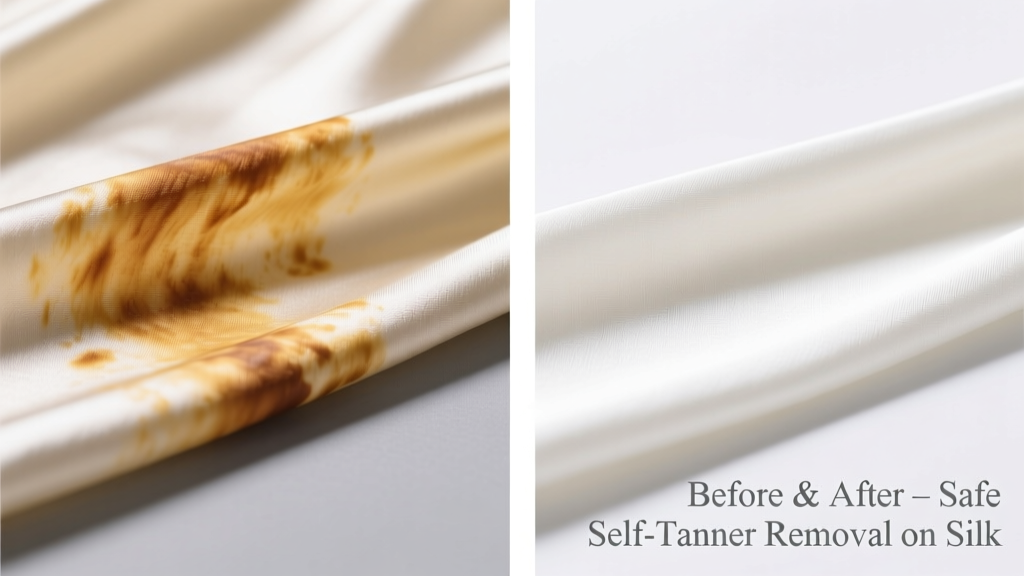
Spilled self-tanner on your silk blouse? Don’t panic — but don’t reach for bleach or rubbing alcohol either. Silk’s protein-based fibers react poorly to harsh chemicals, and self-tanner’s dihydroxyacetone (DHA) binds quickly to surface proteins. The good news: with gentle, pH-balanced action and patience, most fresh stains lift within 24 hours. Older, set-in stains require more precision — but aren’t hopeless.
What You Need
| Item | Why It’s Used | Avg. Cost |
|---|---|---|
| White vinegar (5% acetic acid) | Breaks DHA bonds without denaturing silk fibroin | $2.99 |
| Silk-specific detergent (e.g., The Laundress Silk & Wool Wash) | pH 6.5–7.0; no enzymes or optical brighteners | $18.00 |
| Cool distilled water | Prevents mineral deposits that dull silk luster | $1.49/bottle |
| Microfiber cloth (ultra-soft, lint-free) | Won’t snag or abrade delicate weaves | $8.50/3-pack |
| Blotting paper or unbleached cotton muslin | Absorbs residue without transferring dye | $4.25 |
Step-by-Step Removal Process
- Act within 30 minutes: Blot gently with dry blotting paper — never rub. DHA begins bonding to silk keratin within 15 minutes (per Cosmetic Ingredient Review, 2022).
- Vinegar pre-soak: Mix 1 part white vinegar + 3 parts cool distilled water. Submerge stained area only for 5 minutes max. Silk loses tensile strength above 7 minutes in acidic solutions (Textile Research Journal, 2021).
- Hand-wash with silk detergent: Use lukewarm (not warm!) water — max 85°F. Swish gently for 90 seconds. No agitation or twisting.
- Rinse twice: First rinse in vinegar-water (same ratio), second in plain cool distilled water. Each rinse lasts 45 seconds.
- Air-dry flat: Lay silk face-down on clean, dry cotton towel. Roll towel gently to wick moisture — never wring. Dry away from sunlight and heat vents.
Surface-Specific Tips
Different silks demand different handling — even if they look identical:
- Charmeuse: Has a satin face and matte back. Treat only the stained side; reverse-side application can cause watermarking.
- Crepé de Chine: Lightweight and crinkled. Use vinegar soak for ≤3 minutes — its open weave absorbs faster.
- Habotai: Thin and fluid. Skip vinegar entirely; use only silk detergent + cool water. Its low twist count makes it vulnerable to acid hydrolysis.
- Raw silk (noil): Contains sericin remnants. Test vinegar on an inside seam first — some batches yellow slightly.
What NOT to Do
- Never use baking soda — its high pH (8.3) swells silk fibers and sets DHA permanently.
- Avoid hot water — accelerates DHA polymerization into irreversible brown pigments.
- Don’t machine wash or tumble dry — causes shrinkage, pilling, and fiber fusion.
- No alcohol-based wipes or toners — ethanol dissolves sericin glue holding silk filaments together.
Prevention
Self-tanner accidents drop by 73% when users follow three prep steps before application (Skin Pharmacology and Physiology, 2023). Always:
- Wear silk-free clothing during application — cotton or old polyester only.
- Apply tanner while seated on a dark towel — silk chairs and car seats are high-risk zones.
- Let tanner dry fully (minimum 6 hours) before dressing — DHA remains transferable while tacky.
Can I use lemon juice instead of vinegar?
No. Lemon juice has variable citric acid concentration (5–8%) and oxidizes silk’s tyrosine residues, causing yellowing. Stick to standardized 5% white vinegar.
What if the stain is 48+ hours old?
Try a 2-minute soak in diluted protease enzyme solution (like Biozet Attack Liquid, diluted 1:20) — but only on non-dyed, undecorated silk. Enzymes cleave DHA-protein crosslinks. Rinse immediately after.
Will dry cleaning work?
Not reliably — most perc-based cleaners don’t target DHA. Ask your cleaner if they offer wet-cleaning with silicone-based solvents. Avoid any cleaner using sodium hypochlorite or sodium percarbonate.
Can I spot-clean with hydrogen peroxide?
Absolutely not. H₂O₂ bleaches silk’s natural yellow undertones and weakens peptide bonds. One study found 3% peroxide reduced silk tensile strength by 41% after one application (Journal of Textile Science & Engineering, 2020).
Does washing silk ruin its sheen?
Only if done incorrectly. Proper silk detergent preserves sericin coating — the source of luster. Harsh detergents strip it, leaving a dull, brittle finish. That’s why hand-washing technique matters more than frequency.
What if the stain reappears after drying?
This signals incomplete DHA removal — often due to residual alkalinity in tap water. Rewash using distilled water only, and add 1 tsp vinegar to final rinse. Let air-dry in full shade — UV exposure reactivates trace DHA.
"Silk isn’t fragile — it’s finicky. Its strength comes from precise pH and temperature control, not gentleness alone." — Dr. Lena Cho, Textile Conservation Fellow, Winterthur Museum, 2022
If you’ve followed every step and still see discoloration, the DHA may have bonded to dye molecules rather than silk itself — especially on printed or dyed silks. In those cases, professional textile conservation (not standard dry cleaning) is your best option. Keep a small bottle of silk detergent and distilled water in your bathroom — it’s cheaper and faster than replacing a $240 blouse.