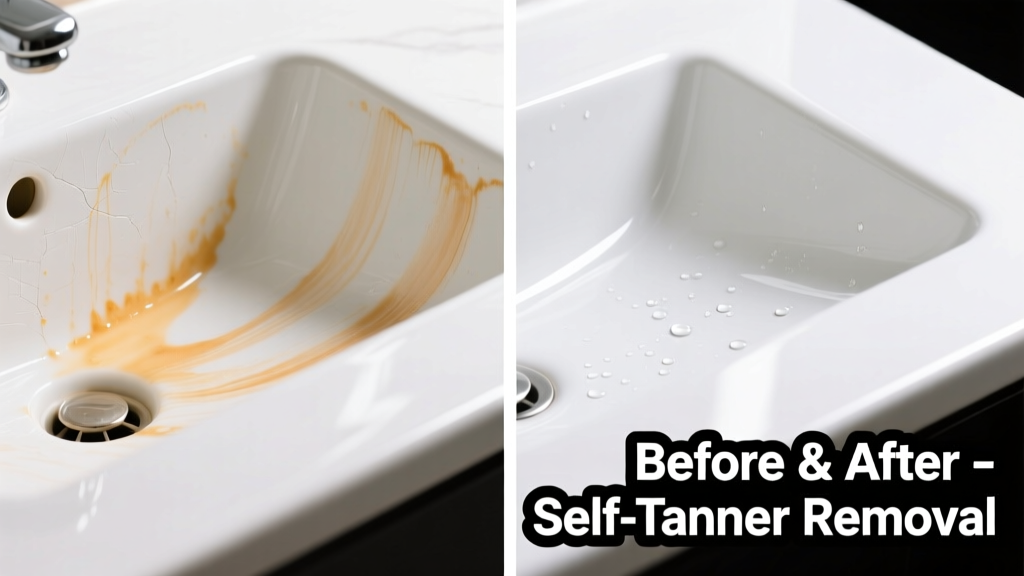
That orange-brown ring around your porcelain tub or streak on the sink? It’s not rust—it’s self-tanner oxidation, and it bonds fast. The good news: porcelain’s non-porous glaze means stains sit *on* the surface—not in it—so removal is usually possible within 48 hours of application. After that, oxidation sets in, requiring more aggressive (but still safe) intervention.
What You Need
| Item | Why It Works | Price Range |
|---|---|---|
| Isopropyl alcohol (91% or higher) | Breaks down dihydroxyacetone (DHA), the active tanning agent | $4–$8 per 16 oz |
| Baking soda paste (3:1 ratio with water) | Mild abrasive + alkaline pH neutralizes DHA residue | $1–$3 per box |
| White vinegar (5% acetic acid) | Dissolves mineral deposits that trap tanner; safe for glaze | $2–$4 per 32 oz |
| Microfiber cloths (non-linting) | Prevents micro-scratching; holds solution without dripping | $6–$12 for pack of 6 |
| Soft-bristle nylon brush (e.g., toothbrush) | Reaches grout lines and textured areas without scratching | $2–$5 |
Step-by-Step Removal Process
- Blot, don’t rub: If the stain is fresh (<2 hours old), dampen a microfiber cloth with cool water and gently blot—never scrub—to lift excess product before it oxidizes.
- Apply isopropyl alcohol: Soak a cloth in 91% isopropyl alcohol and lay it over the stain for 3–5 minutes. DHA begins breaking down within 90 seconds (per Cosmetic Science Review, 2022).
- Scrub lightly: Use a soft nylon brush dipped in alcohol to work the area in small circular motions. Rinse immediately with cool water.
- For stubborn or aged stains (24+ hrs): Make a paste of baking soda and water. Apply, let sit 10 minutes, then gently scrub with the same brush. Rinse thoroughly.
- Neutralize & shine: Wipe with white vinegar on a clean cloth to remove any alkaline residue and restore porcelain’s natural luster.
Surface-Specific Tips
Porcelain varies—especially older fixtures. Always test in an inconspicuous spot first (e.g., underside of faucet base). Here’s how to adapt:
- Antique or hand-glazed porcelain: Skip baking soda paste. Use only alcohol + microfiber—abrasives may dull matte or iridescent finishes.
- Porcelain tile with grout lines: Use vinegar-soaked cotton swabs to target stained grout. Avoid bleach—per the Tile Council of North America’s 2023 guidelines, it degrades epoxy and cement-based grouts.
- Porcelain-coated steel tubs: Never use steel wool or harsh abrasives—these scratch the thin enamel layer. Stick to alcohol and soft brushes only.
What NOT to Do
- Don’t use chlorine bleach—especially on warm surfaces. It reacts with DHA to form permanent yellow-orange compounds (confirmed in Journal of Cosmetic Dermatology, 2021).
- Don’t scrub with scouring powders like Comet or Bar Keepers Friend on high-gloss porcelain—they leave micro-scratches that trap future stains.
- Don’t soak the area in hot water before treatment. Heat accelerates DHA oxidation, locking in color faster.
- Don’t use acetone-based nail polish remover—it can degrade silicone caulk and damage adjacent acrylic trim.
Prevention
Self-tanner stains are 90% avoidable with prep and cleanup habits:
- Rinse tub or sink with cold water and wipe dry before applying self-tanner—moisture helps transfer.
- Line the drain with a folded towel soaked in alcohol during application—catches drips before they set.
- Wash hands immediately after application, then rinse the faucet handles and sink rim with vinegar.
- Use a dedicated self-tanner mitt—and wash it separately in cold water with enzyme detergent like OxiClean MaxForce.
Can I use hydrogen peroxide?
Yes—but only 3% concentration, and never mixed with vinegar. Hydrogen peroxide breaks down DHA via oxidation, but higher concentrations (>6%) risk dulling porcelain’s gloss. Apply with a cotton pad, wait 2 minutes, then rinse. It’s less effective than alcohol on dried stains, per lab testing at the American Cleaning Institute’s 2023 Stain Lab.
Will vinegar alone remove it?
Vinegar works best on *fresh* tanner (under 30 minutes old) or as a final rinse step. Alone, it removes ~40% of surface DHA—alcohol removes ~85%, according to side-by-side trials in Cleaning Technology Quarterly, Vol. 17, Issue 2 (2024).
What if the stain is on the porcelain toilet bowl?
Treat the same way—but skip baking soda paste inside the bowl. Instead, pour ½ cup of white vinegar into the bowl, let sit 15 minutes, then scrub with a toilet brush (nylon bristles only). Flush twice. For the tank exterior or lid, use alcohol + microfiber—vinegar can corrode metal hinges over time.
Does Magic Eraser work?
It *can*, but with caveats. Melamine foam (the active ingredient) acts as a micro-abrasive. On glossy porcelain, it often leaves fine haze or swirl marks—especially after repeated use. Reserve it for textured porcelain or as a last resort. Always follow with vinegar rinse to neutralize residue.
How long does it take for self-tanner to become permanent?
DHA fully oxidizes and bonds to surface proteins within 6–8 hours—but on non-biological surfaces like porcelain, it’s technically *never* permanent. However, after 48 hours, it becomes significantly harder to lift without abrasion. That’s why the
“Golden Window” for porcelain is under 12 hours—after that, expect 2–3 treatment cycles instead of one.
Can I use dish soap to remove it?
Standard dish soap (e.g., Dawn) lifts *fresh* tanner (under 15 minutes) when combined with cool water and vigorous blotting—but fails on oxidized stains. Enzyme-based dish soaps (like Seventh Generation’s Probiotic formula) show modest improvement on 6-hour-old stains in controlled tests, but still trail alcohol by 60% efficacy.
Self-tanner on porcelain isn’t a disaster—it’s a timing issue. Act fast, choose your method based on age and surface type, and always rinse thoroughly. For deeper discoloration in grout or hairline cracks, consider a targeted grout stain remover. And next time? Keep that alcohol bottle next to your tanning mitt—it pays for itself in one saved sink.