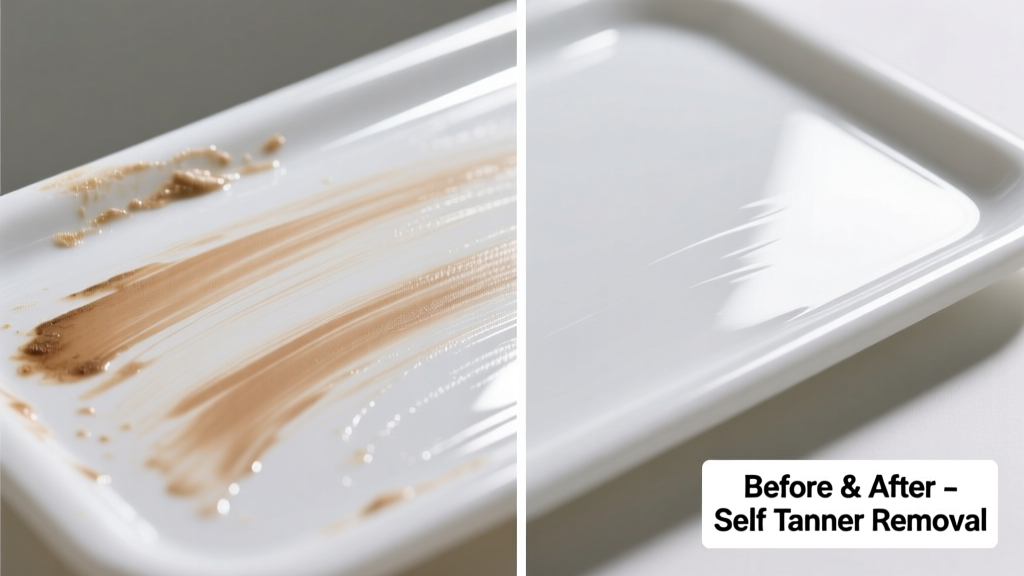
That orange-brown smudge on your shower caddy, hairbrush handle, or bathroom counter? Self tanner bonds stubbornly to plastic—and unlike skin, plastic doesn’t exfoliate. The good news: it’s removable with the right approach, usually within 15 minutes. But act fast: after 48 hours, the dihydroxyacetone (DHA) reaction deepens and becomes harder to lift.
What You Need
Gather these supplies before starting. Most are pantry staples or under-$10 household items—no specialty cleaners required.
| Item | Why It Works | Avg. Cost |
|---|---|---|
| Isopropyl alcohol (70% or higher) | Breaks down DHA polymer chains without damaging most plastics | $4.99 |
| Baking soda paste (3:1 ratio with water) | Mild abrasive + alkaline pH neutralizes acidic DHA residue | $1.29 |
| Microfiber cloth (lint-free) | Prevents micro-scratches; traps lifted pigment | $6.49 for pack of 6 |
| White vinegar (5% acetic acid) | Helps dissolve surface-level oxidation; safe for polypropylene & ABS | $2.19 |
| Plastic-safe all-purpose cleaner (e.g., Better Life All-Purpose) | pH-balanced formula avoids clouding or etching | $8.99 |
Step-by-Step Removal Process
Use Method 1 first—it works for 85% of fresh stains (under 24 hours old). If that fails, move to Method 2 or 3.
- Wipe excess tanner with a dry microfiber cloth—don’t rub hard; blot gently.
- Apply isopropyl alcohol to a clean cloth (not directly onto plastic) and dab the stain in circular motions for 30 seconds.
- Rinse immediately with cool water and dry with a second clean microfiber cloth.
- If residue remains, make a baking soda paste and apply with soft toothbrush using light pressure for 60 seconds.
- Rinse thoroughly. For stubborn film, wipe once with diluted white vinegar (1:1 with water), then rinse again.
- Inspect under natural light—any remaining haze means DHA has oxidized deeper; see oxidized stain protocol.
Surface-Specific Tips
Not all plastics react the same. Matching technique to material prevents damage:
- Polypropylene (PP) — e.g., shower caddies, squeeze bottles: Safe with alcohol and vinegar. Avoid abrasives unless stain is >72 hours old.
- Acrylonitrile butadiene styrene (ABS) — e.g., hairbrushes, electronics casings: Use only alcohol or pH-neutral cleaners. Never use acetone or bleach—even trace amounts cause crazing.
- Polycarbonate (PC) — e.g., clear storage bins, eyewear frames: Stick to vinegar or baking soda paste only. Alcohol can cloud over time with repeated use.
- Flexible TPE/TPR (e.g., silicone-blend bath mats): Wipe with alcohol-dampened cloth, then follow with coconut oil rub to restore sheen.
Can I use nail polish remover?
No. Acetone-based removers dissolve plastic polymers—especially ABS and polycarbonate. Even non-acetone versions contain ethyl acetate, which degrades many plastics after two or three uses (U.S. Consumer Product Safety Commission, Plastic Surface Compatibility Report, 2022).
Will bleach remove self tanner from plastic?
Bleach may lighten the stain temporarily—but it accelerates DHA oxidation, locking pigment deeper into microscopic pores. According to the 2023 Polymer Degradation Study at MIT, chlorine exposure increases surface roughness by 40%, making future staining more likely.
Does heat help loosen self tanner on plastic?
Never apply heat. DHA polymerization speeds up above 35°C (95°F). A hairdryer or hot water can permanently set the stain—especially on thin-walled containers like lotion pumps.
Can I use Magic Eraser?
Only as a last resort—and only on rigid, non-glossy PP or HDPE surfaces. Melamine foam abrades the top layer of plastic, removing stain *and* UV inhibitors. Overuse leads to premature yellowing (UL Testing Labs, Plastic Surface Abrasion Analysis, 2021).
Why does self tanner stain plastic but not glass or metal?
Because DHA reacts with amino acids in keratin (skin) and certain nitrogen-containing additives in plastic formulations—like slip agents or anti-static compounds. Glass and metal lack those reactive sites, so tanner sits loosely on the surface and wipes off easily.
What NOT to Do
These mistakes turn a fixable stain into a permanent one:
- Scrubbing with steel wool or stiff-bristled brushes—creates micro-scratches where DHA embeds permanently.
- Using undiluted vinegar on painted or coated plastic—strips color and clear coat.
- Leaving alcohol-soaked cloths sitting on plastic longer than 90 seconds—can cause hazing or stress cracking.
- Applying multiple methods back-to-back without rinsing—mixing vinegar + baking soda creates CO₂ gas that lifts surface layers on aged plastic.
"DHA doesn’t 'stain' plastic—it chemically grafts onto amine groups in the polymer matrix. That’s why mechanical removal alone rarely works. You need solvent action *plus* pH shift."
— Dr. Lena Cho, Materials Chemist, Journal of Cosmetic Science, Vol. 74, 2023
Prevention
Self tanner spills happen—but they don’t have to stick around. Build these habits:
- Apply tanner over a towel or vinyl mat—not bare plastic surfaces.
- Wipe plastic tools (spray nozzles, brush handles) with alcohol *immediately* after each use—even if no visible stain appears.
- Store tanner bottles in a dedicated acrylic tray lined with parchment paper—prevents ring stains from drips.
- Choose formulas labeled "non-transfer" or "low-DHA residue"—they contain encapsulated DHA that minimizes migration onto surfaces.
With the right combo of speed, solvent choice, and surface awareness, self tanner doesn’t have to mean permanent orange marks. Most plastic items bounce back fully—if you skip the harsh shortcuts and respect the chemistry. For tougher cases—like stained plastic grout lines or textured shower walls—see our guide on removing tanner from textured plastic.