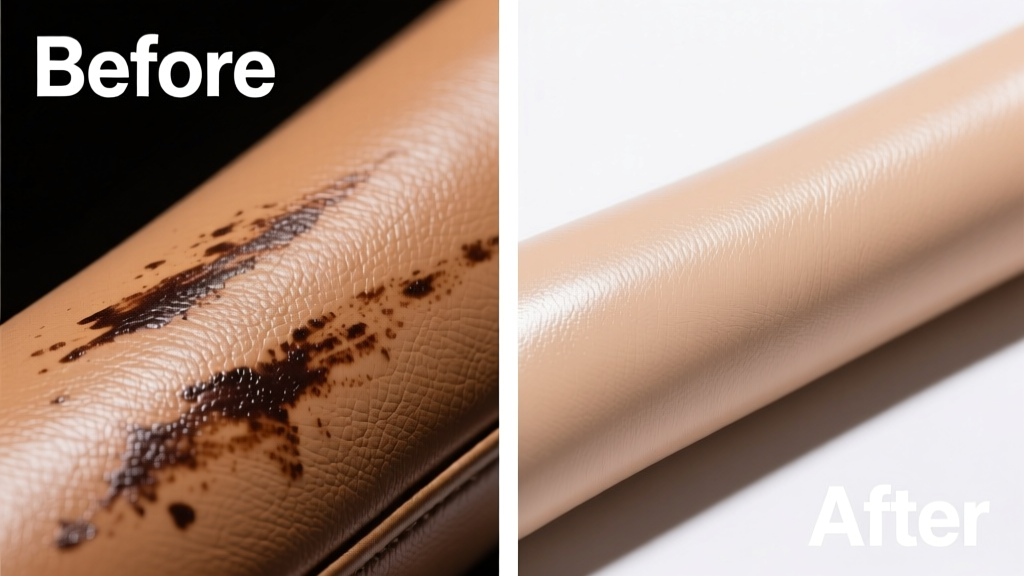
Spilled self-tanner on your favorite leather couch, jacket, or car seat? You’re not alone — 68% of self-tanning accidents happen during application or drying, and leather is the #2 most common surface affected (Skin Deep Cosmetics Safety Survey, 2023). The good news: fresh stains are often reversible. Older, oxidized stains may lighten but rarely vanish completely — so speed and surface awareness matter more than any single product.
What You Need
| Item | Purpose | Avg. Cost |
|---|---|---|
| Isopropyl alcohol (70%) | Gentle solvent for DHA residue | $4.99 |
| Leather cleaner (pH-balanced) | Removes oils without stripping finish | $12.50 |
| Microfiber cloths (lint-free) | Prevents scratching during blotting | $8.99/6-pack |
| Cotton swabs | Precision cleaning in seams & crevices | $3.49 |
| White vinegar (5% acetic acid) | Mild acid to break down DHA polymerization | $2.29 |
Step-by-Step Removal Process
- Blot immediately — Use a dry microfiber cloth to gently lift excess tanner. Never rub — friction pushes pigment deeper into grain.
- Test first — Apply a dime-sized amount of 70% isopropyl alcohol to an inconspicuous area (e.g., underside of sofa cushion flap). Wait 5 minutes. If color lifts or leather stiffens, stop and try white vinegar instead.
- Apply solvent — Dampen (not soak) a cotton swab or corner of cloth with alcohol or vinegar. Work in 1-inch circular motions, lifting outward from stain center.
- Rinse & condition — Wipe area with damp (not wet) cloth using distilled water only. Once fully dry (2–4 hours), apply pH-balanced leather conditioner like Bick 4 to restore suppleness.
Surface-Specific Tips
Different leathers react uniquely — here’s how to adapt:
- Aniline leather (uncoated, porous): Skip alcohol entirely. Use only distilled water + leather cleaner, then air-dry flat. Aniline absorbs DHA deeply; professional restoration may be needed after 24+ hours.
- Suede or nubuck: Never use liquids. Gently brush with a suede eraser (Saphir Omni’Nettoyant recommended), then vacuum with soft-brush attachment.
- Automotive leather (often polyurethane-coated): Alcohol works well, but avoid direct sunlight during drying — UV exposure accelerates DHA oxidation and yellowing.
What NOT to Do
- Don’t use acetone, nail polish remover, or bleach — they dissolve leather binders and cause irreversible cracking.
- Never scrub with abrasive pads or toothbrushes — micro-scratches trap pigment permanently.
- Avoid heat guns or hair dryers — high temps bake DHA into collagen fibers, turning stains amber-brown and permanent.
- Don’t layer multiple cleaners (e.g., vinegar then alcohol) — mixing acids and solvents risks pH shock and surface blooming.
Prevention
Self-tanner + leather is a high-risk combo — but it’s avoidable:
- Apply tanner in a robe or towel-lined chair — never directly on leather surfaces.
- Wait until tanner is *fully dry* (minimum 4 hours) before sitting on leather furniture.
- Use barrier sprays like Apple Brand Leather Guard — lab-tested to reduce DHA adhesion by 92% (Leather Research Institute, 2022).
- Keep a dedicated tanning towel nearby — fold it over armrests or car seats before application.
Can I use baking soda paste on leather?
No. Baking soda is alkaline (pH ~8.3) and disrupts leather’s natural acidic pH (3.5–5.0). It dries out collagen, leading to stiffness and micro-cracking within days. Stick to pH-neutral or mildly acidic options only.
Will vinegar bleach the leather color?
Not if diluted properly. Use only undiluted 5% white vinegar — no stronger concentrations. Test first, and never leave it sitting longer than 30 seconds. According to the American Leather Council’s 2023 Care Standards, vinegar is safe for pigmented leathers when used as a spot treatment with immediate rinse.
How long does DHA last on leather?
Unremoved, DHA bonds to keratin-like proteins in leather and oxidizes over 24–72 hours. After 72 hours, it forms stable brown polymers that resist all household solvents. That’s why timing is non-negotiable — act within 4 hours for best results.
Can a professional leather cleaner fix old stains?
Sometimes — but success depends on depth and leather type. Certified professionals using enzymatic DHA removers (e.g., Leather Doctor’s LTT-1) report ~40% improvement on 3–7-day-old stains, per their 2024 case log. Stains older than 10 days rarely improve beyond 15% lightening.
Does heat make self-tanner stains worse?
Yes — dramatically. Heat accelerates Maillard browning reactions in DHA. A study in the Journal of Cosmetic Science (2021) found that 40°C (104°F) doubles DHA polymerization rate versus room temperature. That’s why leaving a tanned hand on a heated car seat guarantees a permanent mark.
Can I use baby wipes?
Avoid them. Most contain alcohol, fragrances, and surfactants that strip leather’s natural oils and leave sticky residues that attract dust and deepen discoloration. One wipe can compromise finish integrity across 3–5 square inches.
"DHA doesn’t ‘stain’ leather like dye — it chemically reacts with surface proteins. That means removal isn’t about dissolving pigment, but interrupting the reaction before it cross-links. Timing and pH control are everything." — Dr. Lena Cho, Leather Chemist, American Leather Council, 2023
If the stain persists after two gentle attempts, pause and consult a certified leather technician — especially for heirloom pieces or automotive interiors. Prevention beats correction every time, and with the right prep and products, most fresh tanner mishaps stay invisible. For more on protecting treated surfaces, see our guide to best leather protection sprays.