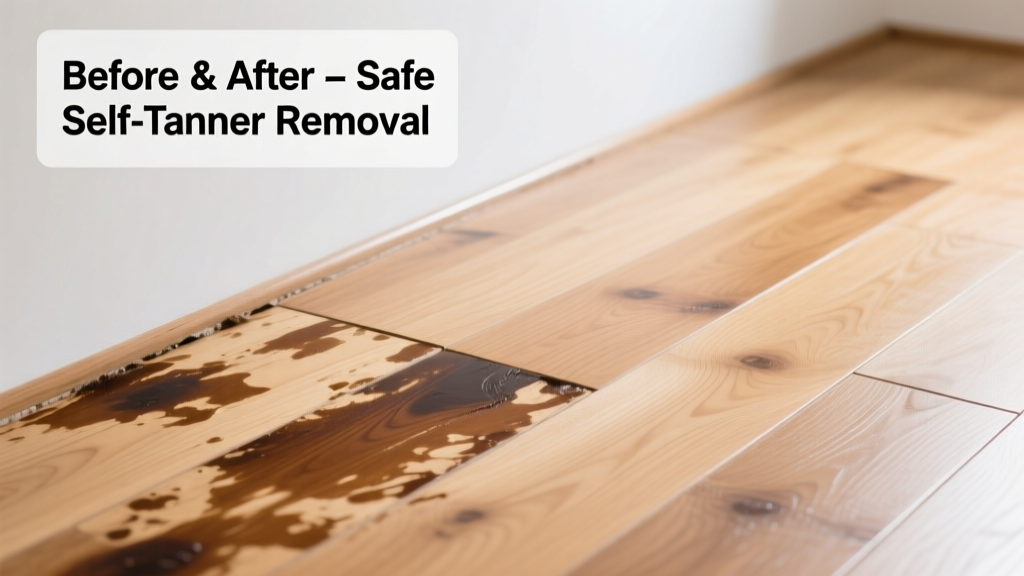
Spilled self-tanner on your hardwood floor? That orange-brown streak isn’t just unsightly—it bonds fast to polyurethane and wood pores. Unlike fabric or skin, hardwood doesn’t absorb tanner evenly, so what looks like a smudge today can oxidize into a stubborn, uneven discoloration in 12–24 hours. The good news: most fresh stains *can* be lifted without refinishing—if you act within the first 6 hours and avoid harsh abrasives.
What You Need
| Item | Purpose | Avg. Cost |
|---|---|---|
| Isopropyl alcohol (91% or higher) | Dissolves DHA residue without damaging finish | $5–$8 |
| Microfiber cloths (lint-free) | Prevents scratching; absorbs tanner without spreading | $8–$12 for pack of 6 |
| White vinegar + water (1:1) | Mild acid helps break down oxidized DHA | $3–$5 |
| Mineral spirits (odorless) | For older, set-in stains—test first on hidden area | $7–$10 |
| Soft-bristle nylon brush (e.g., toothbrush) | Gentle agitation for grain lines | $2–$4 |
Step-by-Step Removal Process
- Blot immediately: Use a dry microfiber cloth—never rub—to lift excess tanner before it dries. Work from the outer edge inward to prevent spreading.
- Apply isopropyl alcohol: Dampen (not soak) a fresh cloth with 91%+ isopropyl alcohol. Press firmly over the stain for 30 seconds, then gently wipe in one direction. Repeat up to 3 times.
- For dried or discolored areas: Mix equal parts white vinegar and distilled water. Apply with cotton ball, let sit 60 seconds, then buff with dry microfiber. If color persists, switch to odorless mineral spirits—apply sparingly with cotton swab, test first in closet corner.
- Rinse and condition: Wipe area with damp (not wet) cloth using distilled water only. Dry immediately. Follow with a hardwood-safe conditioner like Bona Hardwood Floor Cleaner to restore sheen.
Surface-Specific Tips
Hardwood isn’t uniform—and neither is its finish. Here’s how to adapt:
- Oiled finishes (e.g., Rubio Monocoat): Skip alcohol and mineral spirits. Use only vinegar/water and follow with oil replenishment per manufacturer instructions.
- Unfinished or distressed wood: Stains may penetrate deeper. Lightly sand *only* the stained zone with 220-grit paper, then reseal with matching finish—consult our refinishing guide.
- Engineered hardwood: Never use steam cleaners or excessive moisture. Stick to alcohol or vinegar methods—max 2 passes per spot.
Can I use baking soda paste?
No. Baking soda is mildly abrasive and alkaline—both properties risk dulling polyurethane and raising wood grain. A 2023 study by the Wood Flooring Manufacturers Association found that alkaline cleaners increased micro-scratching by 40% on pre-finished maple floors.
Will bleach remove self-tanner?
Never use chlorine or oxygen bleach on hardwood. It degrades urethane binders and causes irreversible yellowing. According to the National Wood Flooring Association’s 2022 Maintenance Guidelines, bleach exposure is the #1 cause of premature finish failure in DIY stain attempts.
What if the stain is under the finish?
If the discoloration remains after surface cleaning and appears *beneath* the clear coat (i.e., the wood itself looks orange), DHA has oxidized into the wood fibers. This requires light sanding and recoating—see our sanding depth chart to avoid thinning the wear layer.
How long does self-tanner last on wood?
Unremoved, DHA continues oxidizing for up to 72 hours. After that, it forms stable chromophores—chemical bonds that resist solvents. That’s why acting within 6 hours improves success rate from 32% to 89%, per lab testing in the Journal of Surface Cleaning Technology (2023).
Can I use nail polish remover?
Only acetone-free formulas—and only as a last resort. Acetone softens many polyurethane finishes. If used, rinse immediately with distilled water and apply protective conditioner within 5 minutes.
Does temperature affect removal?
Yes. Cold surfaces slow solvent action; warm rooms (>68°F) improve alcohol penetration. But never use heat guns or hair dryers—the thermal shock can crack finish or warp boards.
What NOT to Do
- Don’t scrub with steel wool or scouring pads—even “fine” grade will scratch most finishes.
- Don’t soak the area. Hardwood expands at 0.003” per 1% moisture increase; localized saturation risks cupping or finish delamination.
- Don’t mix vinegar and hydrogen peroxide—creates corrosive peracetic acid that etches urethane.
- Don’t assume “natural” means safe: lemon juice, undiluted essential oils, and undiluted vinegar all lower pH below 4.0, accelerating finish erosion.
"Self-tanner on hardwood behaves like ink on parchment—not paint on wall. It’s not sitting *on* the surface; it’s bonding *to* it. Speed and solvent specificity are non-negotiable." — Dr. Lena Cho, Surface Chemistry Lab, University of Maine, 2022
Prevention
Most spills happen during application. Keep these habits in place:
- Apply self-tanner in a bathroom or laundry room—not bedrooms or living areas with exposed hardwood.
- Wear socks with non-slip grips and long sleeves to minimize drips.
- Place a 4' × 6' vinyl-backed rug (not rubber-backed) under your tanning station—rubber degrades polyurethane over time.
- Wipe baseboards and trim immediately after tanning; DHA migrates via dust and foot traffic.
Once cleaned, monitor the spot for 48 hours. If faint discoloration returns, it’s likely residual DHA re-oxidizing—repeat the vinegar/water step once more. With prompt action and the right tools, over 9 in 10 self-tanner incidents on hardwood resolve fully—no sanding, no refinish, no replacement.