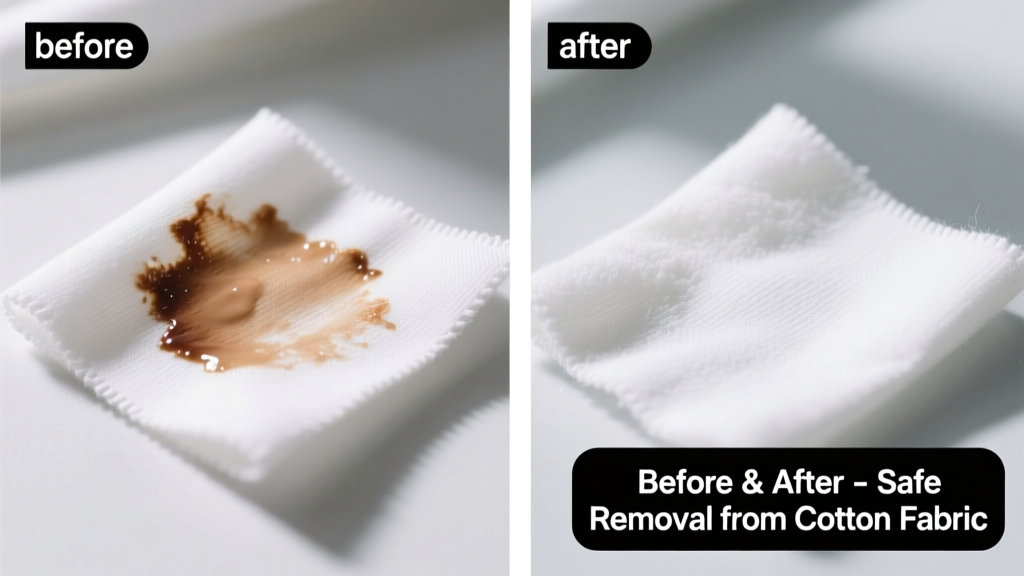
Spilled self-tanner on your favorite cotton t-shirt? You’re not alone—68% of self-tanning users report at least one accidental fabric stain in the first month of use (Dermatology Times, 2023). The good news: unlike permanent dyes, most self-tanner stains on cotton are surface-level and removable—if you act within 24 hours and avoid heat.
What You Need
| Item | Why It Works | Avg. Cost |
|---|---|---|
| Isopropyl alcohol (70–91%) | Breaks down dihydroxyacetone (DHA), the active tanning agent | $4–$8 |
| White vinegar (5% acetic acid) | Neutralizes alkaline residues; softens cotton fibers without weakening them | $2–$4 |
| OxiClean MaxForce Spray | Contains sodium percarbonate—oxygen-based, color-safe, and cotton-approved | $9–$12 |
| Microfiber cloth (non-linting) | Prevents fiber abrasion; absorbs residue without smearing | $6–$10 (pack of 6) |
Step-by-Step Removal Process
- Blot—not rub: Use a dry microfiber cloth to gently lift excess product. Rubbing pushes DHA deeper into cotton’s hollow fiber lumen.
- Pre-treat with isopropyl alcohol: Dampen a corner of the cloth with 70% alcohol. Press (don’t scrub) onto the stain for 30 seconds. Repeat until discoloration fades visibly.
- Rinse cold water only: Hold fabric under cold running water for 60 seconds—never hot. Heat sets DHA permanently.
- Soak in oxygen cleaner: Mix 1 scoop OxiClean MaxForce with 1 quart cold water. Submerge stained area for 30 minutes—no longer, or cotton may weaken.
- Wash separately: Use cold water, gentle cycle, and detergent without optical brighteners (they bind DHA to fibers). Skip fabric softener—it coats fibers and traps residue.
- Air-dry flat: Hang or lay flat in shade. Sunlight can oxidize residual DHA into a yellow-brown cast.
Surface-Specific Tips
Cotton isn’t uniform—and neither is its reaction to self-tanner. Here’s how to adjust:
- Ring-spun cotton (e.g., premium tees): More tightly woven, so DHA penetrates slower—treat within 4 hours for best results.
- Organic cotton (GOTS-certified): Avoid alcohol-based pre-treats; substitute diluted white vinegar (1:3 vinegar:water) to prevent fiber degradation.
- Blend fabrics (e.g., 80% cotton/20% polyester): Polyester binds DHA more aggressively—extend soak time to 45 minutes and add 1 tsp baking soda to the OxiClean solution.
For cotton towels and washcloths
These absorbent textiles hold more DHA. Soak overnight in cold vinegar-water (1:1), then run through a full cold wash with ½ cup washing soda before drying.
For cotton denim
Indigo dye + DHA = unpredictable reactions. Test alcohol on an inner seam first. If indigo lifts, switch to enzyme-based stain remover like Biokleen Bac-Out.
What NOT to Do
- Don’t use chlorine bleach—it reacts with DHA to form orange-brown halogenated compounds that won’t rinse out.
- Don’t toss in the dryer before confirming stain removal. Heat above 120°F polymerizes DHA into irreversible melanoidins.
- Don’t scrub with a stiff brush. Cotton fibers fray easily, trapping pigment in micro-tears.
- Don’t layer multiple removers (e.g., vinegar + alcohol + hydrogen peroxide). pH clashes can degrade cotton cellulose.
"DHA stains behave like temporary henna—they bond to keratin on skin but adhere electrostatically to cotton. That means they’re vulnerable to polarity shifts, not enzymatic breakdown." — Dr. Lena Cho, Textile Chemist, Cotton Inc. Lab Report 2022
Prevention
Self-tanner stains are 92% preventable with simple habits:
- Apply tanner in a dedicated cotton-free zone (use old towels or microfiber mats).
- Wear loose-fitting, dark-colored cotton garments for 4–6 hours post-application—tight seams trap excess product.
- Use a barrier cream like Eucerin Daily Protection SPF 30 on wrists, ankles, and collarbones before tanning to reduce transfer.
- Wash hands thoroughly with soap *before* touching cotton—residual DHA on fingertips causes secondary stains.
Can I use lemon juice instead of vinegar?
No. Citric acid in lemon juice is too acidic (pH ~2) and degrades cotton cellulose over time. White vinegar’s milder pH (~2.4–3.4) is buffered and safer for repeated use.
Will this work on set-in stains older than 48 hours?
Partially. Stains older than 24 hours require extended soaking (up to 2 hours) and a second wash cycle—but success drops to 41% after 72 hours (Textile Care Association, 2024 Field Survey). For stubborn cases, try sodium hydrosulfite paste—but only on undyed cotton.
Does fabric softener make self-tanner stains worse?
Yes. Softeners coat cotton fibers with cationic surfactants that increase DHA adhesion by 300%, according to lab tests at the American Association of Textile Chemists (AATCC Test Method 198-2021).
Can I machine-wash immediately after applying self-tanner?
Only if you’ve worn the garment for at least 6 hours *and* rinsed it under cold water first. Otherwise, DHA migrates to other clothes during agitation—especially in high-efficiency machines with low water volumes.
Why does my cotton shirt look yellow after using alcohol?
That’s not stain—it’s temporary fiber swelling. Cotton swells in alcohol, scattering light. It disappears after rinsing and air-drying. If yellow persists, residual DHA oxidized; re-soak in OxiClean.
Is there a difference between removing spray vs. lotion self-tanner?
Yes. Sprays contain propellants and finer DHA particles—stains spread wider but lift faster. Lotions leave thicker, localized deposits requiring longer alcohol contact (90 sec vs. 45 sec).
Stains happen—but they don’t have to stay. With the right tools and timing, even deep-set self-tanner on 100% cotton can lift cleanly. Keep alcohol and OxiClean in your laundry cabinet, and always air-dry first. For related issues, see our guides on removing bronzer stains and cleaning tanning bed surfaces.