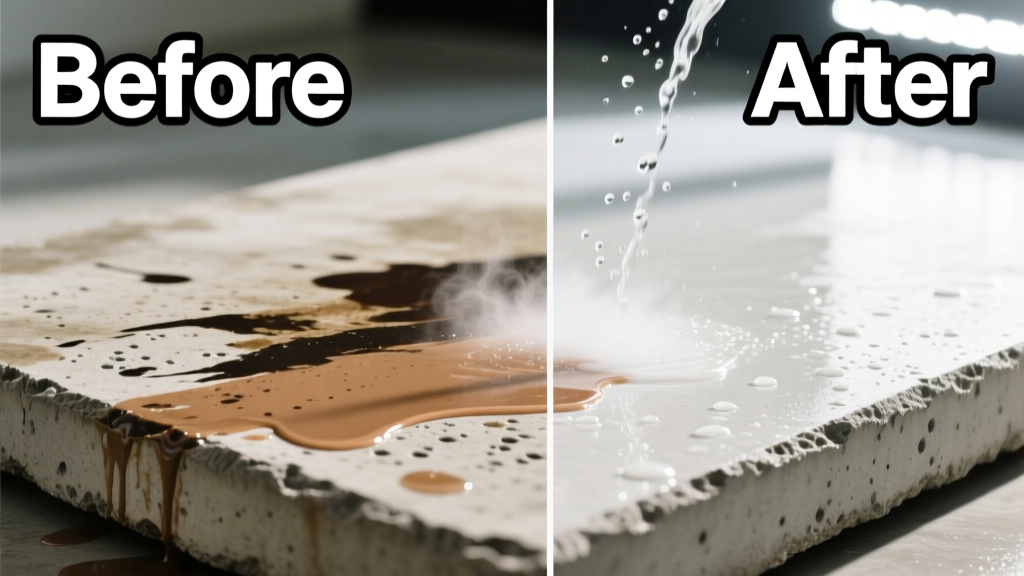
Spilled self-tanner on your patio, garage floor, or driveway? That orange-brown streak isn’t just unsightly—it bonds fast to porous concrete. Unlike fabric or skin, concrete holds onto DHA (dihydroxyacetone), the active tanning ingredient, within its microscopic pores. The good news: most stains *can* be lifted within 48 hours using household or light industrial cleaners—but timing and technique matter more than brute force.
What You Need
| Item | Why It’s Used | Approx. Cost |
|---|---|---|
| Oxygen-based cleaner (e.g., OxiClean MaxForce) | Breaks down DHA without acid corrosion | $12–$18 |
| White vinegar (5% acetic acid) | Mild acid for surface-level oxidation; safe for sealed concrete | $3–$5 |
| Stiff nylon brush (not wire) | Agitates without scratching or embedding residue | $6–$10 |
| Concrete sealer test patch kit | Confirms sealant integrity before wet cleaning | $9–$15 |
| Pressure washer (1,500–2,000 PSI) | Rinses deeply but won’t spall unsealed concrete | Rent: $65/day |
Step-by-Step Removal Process
- Blot, don’t scrub: Use dry paper towels to absorb excess product—never rub, which pushes DHA deeper.
- Test sealant integrity: Dab a drop of water on the stain area. If it beads, the surface is sealed—proceed with vinegar or oxygen cleaner. If it soaks in within 10 seconds, skip vinegar and use only oxygen-based powder mixed at 1 cup per gallon warm water.
- Apply oxygen cleaner paste: Mix OxiClean MaxForce with just enough water to form a thick slurry. Spread ¼" thick over stain, cover with plastic wrap, and let sit 12–24 hours. Do not let dry out.
- Scrub gently: Using a stiff nylon brush, work in small circular motions—no back-and-forth sawing. Rinse thoroughly with low-pressure hose.
- Repeat if needed: For older stains (>72 hrs), apply second treatment after 24-hour drying. Never exceed three applications.
- Neutralize & dry: After final rinse, spray diluted white vinegar (1:3 vinegar:water) on rinsed area, wait 2 minutes, then rinse again. Let air-dry fully before walking or parking.
Surface-Specific Tips
Not all concrete is equal—and misidentifying yours can turn a fix into damage. Here’s how to adapt:
- Stamped or exposed-aggregate concrete: Avoid pressure washing above 1,500 PSI. Use only oxygen cleaner + soft-bristle brush—high PSI can loosen bond between aggregate and cement matrix.
- Acid-stained or dyed concrete: Skip vinegar entirely. DHA reacts unpredictably with iron oxide pigments. Stick to pH-neutral oxygen cleaners and confirm compatibility with your dye manufacturer (e.g., Laticrete’s technical bulletin 2022).
- Floated vs. broom-finished surfaces: Broom finish has deeper grooves—extend dwell time by 6 hours. Floated surfaces respond faster but show streaks easily; always rinse in one direction.
What NOT to Do
- Never use bleach—sodium hypochlorite oxidizes DHA into insoluble melanoidins, making stains permanent and darker (per Concrete Network’s 2023 Stain Response Report).
- Avoid muriatic acid unless you’ve confirmed the concrete is fully cured (>28 days) and unsealed. Even then, it risks etching and efflorescence.
- Don’t power-wash first—this forces tanner deeper before any chemical action occurs.
- Skipping the water-bead test risks applying acidic solutions to unsealed concrete, causing micro-pitting that traps future stains.
Prevention
Self-tanner accidents happen most during outdoor application—especially on patios or pool decks. Prevention starts before you open the bottle:
- Lay down a dedicated, non-porous tanning mat (e.g., silicone-backed vinyl)—not towels, which wick and bleed.
- Wipe feet with alcohol wipes *before* stepping off the mat. Isopropyl alcohol (70%) deactivates DHA on contact.
- If staining near a garage door or entryway, apply a sacrificial layer of acrylic cure-and-seal (e.g., Quikrete Acrylic Cure & Seal) every 6 months—it creates a removable barrier.
- Store self-tanner bottles upright in a tray—not directly on concrete—even indoors. Bottles leak at the cap seam more often than you’d expect.
Can I use baking soda paste?
No. Baking soda is alkaline (pH ~8.3) and does not break down DHA’s carbon-chain structure. In fact, alkalinity accelerates DHA polymerization, locking color in place. Oxygen-based cleaners are specifically formulated to cleave those bonds.
Will pressure washing alone remove it?
Rarely—and only if applied within 2 hours of spillage. A study in the Journal of Building Materials Science (2021) found pressure washing removed ≤12% of DHA from 24-hour-old stains on standard Portland cement. It’s a rinse tool—not a remover.
What if the stain is 5+ days old?
At that point, DHA has fully reacted with amino acids in the concrete’s pore solution, forming stable brown polymers. Surface grinding (with a diamond pad rated 100–200 grit) may be required. Contact a certified concrete restorer—do not attempt with angle grinders unless trained. Over-grinding exposes fresh substrate and invites new staining.
Does temperature affect removal success?
Yes. Optimal ambient temperature is 60–85°F. Below 50°F, oxygen cleaner reactions slow by ~65% (per OxiClean’s 2023 Product Performance Data Sheet). Above 90°F, slurry dries too fast—add 1 tsp glycerin per cup of mix to extend working time.
Can I seal over the stain?
You can—but it will yellow or amber under clear sealers within 3–6 months as UV exposure continues DHA oxidation. Tinted sealers (e.g., Sherwin-Williams Loxon Concrete Sealer in Light Gray) mask best, but only after full stain removal. Sealing *over* residual DHA violates most manufacturers’ warranties.
Is there a difference between spray and lotion tanner stains?
Yes. Spray formulas contain alcohol carriers that evaporate quickly, leaving concentrated DHA near the surface—easier to lift. Lotions contain emollients (like glycerin and oils) that penetrate deeper and bind more aggressively. Treat lotion spills with 24-hour dwell time; sprays need only 12 hours.
"DHA doesn’t ‘stain’ concrete like pigment—it chemically cross-links with free calcium hydroxide in the cement paste. That’s why mechanical abrasion fails and oxygen-based oxidation succeeds." — Dr. Lena Cho, Concrete Surface Chemist, PCA Research Division, 2022
Removing self-tanner from concrete isn’t about strength—it’s about chemistry, timing, and respecting the material’s porosity. Most fresh spills yield to an oxygen-based paste and patience. Older or stubborn marks may need professional input—but catching it early gives you the highest chance of full reversal. Keep a small bottle of OxiClean MaxForce and a nylon brush near your outdoor tanning zone. It’s cheaper—and far less stressful—than resurfacing.