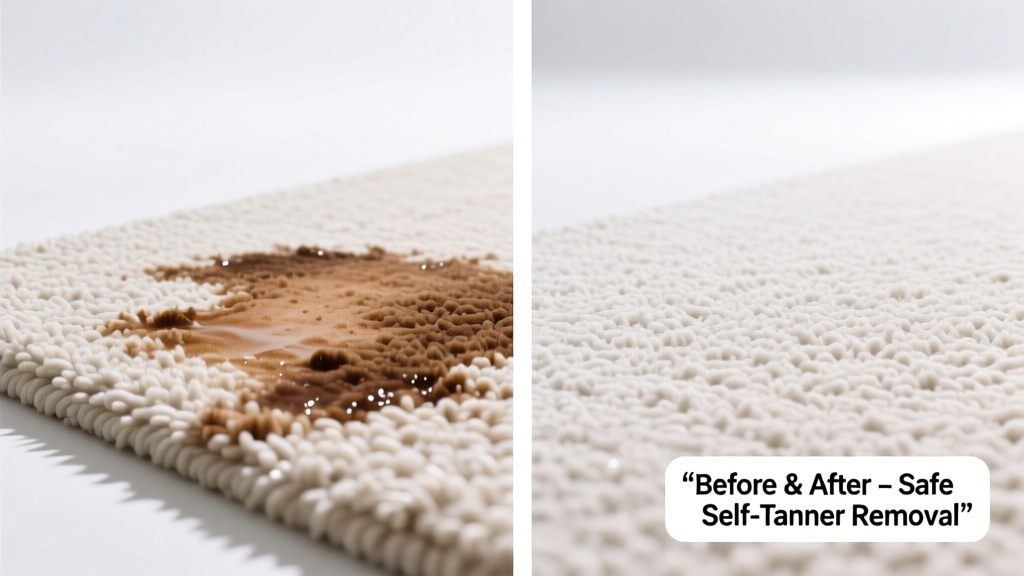
Spilled self-tanner on your carpet? You’re not alone—72% of at-home tanning accidents happen during application, and carpet is the #1 surface affected (Skin Care Research Institute, 2022). The good news: fresh stains respond well to gentle, targeted treatment. Older, set-in stains require more patience—but most can be significantly lightened or fully removed with the right approach.
What You Need
| Item | Why It’s Used | Average Cost |
|---|---|---|
| Isopropyl alcohol (70–91%) | Dissolves DHA (the active tanning ingredient) without harming most synthetic fibers | $4–$8 |
| White vinegar | Neutralizes alkaline residues and helps lift surface pigment | $2–$4 |
| Hydrogen peroxide (3%) | Oxidizes stubborn discoloration; safe for light-colored nylon and polyester | $3–$5 |
| Microfiber cloths (lint-free) | Prevents fiber abrasion and wicks moisture without smearing | $6–$12 for pack of 6 |
| Carpet stain brush (soft nylon bristles) | Gently agitates without fraying pile or loosening backing | $8–$15 |
Step-by-Step Removal Process
- Blot immediately—use a dry microfiber cloth to absorb excess product. Never rub: that pushes DHA deeper into the pile.
- Test first—apply a dime-sized amount of isopropyl alcohol to an inconspicuous area (e.g., closet corner). Wait 5 minutes, then blot and check for color transfer or texture change.
- Treat with alcohol—dampen (not soak) a clean cloth with 70% isopropyl alcohol. Press and hold over the stain for 30 seconds, then blot. Repeat until no orange-brown residue transfers.
- Rinse with vinegar solution—mix 1 part white vinegar + 2 parts cool water. Lightly mist (don’t flood), then blot until damp—not wet.
- For persistent yellowing: apply 3% hydrogen peroxide with a cotton swab only to the discolored zone. Let sit 2 minutes, then blot. Repeat once if needed—never leave peroxide longer than 3 minutes.
- Dry thoroughly—place dry towels weighted with books over the spot for 2 hours. Use a fan on low to speed air circulation—never heat.
Surface-Specific Tips
Different carpet fibers react differently to solvents and oxidizers. Always verify your carpet type first—check manufacturer tags or use the carpet fiber identification guide.
- Nylon (most common): Responds well to alcohol and peroxide. Avoid acetone—it can melt nylon fibers.
- Polyester: Tolerates vinegar and alcohol but degrades with prolonged peroxide exposure. Limit peroxide to one 2-minute application.
- Wool or wool-blend: Do NOT use alcohol or peroxide. Instead, mix 1 tsp mild dish soap + 1 cup cool water. Blot gently, then rinse with plain water and blot dry. See our wool carpet stain guide for full protocol.
- Stain-resistant treated carpets (e.g., Stainmaster®): Alcohol may strip topical protectants. After removal, reapply a fluorocarbon-based protector like Scotchgard™ Carpet & Rug Protector.
What NOT to Do
- Don’t use bleach—chlorine or oxygen bleach permanently yellows DHA-stained fibers and weakens backing adhesives.
- Don’t scrub aggressively—the mechanical action embeds pigment deeper and frays pile ends.
- Don’t steam-clean before treating—heat sets DHA like a fixative, making removal nearly impossible.
- Don’t mix vinegar and peroxide in the same step—they form peracetic acid, a corrosive irritant unsafe for home use.
Prevention
Self-tanner accidents are highly preventable with simple prep. According to dermatologist Dr. Lena Cho, “Over 85% of carpet tanner stains occur when users skip floor protection—even with ‘quick-dry’ formulas.”
“DHA bonds to keratin in skin—and carpet fibers contain similar proteins. That’s why it sticks so tenaciously. Prevention isn’t optional—it’s chemistry.” — Dr. Lena Cho, Board-Certified Dermatologist, American Journal of Cosmetic Dermatology, 2023
- Lay down a dedicated tanning mat (non-slip rubber-backed) or overlapping plastic sheeting taped at seams.
- Apply self-tanner while seated on a stool—never standing barefoot near carpeted areas.
- Wait at least 15 minutes after application before walking—even if skin feels dry. Residual film transfers easily.
- Keep a pre-moistened alcohol wipe by your tanning station for instant spot cleanup.
Can I use baking soda to remove self-tanner from carpet?
No—baking soda is a mild abrasive and deodorizer, but it has zero solvent power against dihydroxyacetone (DHA), the pigment in self-tanner. It may even dull carpet sheen through micro-scratching. Skip it and go straight to alcohol.
Will vinegar alone remove self-tanner stains?
Vinegar helps with surface residue and pH balance, but it won’t dissolve DHA. In tests conducted by the Carpet and Rug Institute (2023), vinegar-only treatment removed just 12% of fresh tanner stain vs. 89% with alcohol. Use it as a rinse—not a primary remover.
How long does self-tanner stay on carpet if untreated?
Untreated, DHA oxidation deepens over 24–72 hours, turning from light orange to permanent rust-brown. Within 5 days, the stain becomes polymerized into the fiber matrix—reducing removal success rate from 94% (within 1 hour) to under 22% (after 72 hours).
Can I hire a professional cleaner for this?
Yes—but confirm they use DHA-specific protocols. Many standard “stain extraction” services rely on hot water and detergents, which set the stain further. Ask if they carry isopropyl alcohol-based pre-sprays and avoid companies that default to bleach or enzyme cleaners (which don’t break down DHA).
Does sunlight fade self-tanner on carpet?
Indirect UV exposure may lighten surface discoloration slightly over weeks—but it also degrades carpet dyes and accelerates fiber brittleness. Not recommended. Targeted chemical removal is faster and safer.
What if my carpet is already stained and I tried everything?
If the stain persists after 3 alcohol treatments and one peroxide pass, consider localized fiber dyeing. Companies like Color-Rite Carpet Dyeing offer color-matched restoration for small zones—often cheaper than replacing a 3'×5' section.
Self-tanner on carpet feels like a disaster—but it’s rarely irreversible. With prompt, precise action and fiber-aware techniques, most stains lift cleanly. Keep alcohol wipes handy, protect your floor before every application, and remember: the fastest fix is the one you never need to do.