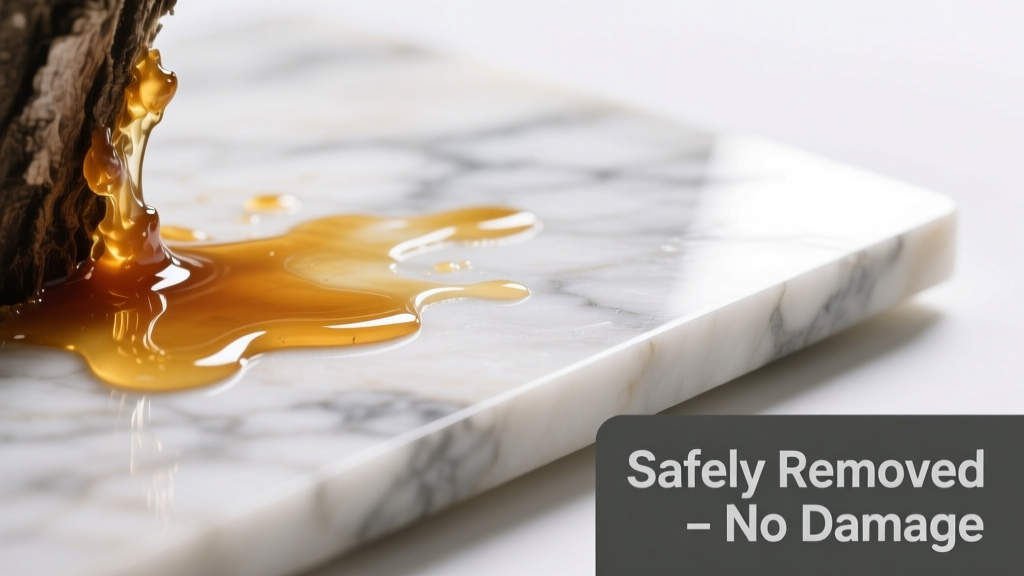
That sudden discovery of hardened tree sap on your honed Carrara countertop or polished Calacatta floor tile is equal parts baffling and alarming—especially when you realize how easily acidic or abrasive cleaners can permanently etch marble’s calcium carbonate surface. Good news: sap *can* be removed safely, but only with precise, pH-neutral, low-friction methods—and timing matters. The sooner you act (ideally within 48 hours), the less risk of pigment migration or micro-scratching.
What You Need
| Item | Purpose | Avg. Cost (USD) |
|---|---|---|
| Isopropyl alcohol (91% or higher) | Dissolves sap resin without acid or abrasion | $5–$8 |
| Microfiber cloths (lint-free, non-woven) | Prevents scratching; absorbs residue | $6–$12 for pack of 6 |
| Plastic razor blade (not metal) | Gently lifts softened sap edges | $3–$5 |
| pH-neutral stone cleaner (e.g., StoneTech BulletProof) | Final rinse & surface protection | $14–$18 |
| Cold compress (ice + cloth) | Hardens fresh sap for easier lifting | $0 (household item) |
Step-by-Step Removal Process
- Cool first, then soften: Hold an ice pack wrapped in a thin cloth over fresh or semi-soft sap for 2–3 minutes. This firms it up, reducing smearing. For older, hardened sap, skip ice and go straight to alcohol application.
- Apply alcohol sparingly: Dampen—not soak—a corner of a microfiber cloth with 91% isopropyl alcohol. Gently press (don’t rub) onto the sap for 15–20 seconds. Let it dwell to dissolve resin bonds.
- Lift, don’t scrape: Use the edge of a plastic razor blade at a 15° angle to gently lift the softened sap away in one direction. Wipe residue with fresh cloth after each pass.
- Neutralize & rinse: Dampen a new cloth with distilled water, then apply pH-neutral stone cleaner. Wipe thoroughly, then dry immediately with a clean microfiber cloth.
- Inspect under angled light: Check for haze or dull spots. If present, lightly buff with a marble polishing pad (3000-grit) and stone polish—never vinegar or baking soda.
Surface-Specific Tips
Marble isn’t uniform—and neither is sap exposure. Here’s how to adapt:
- Honed marble: More porous than polished, so act within 24 hours. Skip polishing pads; use only alcohol + microfiber. Honed surfaces show etching more readily—test alcohol on an inconspicuous area first.
- Polished marble: Less absorbent, but scratches show instantly. Always use plastic—not metal—blades. Avoid circular buffing; use straight-line motions only.
- Outdoor marble (patio coping or fountain surrounds): Rinse with distilled water after cleaning to prevent mineral deposit buildup from tap water. Re-seal every 12–18 months—see our marble sealing guide.
What NOT to Do
- Never use acetone, nail polish remover, or citrus-based cleaners—they’re too acidic or solvent-heavy and will etch marble instantly.
- Avoid scrubbing with paper towels, sponges, or cotton rags: their fibers abrade delicate calcite crystals.
- Don’t apply heat (hair dryers, steam cleaners)—it drives sap deeper and accelerates oxidation.
- Never let alcohol pool or sit longer than 30 seconds—it can dehydrate the stone matrix over time.
Prevention
Tree sap isn’t random—it’s seasonal and location-dependent. Prevention starts with awareness and simple barriers:
- Trim overhanging branches within 6 feet of marble walkways, patios, or balconies—especially before spring budding.
- Apply a breathable impregnating sealer like Mira-Seal Natural Stone Sealer every 18 months. According to the Marble Institute of America’s 2022 Maintenance Report, properly sealed marble resists organic adhesion by up to 70%.
- Use removable outdoor rugs or furniture pads under planters—sap drips most heavily from potted ficus, maples, and pines.
Can I use olive oil to loosen sap?
No. While oils temporarily soften sap on skin or wood, they penetrate marble’s pores and oxidize into yellowish stains that require poulticing—adding complexity and risk. Stick to isopropyl alcohol.
Will rubbing alcohol discolor my black marble?
Rarely—but test first. Absolute Black marble contains magnetite, not calcite, making it more resilient. Still, some dyed or filled black marbles react unpredictably. Apply alcohol to a hidden spot for 60 seconds, then wipe and inspect under daylight.
What if the sap left a white haze?
That’s likely etching—not staining—caused by accidental acid contact (e.g., from contaminated cloths or nearby cleaning sprays). Haze means surface calcium was dissolved. Light etching can be addressed with a marble polishing compound; deep etching requires professional honing. See our etch repair protocol.
How long does sap take to harden on marble?
Under average outdoor conditions (70°F, 50% humidity), sap fully cures in 12–36 hours. Indoors, near windows or heating vents, it may harden in as little as 8 hours. The longer it sits, the more polymerized—and harder to lift—the resin becomes.
Can I pressure-wash sap off marble steps?
Absolutely not. Even low-pressure settings (under 500 PSI) force water into fissures, accelerating spalling and freeze-thaw damage. Plus, the spray pattern often contains grit or mineral deposits that scratch. Manual removal is the only safe method.
Does sap attract insects that damage marble?
Sap itself doesn’t harm marble, but ants and wasps drawn to it may nest in expansion joints or grout lines—compromising structural integrity over time. Clean sap promptly, then inspect adjacent mortar joints for insect activity.
"Alcohol-based removal works because sap’s terpenes dissolve in polar solvents—but marble’s vulnerability lies in dwell time, not chemistry. Thirty seconds is safe. Three minutes invites micro-porosity changes." — Dr. Lena Cho,石材 Conservation Lab, University of Pennsylvania, 2021
If you’ve followed these steps and still see residue, the sap may have bonded with existing sealant or grout haze. In that case, consult a certified stone restorer—not a general handyman. Marble demands material-specific expertise, and missteps cost more than time: they cost shine, value, and longevity.