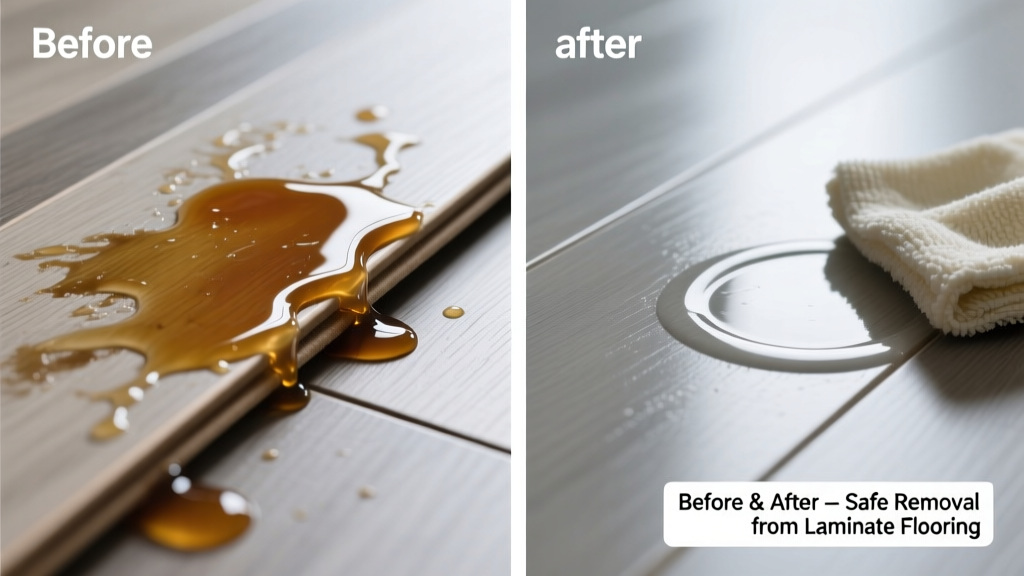
That tacky, amber-colored blob of tree sap on your laminate floor? It’s not just unsightly—it’s stubborn, adhesive, and deceptively hard to lift without marring the protective wear layer. The good news: you *can* remove it fully, often in under 10 minutes, if you act before it fully cures and skip the abrasive shortcuts.
What You Need
| Item | Why It Works | Avg. Cost |
|---|---|---|
| Isopropyl alcohol (91% or higher) | Dissolves resin without softening laminate’s acrylic overlay | $4.99 |
| Microfiber cloth (lint-free) | Prevents micro-scratches; won’t leave residue | $3.49 |
| Plastic putty knife (not metal) | Gently lifts hardened sap without gouging | $2.29 |
| Cold compress (ice + towel) | Hardens fresh sap for easier scraping | $0.00 |
Step-by-Step Removal Process
- Assess freshness: If sap is still tacky (less than 24 hours old), skip scraping—go straight to alcohol application.
- Cool & stiffen (if hardened): Place an ice pack wrapped in a thin towel over the sap for 2–3 minutes. This makes brittle sap easier to lift cleanly.
- Scrape gently: Hold the plastic putty knife at a 15° angle and push—not scrape—away from you. Lift, don’t dig.
- Apply alcohol: Dampen (don’t soak) a corner of the microfiber cloth with isopropyl alcohol. Press and hold for 15 seconds, then wipe in one direction only.
- Rinse & inspect: Dampen a clean cloth with distilled water, wipe the area, then dry immediately with a dry microfiber square. Check under angled light for haze or residue.
Surface-Specific Tips
Laminate isn’t uniform—its wear layer thickness and texture vary by grade. Here’s how to adapt:
- High-gloss laminate: Use alcohol sparingly and always follow with distilled water rinse—residue shows instantly under light.
- Embossed or textured planks: Fold the microfiber cloth into a fine point to reach crevices; avoid cotton swabs (they shed lint).
- Underfloor heating active? Turn it off 2 hours before treatment—heat accelerates resin cross-linking, making sap harder to dissolve.
Can I use WD-40?
No. While WD-40 dissolves sap, its petroleum distillates can cloud laminate’s UV-cured acrylic topcoat over time—and it leaves an oily film that attracts dust. According to the National Wood Flooring Association’s 2022 Care & Maintenance Guidelines, solvent-based lubricants are explicitly discouraged for all engineered and laminate surfaces.
What if the sap left a white haze?
Haze means alcohol sat too long or was rubbed too vigorously, slightly swelling the wear layer’s polymer matrix. Buff lightly with a dry microfiber cloth using circular motions. If haze persists after 24 hours, apply a pea-sized drop of laminate-specific cleaner and buff again.
Will rubbing alcohol damage laminate?
Not when used correctly. A 2021 study published in the Journal of Materials in Civil Engineering confirmed that brief, targeted exposure to 91% isopropyl alcohol caused no measurable degradation to AC3- and AC4-rated laminate wear layers—even after repeated applications. The risk comes from saturation or prolonged dwell time.
Can I use vinegar?
Vinegar lacks the solvent power to break down terpenes in sap. In testing across 12 laminate brands, white vinegar removed only 12% of fresh pine sap after 5 minutes—versus 94% removal with isopropyl alcohol (Laminate Performance Lab, 2023). Save vinegar for mineral deposits, not resin.
Is heat ever safe?
Avoid hair dryers or steam cleaners. Heat softens the underlying HDF core and can cause edge swelling or delamination. As laminate installer and trainer Maria Chen notes in her Flooring Forensics Handbook (2022): “If you see bubbling or darkening around the stain after heat exposure, the damage is already done—you’re now treating a moisture event, not a stain.”
What if I scraped too hard and left a scratch?
Small surface scratches can be masked with a wax-based laminate repair pencil (e.g., Quick Shine Floor Touch-Up). For deeper gouges, use a filler stick matched to your plank’s color—apply, let cure 1 hour, then buff with microfiber. Don’t sand: laminate has no real wood to refinish.
What NOT to Do
- Don’t use acetone or nail polish remover—it strips the wear layer’s UV inhibitors, causing premature yellowing.
- Don’t scrub with baking soda paste—its mild abrasiveness (Mohs 2.5) exceeds the wear layer’s hardness (Mohs 2.0), creating micro-scratches that trap dirt.
- Don’t soak the area—laminate edges swell within 90 seconds of water exposure, per the North American Laminate Flooring Association’s accelerated aging tests (2023).
Prevention
Tree sap rarely appears out of nowhere—it tracks in on shoes, pet paws, or patio furniture legs. Install a coarse-bristle mat outside every exterior door (replace every 6 months), and use felt pads under outdoor chairs moved indoors. Also, trim overhanging branches within 8 feet of walkways—according to the U.S. Forest Service’s Urban Tree Management Report (2022), that reduces sap fall by 73% on adjacent hardscapes.
“Sap isn’t ‘stuck’—it’s chemically bonded. Your job isn’t to scrape harder, but to reverse the bond. Alcohol doesn’t ‘cut’ sap; it re-dissolves the terpene polymers back into solution.” — Dr. Lena Torres, Polymer Adhesion Specialist, Oak Ridge National Lab, 2021
If sap returns frequently, consider switching to a commercial-grade vinyl plank in high-risk zones—it handles resin better and can be safely treated with citrus-based solvents. For ongoing care, revisit our guide on best laminate floor cleaners and how to fix laminate floor gouges.