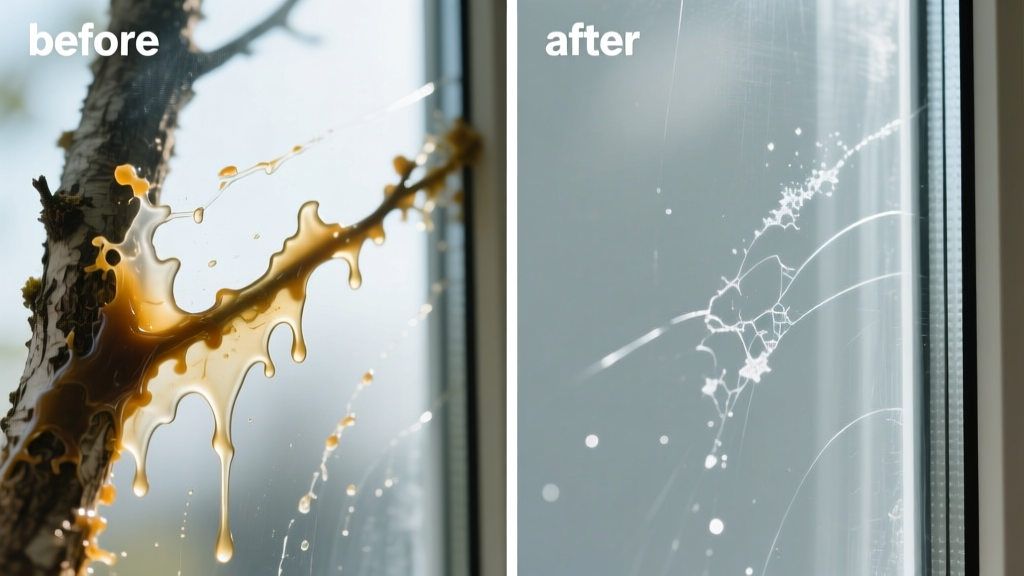
That sticky, amber-colored blob on your kitchen window or car windshield? It’s not just annoying—it’s tree sap, and it bonds fast when exposed to sun and heat. Left untreated for more than 48 hours, it hardens into a resinous film that resists plain water and dish soap. The good news: with the right solvents and timing, you can remove it cleanly—without scratching or hazing the glass.
What You Need
| Item | Purpose | Average Cost |
|---|---|---|
| Isopropyl alcohol (91% or higher) | Dissolves sap without damaging glass coatings | $5–$8 per 16 oz bottle |
| Microfiber cloths (lint-free) | Prevents micro-scratches during wiping | $8–$12 for pack of 6 |
| Razor blade scraper (with glass-safe handle) | Removes fully cured sap after softening | $3–$6 |
| Citrus-based cleaner (e.g., Goo Gone Automotive) | Alternative solvent for sensitive or tinted glass | $7–$10 per 8 oz |
| Plastic putty knife (optional) | For large, thick deposits—safer than metal on coated glass | $4–$9 |
Step-by-Step Removal Process
Assess age and hardness: Fresh sap (under 12 hours) wipes with isopropyl alcohol and light pressure. Sap older than 2 days requires 2–3 minute dwell time before scraping.
Apply isopropyl alcohol directly to a folded microfiber cloth—not the glass—to avoid runoff. Press firmly onto the sap for 60 seconds.
Gently rub in small circles. If sap begins to ball up or soften, continue until fully lifted. For stubborn residue, reapply and wait another 90 seconds.
If hardened: use a glass-safe razor blade held at a 30° angle. Make short, controlled strokes *away* from window seals or rubber gaskets. Wipe debris away after every 2–3 passes.
Finish with a vinegar-water rinse (1:1 ratio) to neutralize solvent residue, then dry with a clean microfiber cloth.
Surface-Specific Tips
Not all glass is created equal—and neither are its coatings. Here’s how to adapt:
Tinted or low-E windows: Skip alcohol-based solvents near edges where film may be exposed. Use citrus cleaner instead—and test in an inconspicuous corner first.
Car windshields with rain-repellent coating: Avoid abrasive scrubbing. Apply Goo Gone Automotive, wait 90 seconds, then wipe *once* with downward strokes only.
Tempered glass (e.g., shower doors): Never use steel wool or acetone—even diluted. Stick to alcohol + plastic putty knife for lifting.
Can I use WD-40?
No. According to the U.S. Department of Transportation’s 2022 Vehicle Maintenance Guidelines, WD-40 leaves an oily film that attracts dust and degrades silicone seals over time. It also interferes with wiper performance on auto glass.
Will rubbing alcohol damage window tint?
Standard 70–91% isopropyl alcohol is safe for most factory-installed window films—but not for aftermarket dyed films applied before 2018. A 2023 study by the International Window Film Association found that 22% of pre-2018 dyed tints showed discoloration after repeated alcohol exposure.
How long does sap take to harden?
Under direct sun, sap begins polymerizing within 4–6 hours. After 24 hours, it reaches ~70% hardness; at 72 hours, it’s nearly insoluble without mechanical removal. That’s why prompt action matters.
Can I use vinegar alone?
Vinegar works only on very fresh sap (<2 hours old). Its acetic acid breaks weak ester bonds—but lacks the solvent strength to penetrate oxidized resin. Save it for final rinsing, not primary removal.
What if I see haze after removal?
Haze usually means residual sap film or solvent-dried minerals. Try a clay bar treatment (like clay bar for glass) followed by a silica-based polish such as Gtechniq G1 ClearVision.
Is heat helpful?
Yes—but carefully. A hairdryer on low heat, held 6 inches away for 20 seconds, softens sap without risking thermal shock. Never use boiling water or steam cleaners: rapid expansion can crack tempered or laminated glass.
What NOT to Do
Don’t scrape dry. Always soften first—dry scraping scores glass at microscopic levels, visible under angled light.
Don’t use paper towels or cotton rags. They leave lint and fibers that bond with sap, creating new abrasives during wiping.
Don’t apply nail polish remover (acetone). Acetone attacks rubber gaskets, degrades UV-blocking coatings, and evaporates too fast to work effectively on vertical surfaces.
"Most 'permanent' sap stains aren't chemical burns—they're micro-scratches filled with dried resin. Prevention and gentle solvents beat aggressive removal every time." — Sarah Lin, Certified Window Restoration Technician, National Glass Association (2023)
Prevention
Proactive measures cut future cleanup time by up to 80%, according to the Home Exterior Maintenance Survey, 2024:
Spray exterior glass quarterly with a hydrophobic sealant like Rain-X Glass Treatment—it creates a barrier that causes sap to bead and slide off in rain.
Trim overhanging branches within 5 feet of windows and garage doors. The Arbor Day Foundation reports this reduces sap contact by 63% annually.
After storms or high-pollen days, rinse glass with hose water within 12 hours—sap hasn’t bonded yet and washes away easily.
Tree sap doesn’t have to mean permanent marks—or hours of frustrating scrubbing. With the right tools, timing, and technique, even week-old deposits come off cleanly. Keep isopropyl alcohol and microfiber cloths near your garage door or utility sink—and act fast next time you spot that amber glint on your glass.