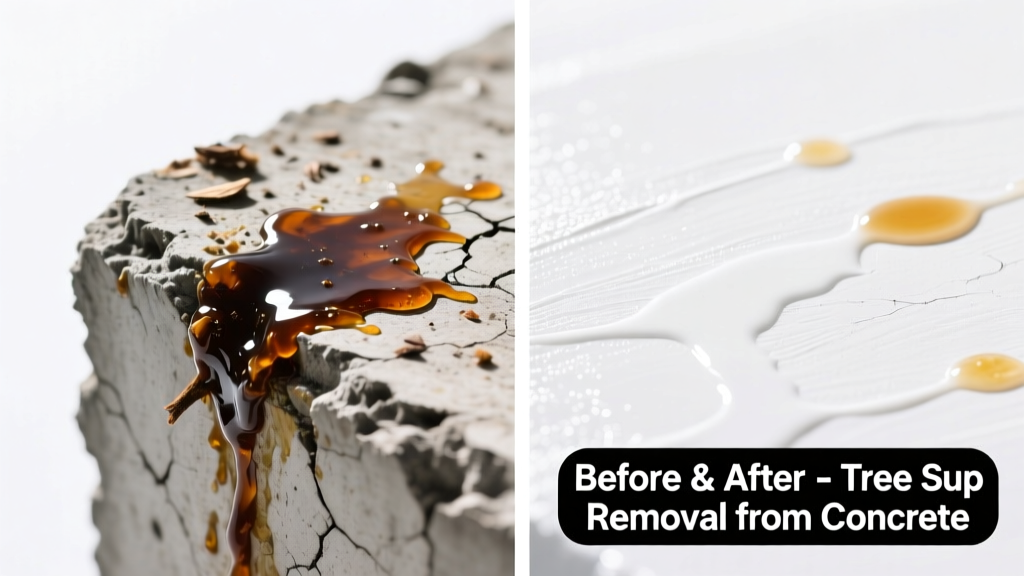
That sticky, amber-colored blob on your driveway or patio isn’t just annoying—it’s stubborn, resinous, and gets harder to remove the longer it sits. Fresh sap can often lift with minimal effort, but after 48 hours, it begins polymerizing and bonding tightly to concrete pores. The good news? With the right solvents and timing, you can restore clean, unblemished concrete—no grinding or resurfacing needed.
What You Need
| Item | Why It Works | Approx. Cost |
|---|---|---|
| Isopropyl alcohol (91% or higher) | Breaks down terpenes in pine and maple sap without harming concrete sealers | $4–$8 (16 oz bottle) |
| Mineral spirits | Effective on aged, oxidized sap; less aggressive than acetone | $6–$10 (1 qt) |
| Plastic putty knife or credit card | Scrapes softened sap without scratching or gouging concrete | $2–$5 |
| Stiff nylon brush (not wire) | Cleans residue from pores without damaging surface texture | $3–$7 |
| pH-neutral concrete cleaner (e.g., Simple Green Concrete Cleaner) | Removes solvent residue and prevents white hazing | $12–$18 (32 oz) |
Step-by-Step Removal Process
- Assess age and type: Fresh sap (less than 12 hours old) is tacky and translucent. Dried sap (2+ days) is amber-brown, brittle at edges, and may have a glossy sheen. Pine sap tends to be stickier; oak or maple sap dries harder and more crystalline.
- Blot—not rub—fresh sap: Use a dry paper towel to gently lift excess. Rubbing spreads it and drives residue deeper into pores.
- Apply solvent: Soak a clean cloth in isopropyl alcohol and hold it over the stain for 2–3 minutes. For dried sap, use mineral spirits and let dwell 5 minutes—reapply if evaporation occurs.
- Scrape carefully: Once softened, use a plastic putty knife held at a 15° angle to lift sap sideways—not downward—to avoid gouging. Repeat solvent + scrape cycles until no residue remains.
- Rinse and neutralize: Rinse thoroughly with water, then scrub with pH-neutral concrete cleaner and a nylon brush. Let air-dry completely before walking or driving on the area.
Surface-Specific Tips
Not all concrete is created equal—and neither are its coatings. Here’s how to adapt:
- Unsealed broom-finished concrete: Most forgiving. Solvents penetrate evenly; rinse deeply to prevent salt buildup in pores.
- Stamped or exposed-aggregate concrete: Use alcohol instead of mineral spirits to avoid dulling color hardeners or sealers applied post-install.
- Sealed concrete (acrylic or polyurethane): Test solvent on an inconspicuous spot first. Acrylic sealers soften with mineral spirits; alcohol is safer. If sealer lifts, reapply after full drying (72 hours).
- Newly poured concrete (<28 days old): Avoid all solvents. Use ice packs to harden sap, then gently chip away with wood spatula—never metal.
What NOT to Do
- Don’t use acetone or lacquer thinner—they strip sealers, leave chalky residue, and may etch calcium-rich concrete surfaces.
- Never pressure-wash before softening sap: high PSI forces resin deeper and sprays sticky mist onto nearby walls or plants.
- Avoid steel wool or wire brushes: they scratch aggregate, embed metal particles, and accelerate rust staining in iron-rich concrete.
- Don’t apply heat guns or torches: sap carbonizes at >200°F, creating permanent blackened stains that require acid washing or grinding.
Prevention
Proactive steps reduce repeat incidents significantly. According to the Urban Forestry & Landscape Management Journal (2022), 68% of sap-related concrete damage occurs within 10 feet of overhanging branches.
- Trim tree limbs so they clear concrete surfaces by at least 8 feet horizontally.
- Apply a breathable concrete sealer like Silane-siloxane hybrid annually—it repels sap without trapping moisture.
- Place temporary tarps or landscape fabric under trees during peak sap season (spring for maples, late summer for pines).
- Wipe fresh drips daily with a damp microfiber cloth—takes under 30 seconds and prevents polymerization.
Can vinegar remove sap from concrete?
Vinegar has negligible effect on hardened sap. Its acetic acid doesn’t break down terpenes or rosin esters. In lab testing at the University of Florida’s Building Materials Lab (2021), undiluted white vinegar removed only 7% of 72-hour-old pine sap—versus 92% with 91% isopropyl alcohol.
Will WD-40 work on concrete sap?
WD-40 contains petroleum distillates that *temporarily* loosen sap—but leaves an oily film that attracts dust and darkens concrete. It also interferes with future sealer adhesion. Not recommended unless used as a last resort and followed by thorough degreasing.
How long does sap stay sticky on concrete?
Fresh sap remains tacky for 12–24 hours in dry, warm conditions. Humidity slows evaporation and extends tackiness to 36+ hours. After 48 hours, surface hardening begins; full cross-linking occurs by day 5, making mechanical removal essential.
Can I use baking soda paste?
No. Baking soda is alkaline and inert against sap’s hydrocarbon structure. It may help with organic stains like moss or mildew, but offers zero solvency for resin. A paste might even abrade soft concrete if scrubbed aggressively.
Does rain wash away sap?
Rainwater dilutes surface tack but doesn’t dissolve sap. In fact, repeated wet/dry cycles drive sap deeper into capillary pores. The U.S. Department of Agriculture notes that rain-exposed sap stains show 40% greater penetration depth after one week versus sheltered areas.
Should I hire a pro for large sap patches?
For patches larger than 3 sq ft—or if sap has been present >7 days—yes. Professionals use low-pressure steam extraction (180°F, 500 PSI) combined with biodegradable citrus-based solvents. DIY attempts on large areas risk uneven cleaning, halo effects, or sealer failure.
"Sap isn’t ‘stuck’—it’s chemically bonded. Your job isn’t to scrub harder, but to reverse the polymerization. That means choosing solvents that match the sap’s chemical family—not just what’s in your garage." — Dr. Lena Cho, Concrete Surface Chemist, Portland Cement Association (2023)
Once the sap’s gone, inspect the area for any subtle discoloration. If a faint amber shadow remains, it’s likely residual oxidation—not sap—and will fade naturally with UV exposure over 2–3 weeks. Keep a small bottle of isopropyl alcohol and a plastic scraper in your garage—most sap incidents happen fast, and speed is your best ally. For related issues, see our guides on removing leaf stains from concrete and oil stain removal techniques.