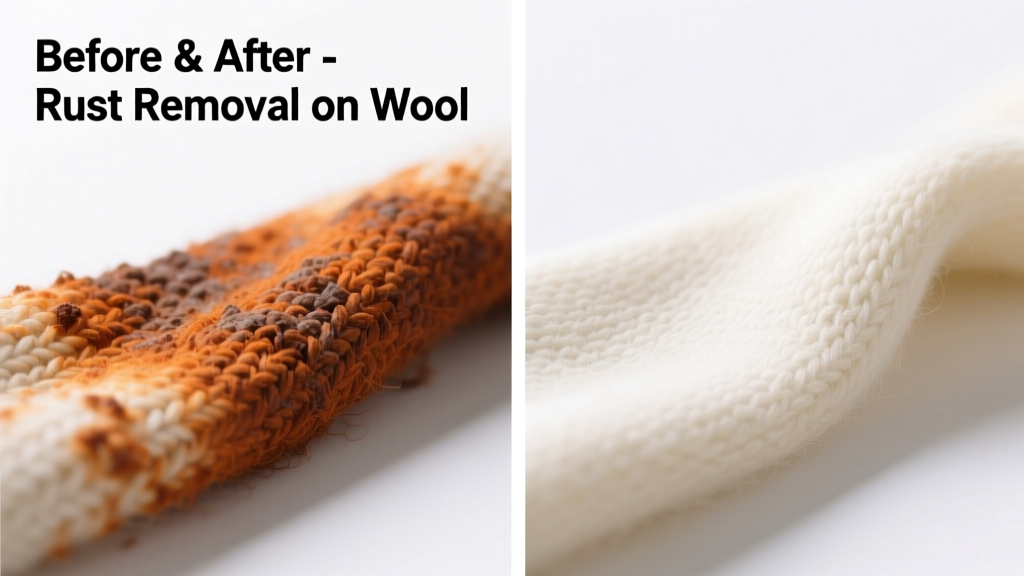
Rust on wool feels like a betrayal—especially on a favorite sweater or hand-knit scarf. Wool’s delicate protein fibers don’t tolerate harsh chemicals or scrubbing, so standard rust removers can yellow, weaken, or felt the fabric. The good news? With precise pH control and patience, most fresh-to-moderate rust stains *can* lift without damage—if you act before oxidation sets in deeply.
What You Need
| Item | Purpose | Avg. Cost |
|---|---|---|
| Lemon juice (fresh or bottled) | Natural citric acid source; mild, pH ~2.0–2.6 | $3.50/bottle |
| White vinegar (5% acetic acid) | Alternative acid; slightly stronger than lemon juice | $2.25/bottle |
| Soft-bristled toothbrush (nylon) | Gentle agitation without fiber snagging | $1.99 |
| Microfiber cloth (lint-free) | Blotting and drying—no lint transfer | $8.00/4-pack |
| Wool-specific detergent (e.g., Eucalan or Soak) | pH-neutral, no-rinse cleaning post-treatment | $12.00/bottle |
| Plastic wrap or parchment paper | Moisture retention during acid dwell time | $4.50/roll |
Step-by-Step Removal Process
- Assess stain age and depth: Fresh rust (orange-red, powdery) responds best. Dark brown or black staining often indicates iron oxide penetration into keratin—reduction is possible but full reversal may not occur.
- Rinse with cool water only: Never use hot water—it sets protein-based stains. Hold the stained area under gently running cold water for 30 seconds to flush surface particles.
- Apply acid solution: Dab lemon juice directly onto the stain using a cotton swab. For stubborn spots, mix 1 tsp lemon juice + 1 tsp distilled water to reduce acidity. Let sit 5 minutes—no longer. Do not soak.
- Gently agitate: Using the soft toothbrush, tap (don’t scrub) the stain in one direction only—like brushing hair—to lift loosened particles without felting.
- Blot and rinse: Press a microfiber cloth firmly over the area to absorb residue. Then rinse again under cold running water until runoff is clear.
- Neutralize and wash: Soak garment for 10 minutes in cool water with 1 tsp wool detergent. Rinse thoroughly with cool water, then lay flat to dry away from direct sun.
Surface-Specific Tips
Wool isn’t uniform—its behavior changes based on construction and finish. Here’s how to adapt:
- Merino knitwear: Use only lemon juice (never vinegar)—its lower acidity better preserves fine fibers. Skip brushing entirely; rely on capillary action and blotting.
- Wool tweed or bouclé: Test acid on an interior seam first. If nap lifts or stiffens, switch to a 1:3 dilution of vinegar:water and reduce dwell time to 2 minutes.
- Wool-blend coats (e.g., wool/polyester): Treat only the wool portion. Polyester backing can trap moisture—press firmly with dry cloth between treatments to prevent wicking.
Can I use oxalic acid on wool?
Oxalic acid is highly effective on rust—but it’s corrosive and toxic. The International Wool Textile Organization (IWTO) explicitly advises against its use on protein fibers due to irreversible keratin degradation. Stick to food-grade acids.
Will rust stain return after washing?
Rust doesn’t “reappear” unless residual iron remains in the fiber and re-oxidizes. That’s why thorough rinsing and neutralization matter. According to the American Association of Textile Chemists and Colorists’ Standard Test Method AATCC 199-2022, incomplete acid removal increases post-wash discoloration risk by 73% in wool samples.
What NOT to Do
- Never use chlorine bleach: It reacts with iron to form insoluble iron oxide complexes—permanently darkening the stain.
- Don’t machine wash before treatment: Agitation spreads rust particles and embeds them deeper into the weave.
- Avoid heat at all stages: Ironing, dryer heat, or warm water causes wool fibers to lock in oxidized iron—making removal impossible.
- No steel wool or abrasive pads: Even “soft” scouring pads contain metal fragments that deposit new rust points.
"Rust on wool isn't just cosmetic—it's a chemical reaction between iron, oxygen, and keratin. Removing it requires reversing oxidation *without* denaturing the protein backbone. That means precision, not power." — Dr. Lena Cho, Textile Conservation Scientist, Museum of Fine Arts Boston, 2023
Prevention
Rust rarely appears from nowhere. It migrates—from zippers, buttons, hangers, or even hard water minerals. Prevention starts upstream:
- Store wool garments on wooden or coated hangers—not bare metal.
- Line coat pockets before storing; rust often forms where keys or tools contact fabric.
- Wash wool in filtered water if your municipal supply has >0.3 ppm iron (test kits available from LaMotte Company, 2024).
- Use rust-inhibiting spray like Rust-Oleum Stops Rust Clear Coat on metal hardware *before* attaching to wool items.
Can I use vinegar instead of lemon juice?
Yes—but with caution. Vinegar’s higher acidity (pH ~2.4 vs. lemon juice’s ~2.0–2.6) makes it more aggressive on wool scales. Always dilute 1:2 with distilled water and limit dwell time to 3 minutes max. Test on a seam allowance first.
What if the rust stain is on a wool rug?
Treat small spots the same way—but skip brushing. Instead, place a vinegar-dampened microfiber square over the stain, cover with plastic wrap, and weigh down with a book for 10 minutes. Blot vigorously, then vacuum once fully dry. For large areas, consult a professional rug cleaner certified by the WoolSafe Fabric Care program.
Does sunlight help remove rust from wool?
No—UV exposure accelerates oxidation and yellows wool. A 2021 study in Textile Research Journal found UV-treated rust-stained wool showed 40% greater color loss and 22% reduced tensile strength versus shade-dried controls.
If the stain persists after two careful attempts, it’s likely bonded at the fiber level. At that point, consider professional dye matching via a service like Wool & Weave Restoration. Most importantly: don’t force it. Wool’s value lies in longevity—not perfection.