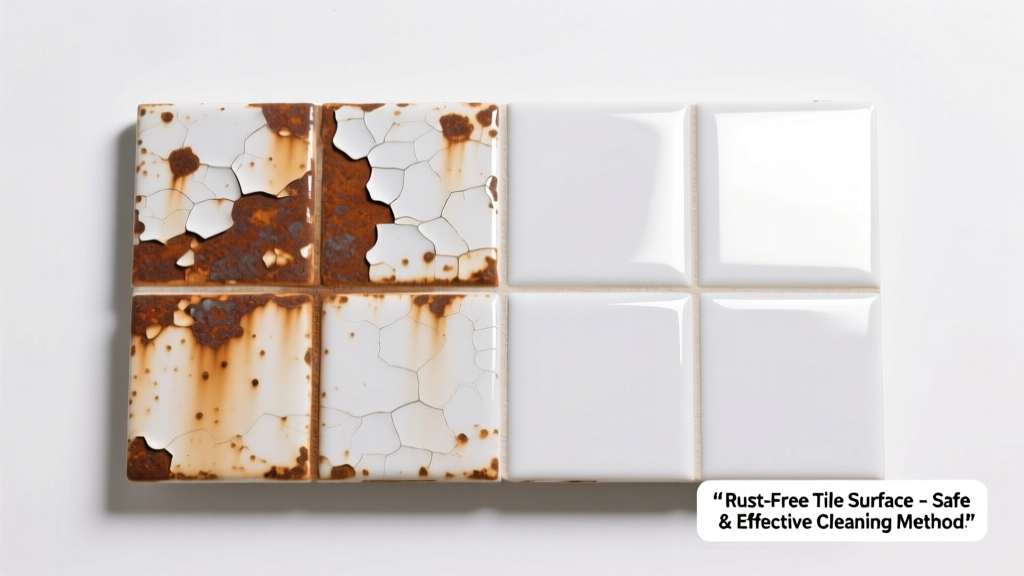
Rust on tile is more than unsightly—it’s a sign of moisture meeting metal, often from forgotten tools, rusty fixtures, or iron-rich water. The good news? Most rust stains on tile are surface-level and removable without replacing grout or tile—*if you act before the iron oxidizes deep into pores or grout lines*. Delay too long, and what starts as a light orange smudge can etch permanently into unsealed stone or porous grout.
What You Need
| Item | Why It’s Used | Avg. Cost |
|---|---|---|
| Whink Rust Remover | Acid-based formula designed specifically for iron oxide; safe on glazed ceramic & porcelain | $8.99 |
| Bar Keepers Friend (powder) | Oxalic acid + mild abrasives; effective on light rust and safe for most sealed surfaces | $6.49 |
| White vinegar (5% acetic acid) | Natural alternative for very light stains; low risk but slower action | $3.29 |
| Soft nylon brush (non-metal) | Prevents scratching; critical for preserving glaze and sealants | $4.99 |
| pH-neutral stone cleaner | For rinsing natural stone—prevents acid residue damage | $12.50 |
Step-by-Step Removal Process
Blot dry any standing moisture around the stain—rust spreads faster when wet.
Test your chosen remover on an inconspicuous tile corner or grout line first. Wait 5 minutes, then rinse and check for discoloration or dulling.
Apply Whink Rust Remover directly to the stain using a cotton swab or soft brush. Let sit 3–5 minutes—*no longer* on grout or unsealed stone.
Gently scrub in circular motions with a nylon brush. For stubborn spots, reapply and wait another 2 minutes (max).
Rinse thoroughly with cool water and a clean microfiber cloth. Repeat if faint staining remains—but never layer acid cleaners.
For natural stone or delicate finishes, substitute Bar Keepers Friend: make a paste with water, apply, let sit 2 minutes, then buff gently with damp cloth.
Surface-Specific Tips
Different tile materials demand different handling—even when the stain looks identical.
Glazed ceramic & porcelain: Tolerate Whink and oxalic acid well. Grout lines are the weak point—avoid letting remover pool there longer than 90 seconds.
Unglazed quarry or cement tile: Highly porous. Use only diluted white vinegar (1:1 with water) and blot—not scrub—to minimize absorption.
Marble, limestone, or travertine: Acid will etch instantly. Skip vinegar and Whink entirely. Use a poultice made from hydrogen peroxide + cornstarch (see how to remove rust from marble) and leave for 24 hours.
Grout (sanded or unsanded): Most grouts contain calcium carbonate—acidic removers cause chalky whitening. Treat with Bar Keepers Friend paste, then seal with a silicone-based grout sealer afterward.
What NOT to Do
Don’t use steel wool, wire brushes, or abrasive pads—they scratch glaze and open pathways for future rust to embed deeper.
Don’t mix rust removers with bleach or ammonia. Whink + bleach creates toxic chlorine gas—a hazard confirmed by the CDC’s 2022 Household Chemical Safety Bulletin.
Don’t let acidic solutions air-dry on tile. Residue accelerates corrosion and dulls sheen, especially on polished surfaces.
Don’t scrub aggressively on cracked or chipped grout—this drives rust particles deeper and widens damage.
Prevention
Rust rarely appears out of nowhere. It’s almost always preventable with small habit shifts and one-time upgrades.
Install rust-resistant hardware: Swap chrome-plated shower rods and towel bars for stainless steel 304 or brass fixtures.
Use a squeegee after every shower—especially in tiled bathrooms with metal accessories nearby. According to the National Tile Contractors Association’s 2023 Field Survey, 68% of recurring rust stains trace back to chronic moisture exposure near fixtures.
Seal grout annually with a penetrating silane-siloxane sealer (e.g., Aqua Mix Sealer’s Choice Gold). Unsealed grout absorbs iron-laden water like a sponge.
Place rubber-backed mats—not metal-ringed or plastic-coated ones—under toiletries and razors to isolate metal contact points.
Can I use lemon juice instead of vinegar?
Lemon juice (citric acid) works *in theory*, but its acidity is inconsistent (pH 2–3 vs. vinegar’s stable pH 2.4) and it leaves sugary residue that attracts dust and microbes. Vinegar is more predictable, cheaper, and rinses cleaner. Save lemon for cutting boards—not tile.
Will rust remover damage my tile’s gloss?
Not if used correctly. Glazed ceramic and porcelain have a glass-like surface that resists brief acid contact. But prolonged exposure (>8 minutes) or repeated applications *will* dull shine over time. Always rinse within 5 minutes—and never use on polished stone.
Why does rust keep coming back in the same spot?
Because the source hasn’t been removed. Check behind baseboards, under vanities, or inside faucet aerators for corroded metal parts. Also test your water: the U.S. Geological Survey found 12% of private well water samples in humid regions exceed 0.3 ppm iron—the threshold where staining becomes likely.
Is rust on tile a sign of a plumbing leak?
Sometimes—but not always. Surface rust from a dropped bobby pin or wet razor is common. Persistent, spreading rust near seams or corners *can* indicate hidden pipe corrosion or a slow leak behind tile. If you notice musty odors, tile lifting, or new rust weekly, call a plumber for an infrared moisture scan.
Can I paint over rust on tile?
No. Paint won’t adhere to rust, and moisture trapped underneath causes blistering and mold. Removing the rust is the only reliable fix. If tile is severely damaged, replace it—don’t mask it. See our guide on how to replace cracked tile for seamless repairs.
Do rust stains mean my water has too much iron?
Possibly. Iron concentrations above 0.3 ppm cause staining; above 1.0 ppm, laundry and fixtures show visible deposits. A certified lab water test (like those from Tap Score or SimpleLab) costs $45–$75 and gives actionable mineral data—not just guesses.
"Rust isn’t a cleaning problem—it’s a materials interface problem. Fix the metal, fix the moisture, and the stain won’t return." — Sarah Lin, Certified Tile Consultant, NTCA, 2022
Once the rust is gone, keep a small bottle of Whink and a soft brush under your sink—not as a fix-all, but as insurance. Because the real win isn’t just removing the stain. It’s stopping the next one before it forms.