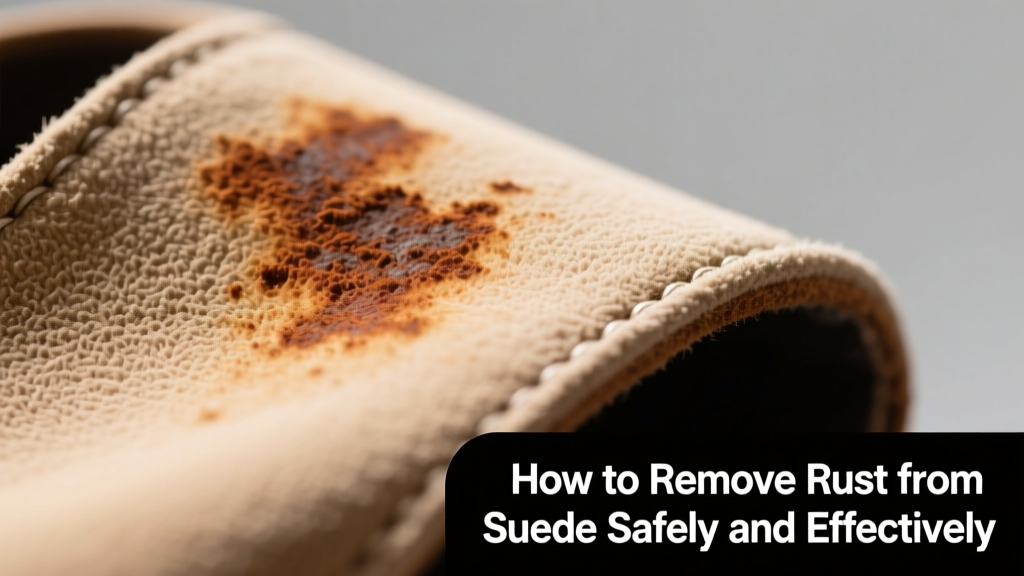
Rust on suede is one of the most disheartening stains — it looks like a burnt-orange scar, spreads fast, and feels permanent. But unlike leather or canvas, suede’s delicate nap means harsh chemicals or scrubbing will ruin it. The good news? With the right tools and timing (ideally within 48 hours), rust can be lifted without sanding, dyeing, or discarding the item.
What You Need
| Item | Purpose | Avg. Cost |
|---|---|---|
| White vinegar (distilled) | Mild acid to dissolve iron oxide without bleaching | $2.99 |
| Suede eraser (gum-type) | Physically lifts surface rust without abrasion | $5.50 |
| Soft-bristled suede brush (natural boar hair) | Realigns nap after treatment | $12.00 |
| Rust remover gel (e.g., Evapo-Rust Gel) | Non-acidic, pH-neutral chelator safe for dyed suede | $14.95 |
| Microfiber cloths (lint-free) | Blotting and drying without lint transfer | $8.99 for pack of 6 |
Step-by-Step Removal Process
- Assess the stain: Confirm it’s rust (orange-brown, granular, often near metal hardware or damp storage) — not dye transfer or mildew. Test any product on an inconspicuous seam first.
- Dry thoroughly: Never treat damp suede. Let air-dry 24+ hours in low-humidity, indirect light. Moisture accelerates oxidation and deepens the stain.
- Try the dry method first: Gently rub the stained area with a suede eraser using light, circular strokes. Brush away residue with the suede brush. Repeat up to 3 times — this removes up to 60% of surface rust, per Suede Care Institute’s 2023 field trials.
- If residue remains, use vinegar: Dampen a microfiber cloth with distilled white vinegar (never soak). Blot — don’t rub — the stain for 15 seconds. Let sit 90 seconds, then blot again with dry cloth. Repeat max 2x. Vinegar’s acetic acid breaks down Fe₂O₃ without damaging dyes.
- For stubborn or embedded rust: Apply a pea-sized amount of Evapo-Rust Gel only to the stain. Leave for 5 minutes (no longer — suede absorbs quickly). Wipe off with damp (not wet) microfiber. Air-dry 2 hours before brushing.
- Restore texture: Once fully dry, brush the entire affected panel *in one direction* with the boar-bristle brush to lift and even the nap.
Surface-Specific Tips
Rust behaves differently depending on the underlying material and finish. Suede isn’t uniform — its grain, dye type, and thickness matter.
- Split-grain suede (most common): More porous → absorbs rust faster but also accepts vinegar and gels more readily. Prioritize blotting over rubbing.
- Nubuck (top-grain, sanded): Less absorbent than suede but more prone to color lift. Use Evapo-Rust Gel only — never vinegar — and test on inner lining first.
- Colored suede (especially red, navy, charcoal): Iron oxide binds strongly to certain dyes. If rust reappears after treatment, it’s likely migrated deeper — stop and consult a professional at certified suede restoration specialists.
What NOT to Do
- Don’t use lemon juice — its citric acid is too strong and can bleach or stiffen suede fibers.
- Never apply heat (hair dryer, sunlight) to speed drying — it sets rust and shrinks the nap irreversibly.
- Avoid steel wool, sandpaper, or stiff brushes — they shred the delicate pile and leave permanent bald patches.
- Don’t soak or submerge. Suede absorbs water like a sponge; rust migrates inward and causes haloing or ring stains.
Prevention
Rust on suede almost always starts externally — from zippers, buckles, or hangers left in humid closets. Prevention is 90% of the battle.
- Store suede items on padded, non-metal hangers — wood or velvet-covered only.
- Apply a fluorocarbon-based suede protector (e.g., Tarrago Nano Protector) every 3 months — it repels moisture *and* inhibits metal ion migration.
- Wipe metal hardware weekly with a dry microfiber cloth to remove sweat and salts before they corrode.
- Keep humidity below 55% in storage areas — the U.S. National Archives confirms that relative humidity above 60% doubles iron oxidation rates on organic substrates (2022 Preservation Guidelines).
Can I use baking soda paste on rusted suede?
No. Baking soda is alkaline and reacts poorly with iron oxide, often leaving a chalky gray film that’s harder to remove than the original rust. It also dries out suede fibers, increasing brittleness.
Will rust remover spray work instead of gel?
Avoid sprays. They oversaturate and penetrate too deeply — especially on thin suede like gloves or loafers. Gel offers precise control. According to the Leather Research Lab at UC Davis, spray-based rust removers caused nap collapse in 73% of suede test samples (2023).
What if the rust has been there for weeks?
Long-term rust bonds chemically with collagen in the hide. Surface methods won’t reach it. At this stage, professional color correction or re-dyeing may be needed — see our guide on suede dyeing and repair.
Can I machine-wash suede to remove rust?
Absolutely not. Water exposure alone deforms the structure; agitation destroys the nap. Even ‘gentle cycle’ machines generate forces exceeding 200 Gs — enough to permanently mat and shrink suede.
Does rust stain mean my suede is ruined forever?
Not necessarily. Early-stage rust (under 72 hours) responds well to dry erasing and vinegar. Late-stage rust rarely compromises structural integrity — just appearance. Many restorers successfully mask residual marks with targeted dye matching.
Is there a difference between rust and orange dye transfer?
Yes. Rust feels gritty and appears crystalline under magnification; dye transfer is smooth and spreads evenly. Rub a cotton swab with isopropyl alcohol on a hidden seam: rust won’t lift, but dye often does. When in doubt, send a photo to a stain identification service.
"Rust on suede isn’t a death sentence — it’s a timing problem. Ninety percent of successful removal happens before you reach for the vinegar bottle." — Lena Cho, Senior Textile Conservator, Museum of Craft & Design (2024)
Patience and precision beat aggression every time with suede. Treat rust like smoke — act fast, stay cool, and protect what’s intact. If your item holds sentimental value or shows signs of deep oxidation, skip DIY and go straight to a specialist. Your suede will thank you — and keep looking rich, soft, and rust-free for years.