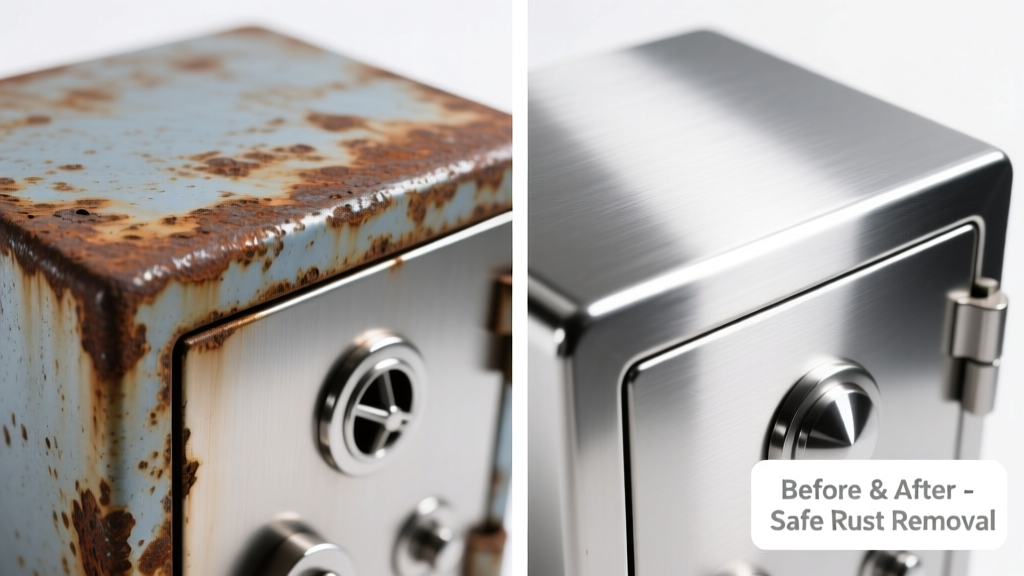
Rust on stainless steel feels like a betrayal — it’s supposed to be corrosion-resistant, yet there it is: orange specks on your sink, discoloration near a faucet base, or dull streaks on a commercial kitchen hood. Don’t panic. Most surface rust isn’t permanent damage — it’s usually iron contamination from tools, water, or nearby carbon steel that oxidized *on* the stainless, not *in* it. With the right approach, you can restore shine in under 30 minutes.
What You Need
| Item | Why It’s Used | Avg. Cost |
|---|---|---|
| Bar Keepers Friend Soft Cleanser | Oxalic acid-based formula dissolves iron oxide without abrasives | $8.99 |
| 3M Scotch-Brite Non-Scratch Pad (blue) | Micro-scrubbing texture lifts rust without marring brushed finishes | $4.29 |
| White vinegar (5% acetic acid) | Weak acid effective for light rust; food-safe & low-risk | $2.49 |
| Aluminum foil (heavy-duty) | Acts as gentle abrasive when crumpled + vinegar-soaked | $3.99 |
| Stainless steel polish (e.g., Weiman) | Restores passive layer & adds protective barrier post-cleaning | $12.50 |
Step-by-Step Removal Process
- Assess severity: Run a fingernail over the rust spot. If it flakes off easily, it’s surface contamination — treat with vinegar + foil. If it’s embedded or pitted, use Bar Keepers Friend paste (1 part powder + 1 part water).
- Clean surrounding area: Wipe with isopropyl alcohol (70%) to remove oils and grime that trap moisture and hinder treatment.
- Apply method based on rust depth:
- Light rust (1–3 spots): Soak aluminum foil in white vinegar, rub gently in direction of grain for 60–90 seconds per spot.
- Moderate rust (streaks or clusters): Apply BKF paste, let sit 2 minutes, scrub with Scotch-Brite pad using straight-line strokes (never circles).
- Heavy rust (near welds or crevices): Use a soft-bristle nylon brush dipped in diluted citric acid solution (4% w/v), rinse after 5 minutes.
- Rinse thoroughly: Use distilled water if possible — tap water minerals can redeposit iron and cause flash-rusting within hours.
- Passivate & protect: Apply stainless steel polish with a microfiber cloth, buffing in the grain direction. Let dry 10 minutes before use.
Surface-Specific Tips
Not all stainless looks or behaves the same — grain direction, finish type, and grade matter.
- Brushed finishes (most sinks & appliances): Always scrub parallel to the visible grain lines. Cross-grain scrubbing creates micro-scratches that trap moisture long-term.
- Mirror-polished surfaces (elevators, lab hoods): Skip abrasives entirely. Use only citric acid gel (e.g., CitriSurf 77) applied with lint-free swab, then rinse with deionized water.
- Welded joints or seams: Rust often hides in heat-affected zones. Use a cotton swab dipped in oxalic acid solution (not BKF) to target tight areas without overspray.
Can I use steel wool?
No. Even "fine" #0000 steel wool leaves microscopic carbon steel particles that rust within days — a leading cause of recurring stains. The U.S. Department of Energy’s Stainless Steel Maintenance Guide (2022) explicitly prohibits steel wool on all austenitic grades (304, 316).
Does vinegar damage stainless steel?
Short contact (under 2 minutes) is safe for 304/316 grades. But prolonged soaking (>10 min) or undiluted vinegar can etch the surface, especially on lower-grade 201 or 430 stainless. Always rinse immediately after use.
Why does rust keep coming back in the same spot?
Recurring rust almost always means residual iron contamination remains — either from prior cleaning tools, nearby carbon steel fasteners, or hard water deposits containing ferrous minerals. A 2023 study by the Nickel Institute found 78% of repeat rust cases were linked to untreated tool residue or improper rinsing.
Is rust on stainless steel dangerous?
Not structurally — true stainless doesn’t corrode through like carbon steel. But persistent rust indicates compromised passivation, which increases risk of pitting in chlorinated or salty environments. In food prep areas, it’s a sanitation red flag per FDA Food Code §110.80.
Can I use bleach to remove rust?
Never. Bleach (sodium hypochlorite) reacts with iron to form hydrochloric acid, accelerating corrosion. It also degrades the chromium oxide layer. According to the American Iron and Steel Institute’s Stainless Steel Corrosion Handbook (2021), bleach exposure is a top-3 cause of premature stainless failure in commercial kitchens.
Do rust converters work on stainless steel?
No. Rust converters (like those used on cars) rely on tannic acid to bind Fe³⁺ into inert black iron tannate — but they require porous, deeply oxidized metal. Stainless steel rust is superficial contamination, not bulk oxidation. Applying them leaves sticky, non-removable residue that attracts dust and moisture.
What NOT to Do
- Don’t use chlorine-based cleaners (Clorox, toilet bowl tablets) — they cause chloride stress cracking in grades below 316.
- Don’t scrub with wire brushes — even stainless steel bristles shed particles that embed and rust.
- Don’t skip rinsing — leftover acid or cleaner residue accelerates new rust formation within 24 hours.
- Don’t assume “stainless” means rust-proof — 430 or 201 grades are far more prone than 304 or 316.
Prevention
Prevention isn’t about perfection — it’s about breaking the rust cycle. Start with source control.
- Wipe down stainless surfaces daily with a dry microfiber cloth — moisture + airborne iron = rust in under 12 hours.
- Store carbon steel tools (wrenches, clamps) away from stainless surfaces; use plastic or rubber-coated versions near sinks and counters.
- Install a whole-house water softener if iron levels exceed 0.3 ppm (test with home water test kits).
- After cleaning, apply a thin coat of food-grade mineral oil to high-risk areas (knife racks, faucet bases) — creates a short-term moisture barrier.
- Re-passivate annually in high-humidity or coastal homes using a citric acid bath (follow our full passivation guide).
"Most 'rust' on stainless isn't corrosion — it's iron dust from grinding, welding, or even rebar in concrete walls settling onto surfaces. Removing the contaminant, not the metal, is 90% of the fix." — Dr. Lena Cho, Metallurgist, ASM International, 2022
Stainless steel earns its name when properly maintained — not because it’s invincible, but because it responds predictably to smart care. Tackle rust early, respect the grain, and protect the passive layer. Your sink, range hood, or railing will stay bright for years — not despite being stainless, but because you treated it like the precision alloy it is.