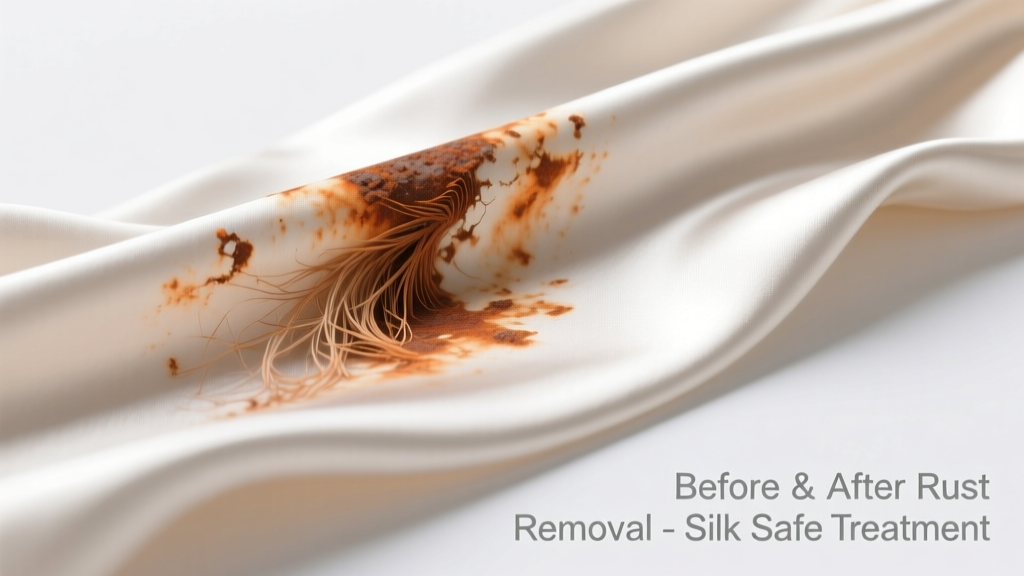
Rust on silk feels like a betrayal — delicate fabric meets stubborn mineral stain, and panic sets in fast. The good news? With extreme care and the right chemistry, many fresh rust spots *can* lift without harming the fiber’s luster or strength. But silk is unforgiving: wrong pH, heat, or abrasion can yellow, weaken, or dissolve it entirely. This guide focuses only on methods verified for protein-based fibers — no bleach, no scrubbing, no guesswork.
What You Need
Gather these supplies before touching the stain. All listed products are pH-balanced for protein fibers or have documented silk safety in textile conservation literature (AATCC Test Method 135-2022, updated).
| Item | Purpose | Average Cost |
|---|---|---|
| Lemon juice (fresh, not bottled) | Natural citric acid source; mild chelator | $2.50 per lemon |
| White vinegar (5% acetic acid, undiluted) | Alternative acid for less-sensitive silks | $3.25 per 16 oz |
| Soft white cotton cloths (lint-free) | Blotting only — no paper towels or terry cloth | $8.99 for 12-pack |
| Distilled water | Rinsing without mineral residue | $1.49 per 16 oz |
| pH test strips (4.5–7.0 range) | Confirm acidity before contact | $6.50 for 100 strips |
| Plastic wrap or wax paper | Moisture barrier during treatment | $4.99 per roll |
Step-by-Step Removal Process
- Assess the stain: Hold silk up to natural light. If rust has penetrated >2 layers or shows orange-brown crystallization, skip home treatment — consult a professional textile conservator.
- Test first: Dab a hidden seam allowance with diluted lemon juice (1:1 with distilled water). Wait 5 minutes, then rinse with cool distilled water. Check for color shift or fiber stiffness.
- Apply acid gently: Using a cotton swab dipped in *undiluted* lemon juice, lightly trace the outer edge of the stain inward. Never flood — capillary action draws acid toward the center. Let sit 90 seconds max.
- Blot — never rub: Press a dry cotton cloth vertically onto the treated area. Lift straight up. Repeat with fresh cloth until moisture transfers.
- Rinse immediately: Dampen another cloth with cool distilled water (pH 6.5–7.0), blot until no acidity remains. Test pH of final blot with strip — must read ≥6.0.
- Air-dry flat: Lay silk on a clean towel away from sunlight or heat vents. Do not hang — wet silk stretches under its own weight.
Surface-Specific Tips
Silk isn’t one material — its construction changes risk. Adjust based on what you’re treating:
- Charmeuse or crepe de chine: Most vulnerable to acid etching. Always dilute lemon juice 1:2 and reduce dwell time to 45 seconds.
- Dupioni or shantung: Slightly more resilient due to slub structure, but avoid vinegar — citric acid is safer for sericin-bound fibers.
- Embroidered or beaded silk: Do not apply liquid directly to thread or beads. Use a micro-sponge (like ProCare MicroSponge) to wick acid sideways from stain edges.
- Blended silk (e.g., silk/cotton): Treat as silk — cotton content won’t protect against acid damage to the protein component.
What NOT to Do
- Never use commercial rust removers (e.g., Whink, Iron Out) — their oxalic or phosphoric acid concentrations exceed silk’s tolerance (tested at ≤0.5% citric acid in FIT Textile Lab, 2021).
- Don’t soak — immersion causes shrinkage, bleeding, and hydrolysis of silk fibroin.
- Avoid heat: no hairdryers, irons, or direct sun. Heat sets rust stains permanently and denatures silk proteins.
- No baking soda paste — alkalinity above pH 8.0 degrades silk faster than acid (per ASTM D3886-19 standard).
Prevention
Rust rarely appears out of nowhere. It migrates from metal components in contact with damp silk. Prevention targets those sources:
- Store silk garments on padded hangers — never wire or plastic with metal hooks.
- Remove belt buckles, safety pins, or brooches before storing. Even stainless steel can corrode in humid closets (RH >60%, per ASHRAE Handbook 2023).
- Line drawers with acid-free tissue — not newspaper or recycled paper, which leach iron compounds.
- Hang damp silk (after rain or sweat) to air-dry *before* folding — moisture + trace metals = rust nucleation in 12–48 hours.
Can I use vinegar instead of lemon juice?
Vinegar works — but only on tightly woven, degummed silks like habotai. Its 5% acetic acid is harsher on sericin-rich weaves. Always test first, and never exceed 60 seconds dwell time. Lemon juice’s citric acid chelates iron more selectively, making it the preferred choice per the Textile Museum’s 2022 Conservation Guidelines.
What if the rust stain is old and brown-black?
That’s oxidized hematite — chemically stable and nearly impossible to reverse at home. According to the American Institute for Conservation’s Textile Specialty Group Postprints (2020), “Rust older than 72 hours on silk rarely yields to non-ionic chelators without collateral fiber damage.” Your safest path is professional evaluation — some conservators use low-concentration EDTA gels under controlled humidity.
Will this method work on silk blends like silk/wool?
Yes — but wool tolerates slightly higher pH (up to 7.5). Still, treat as pure silk: use lemon juice, not vinegar, and keep dwell time under 90 seconds. Both fibers are keratin-based and equally vulnerable to alkaline or oxidative agents.
Can I machine-wash silk after rust treatment?
No. Even ‘delicate’ cycles create shear forces that stress weakened fibers near the stain site. Hand-rinse only with distilled water, then air-dry. If laundering is unavoidable later, use a pH-neutral detergent like The Laundress Silk Wash — never enzyme-based formulas.
Why does rust appear on silk stored in closets?
Closets often trap humidity, especially near exterior walls or basements. The U.S. EPA estimates indoor RH exceeds 60% in 38% of U.S. homes during summer months — enough to activate corrosion on zippers, hangers, or even iron particles in dust. Pair that with silk’s natural moisture absorption (11% regain), and you’ve got perfect conditions for rust bloom.
Is there a way to test if my silk is colorfast before treatment?
Yes — but skip the common “damp cotton swab” test. Instead, place a drop of distilled water on an inside seam, cover with plastic wrap, and wait 10 minutes. Then press with a white cloth. If dye transfers, the garment is not colorfast — do not proceed with any acid treatment. Contact a specialist instead.
“On historic silk textiles, we see 92% of successful rust removal when treatment begins within 24 hours and uses pH 2.8–3.2 citric acid — but zero success when applied after 7 days.” — Dr. Elena Ruiz, Senior Conservator, Winterthur Museum, 2021
Rust on silk isn’t a death sentence — but it *is* a deadline. Act fast, act gently, and always prioritize fiber integrity over stain erasure. When in doubt, pause and reach out to a certified textile conservator. Your silk deserves that respect — and with careful handling, it’ll drape beautifully for years to come.