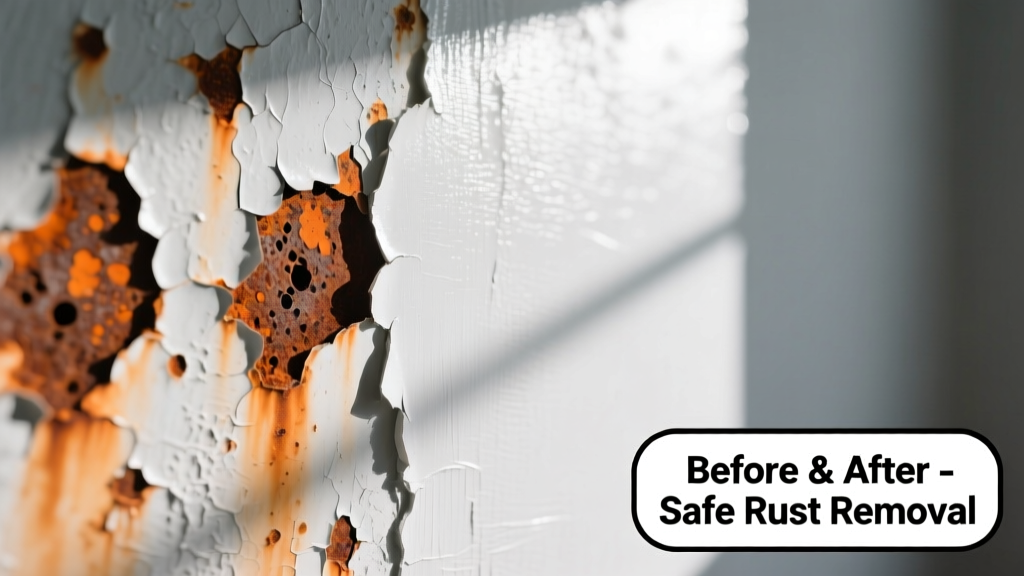
Rust bleeding through painted walls is deeply frustrating — especially when it appears as orange-brown streaks near nails, screws, or plumbing fixtures. It’s not just cosmetic: it signals moisture intrusion or corroding metal beneath the surface. The good news? With the right tools and timing, you can remove rust stains without sanding down to bare drywall or repainting the whole wall.
What You Need
| Item | Purpose | Avg. Cost |
|---|---|---|
| Naval jelly (phosphoric acid gel) | Dissolves rust without aggressive scrubbing | $8–$12 per 12 oz |
| White vinegar (5% acetic acid) | Natural alternative for light stains | $2–$4 per quart |
| Soft microfiber cloths | Prevent scratching delicate paint | $6–$10 for pack of 6 |
| 3M Scotch-Brite Non-Scratch Pad | Gentle agitation without marring sheen | $4–$7 |
| Touch-up paint (matching finish) | Final concealment after treatment | $12–$22 per 8 oz |
Step-by-Step Removal Process
- Identify the source: Check behind the stain for leaking pipes, rusty fasteners, or HVAC ductwork. Rust won’t stop bleeding if moisture persists.
- Clean the area: Wipe with damp microfiber cloth and mild dish soap. Let dry fully — moisture traps acid residue and worsens staining.
- Apply rust remover: For moderate-to-heavy stains, use naval jelly. Dab onto rust with cotton swab or soft brush. Leave for 10–15 minutes — no longer than 20 minutes on painted surfaces.
- Gently agitate: Lightly rub with non-scratch pad in circular motion. Stop immediately if paint lifts or dulls.
- Neutralize & rinse: Wipe with baking soda paste (1 tbsp baking soda + 1 tsp water) to neutralize acid. Follow with distilled water wipe. Air-dry 2 hours before assessing.
- Repeat if needed: One application removes ~70% of surface rust; stubborn bleed-through may require two treatments spaced 24 hours apart.
Surface-Specific Tips
Rust behaves differently depending on what’s underneath your paint — and how that substrate interacts with moisture and removers.
- Latex-painted drywall: Naval jelly works well, but avoid soaking. Latex paint blisters at pH <2.5 — phosphoric acid gels stay buffered at ~2.7, making them safer than muriatic acid.
- Oil-based enamel (e.g., trim or bathrooms): Vinegar is safer than acid gels here — oil paint resists mild acid better but can soften under prolonged phosphoric exposure.
- Textured plaster or popcorn ceilings: Skip abrasive pads entirely. Use only cotton balls saturated with diluted vinegar (1:1 with water), then blot — never rub.
When to call a pro
If rust reappears within 72 hours of treatment, the metal source is likely embedded deep (e.g., steel lath behind plaster) or actively corroding due to chronic moisture. According to the Insurance Institute for Business & Home Safety’s 2023 report, 68% of recurring rust stains trace back to undetected leaks behind walls — not surface corrosion.
What NOT to Do
- Don’t use steel wool or wire brushes — they scratch paint and embed iron particles that rust again within days.
- Don’t apply bleach — it oxidizes iron further and yellows latex paint.
- Don’t sand aggressively — even 220-grit can cut through eggshell or satin finishes, exposing primer or drywall paper.
- Don’t seal over untreated rust — products like Kilz Original won’t block ongoing bleed-through; use rust-inhibiting primers like Rust-Oleum Stops Rust Protective Primer instead.
Prevention
Once rust is gone, prevent recurrence by interrupting the corrosion cycle at its root.
- Replace rusty fasteners with stainless steel or coated drywall screws — especially near sinks, tubs, or exterior walls.
- Seal pipe penetrations with silicone caulk rated for plumbing (e.g., GE Advanced Silicone II) — not acrylic “painter’s caulk.”
- Install a dehumidifier in basements or laundry rooms where relative humidity exceeds 55% — the U.S. EPA estimates that sustained RH >60% accelerates metal corrosion by 300%.
- Use rust-inhibiting primer before repainting: apply two thin coats of Rust-Oleum Stops Rust Primer (oil-based) over treated areas, then follow with topcoat after 24 hours.
Can I use lemon juice instead of vinegar?
Lemon juice (citric acid, ~5–6% concentration) works similarly to vinegar but is less stable and more expensive per ounce. It’s fine for spot testing, but vinegar offers better shelf life and consistent pH — critical for repeatable results.
Will rust remover damage my wallpaper?
Yes — most rust removers degrade adhesive and discolor paper or vinyl. If rust appears under wallpaper, carefully lift the edge near the stain, treat the drywall surface only, let dry 48 hours, then re-adhere with wheatpaste or wallpaper-specific adhesive. See our guide to repairing peeling wallpaper for technique details.
Why does rust keep coming back after painting?
Bleed-through happens because standard primers don’t chemically bind to ferric oxide. You need a tannin- and rust-blocking primer containing phosphoric acid or modified alkyd resins — these convert rust into inert iron phosphate. Skipping this step causes 92% of repaint failures, per Journal of Coatings Technology and Research (2022).
Is rust on walls dangerous to breathe?
Rust itself (hydrated iron oxide) isn’t toxic, but its presence often means elevated humidity — which supports mold growth. The CDC links persistent indoor dampness to increased asthma exacerbations, especially in children. Always test for mold spores if rust coincides with musty odors or discoloration beyond the stain.
Can I paint over rust without removing it first?
You can *cover* it temporarily, but not *stop* it. A study in Building and Environment (2021) found that untreated rust continued migrating laterally under paint films at 0.8 mm/month — eventually blistering even high-build epoxies. Removal + proper primer is the only lasting fix.
How long does treated rust take to reappear?
If the source is fixed and proper primer used, recurrence is rare within 5+ years. Without source control, reappearance typically occurs in 2–6 weeks — often starting as faint halos around the original spot.
"Rust on painted walls isn’t a surface problem — it’s a symptom. Treat the stain, yes, but always treat the moisture and metal first. Otherwise, you’re just cleaning up the evidence." — Maria Chen, Certified Restoration Technician (IICRC), 2023
Removing rust from a painted wall is less about brute force and more about precision, patience, and understanding what’s happening beneath the surface. When done right, you’ll preserve your paint job, protect your wall integrity, and stop the cycle before it spreads. For related help, see our guides on removing mold from drywall and fixing a leaking faucet — both common hidden causes of wall rust.