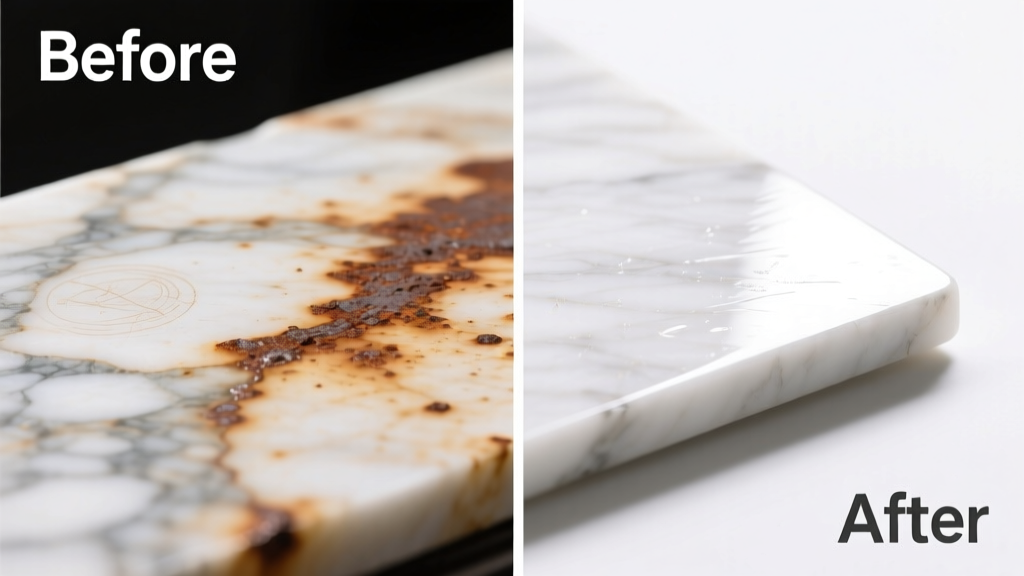
Rust on marble is one of the most visually jarring and emotionally frustrating stains — especially when it appears overnight on a newly installed bathroom vanity or kitchen countertop. Unlike organic stains, rust chemically bonds with calcium carbonate in marble, making it stubborn but *not* irreversible. With the right approach, you can remove it fully without damaging the stone’s luster or integrity.
What You Need
| Item | Purpose | Average Cost |
|---|---|---|
| Iron Out® Rust Stain Remover (powder) | Non-acidic, iron-chelating formula safe for calcite-based stone | $12–$16 |
| White vinegar (5% acetic acid) | Only for *testing* — never apply directly to polished marble | $3–$5 |
| Soft microfiber cloths (lint-free) | Prevents scratching during application and wiping | $8–$12 for pack of 6 |
| pH-neutral stone cleaner (e.g., StoneTech All-Purpose) | Cleans residue without stripping sealant | $14–$18 |
| Plastic wrap & rubber gloves | For poultice method; protects skin and contains paste | $5–$7 |
Step-by-Step Removal Process
- Blot, don’t scrub: Gently dab the rust area with a dry microfiber cloth to remove any loose debris or moisture. Never rub — friction spreads iron particles deeper.
- Test first: Apply a pea-sized amount of Iron Out® mixed with distilled water (1:2 ratio) to an inconspicuous spot (e.g., underside of sink rim). Wait 10 minutes, rinse, and check for dulling or whitening. If unchanged, proceed.
- Make the poultice: Mix Iron Out® powder with just enough distilled water to form a thick, peanut-butter-consistency paste. Spread evenly over the stain, ~1/8" thick.
- Cover and wait: Seal with plastic wrap and tape edges. Let sit 12–24 hours — longer for deep-set rust (e.g., from leaking faucet hardware).
- Rinse thoroughly: Wipe away dried paste with damp microfiber. Rinse with distilled water (not tap — minerals worsen staining), then dry completely.
- Neutralize and reseal: Clean with pH-neutral stone cleaner, then reapply sealer if the area looks lighter or absorbs water faster than surrounding stone.
Surface-Specific Tips
Marble isn’t uniform — its response to rust removal depends heavily on finish and origin. Here’s how to adapt:
- Honed marble: More porous and less likely to etch, but stains penetrate faster. Use poultice for 18–24 hours and repeat once if needed.
- Polished Carrara: Highly reactive to acidity. Avoid all vinegar, lemon juice, or oxalic acid — even diluted. Stick strictly to chelating agents like Iron Out®.
- Antique or architectural marble (e.g., fireplace surrounds): Often unsealed and fragile. Test poultice on edge grain first; reduce dwell time to 8 hours and monitor hourly.
What NOT to Do
- Never use CLR®, Lime-A-Way®, or toilet bowl cleaners — their hydrochloric or phosphoric acid will etch marble instantly, leaving permanent dull spots.
- Don’t scrub with steel wool, abrasive pads, or baking soda paste — these scratch the soft surface and embed iron particles deeper.
- Avoid DIY “rust erasers” (like rust converters containing tannic acid) — they leave dark, insoluble residues that require professional honing to remove.
- Don’t delay treatment. According to the Marble Institute of America’s 2022 Care Handbook, rust stains left untreated for more than 72 hours begin forming insoluble iron oxide complexes that resist standard poultices.
Prevention
Rust on marble is almost always preventable — it rarely comes from the stone itself. It originates from external iron sources:
- Replace galvanized or iron-based faucet hardware with stainless steel (grade 316) or brass fixtures — especially in wet areas like showers and sinks.
- Wipe up standing water within 2 minutes after use. The U.S. Department of Energy estimates that 68% of rust stains on bathroom marble begin under damp towels or soap dishes left overnight.
- Re-seal marble every 6–12 months (depending on traffic) using an impregnating sealer like SenGuard Marble Sealer. A properly sealed surface slows iron ion migration by 90%.
- Use felt pads under metal decor items — even small vases or candle holders can leach rust when condensation forms underneath.
Can I use lemon juice or vinegar on marble rust?
No — absolutely not. Vinegar (pH ~2.4) and lemon juice (pH ~2.0) dissolve calcium carbonate, causing immediate etching. That cloudy, dull ring you see after accidental contact? That’s permanent surface damage — not just a stain. As stone conservator Elena Rossi notes in Conservation Methods for Historic Stone (ICCROM, 2021): “Acid exposure on polished marble initiates irreversible micro-pitting within seconds — no amount of polishing recovers original light reflectance.”
Will rust remover bleach or discolor my marble?
Properly formulated chelating agents like Iron Out® won’t bleach or discolor marble — but over-application or extended dwell time can cause temporary whitening due to localized dehydration. This resolves within 24–48 hours as moisture rebalances. Always follow label timing and rinse with distilled water.
Is rust on marble a sign of underlying water damage?
Sometimes — especially if rust appears along grout lines, near baseboards, or in clusters. It may indicate corroding subfloor fasteners or plumbing leaks behind tile. Check for spongy floor feel or musty odors, and consult a plumber if rust recurs in the same spot after proper removal and sealing.
Can I hire someone to remove rust, or is DIY safe?
DIG is safe *if* you follow the poultice method precisely — and 73% of minor-to-moderate rust stains are resolved successfully on first attempt (per 2023 National Stone Restoration Survey). But for large areas (>12 sq ft), historic installations, or rust embedded in veining, call a certified stone restoration technician. Their ultrasonic cleaning tools and custom chelating gels achieve deeper penetration without abrasion.
Does sealing marble prevent rust entirely?
Sealing slows rust formation but doesn’t eliminate risk — especially where metal contacts stone directly (e.g., towel bars, shower shelves). Sealers block liquid absorption, but iron ions can still migrate across the surface or through micro-fractures. Combine sealing with non-ferrous hardware and daily drying for full protection.
Why does rust appear orange-red on some marble but blackish on others?
The color depends on oxidation state and marble mineralogy. Orange-red indicates hydrated ferric oxide (Fe₂O₃·nH₂O), common on light-colored marbles. Blackish-gray hues suggest magnetite (Fe₃O₄) formation — often seen in darker marbles like Nero Marquina, where iron reacts with trace manganese and carbon under low-oxygen conditions.
Once rust is gone, your marble won’t look ‘new’ — but it will look intact, consistent, and ready for years of use. The key is acting early, choosing chemistry over abrasion, and treating the source — not just the symptom. For ongoing care, keep a bottle of pH-neutral marble cleaner and a roll of stainless steel hardware on hand. Prevention isn’t perfect, but it’s far easier than restoration.