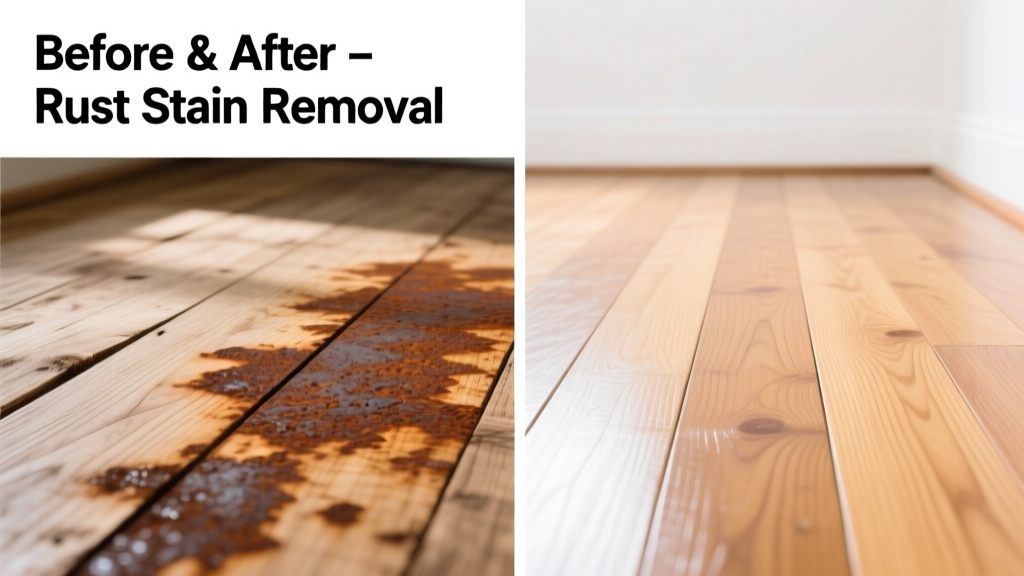
Rust on hardwood isn’t just unsightly—it’s a ticking clock. Left untreated, iron oxide bonds with tannins in oak, walnut, or maple, darkening into permanent gray-black halos. The good news? Most fresh-to-moderate rust stains (under 72 hours) can be reversed without sanding—*if* you act before the metal fully oxidizes into the wood pores.
What You Need
| Item | Purpose | Avg. Cost |
|---|---|---|
| Oxalic acid crystals (e.g., Wood Bleach Pro) | Dissolves iron oxide at molecular level; safest for wood | $12–$18 |
| 0000 steel wool | Gentle abrasion without scratching polyurethane | $4–$6 |
| White vinegar + salt paste | DIY option for light surface rust (not deep-set) | $3–$5 |
| Microfiber cloths (lint-free) | Prevents residue buildup during wiping | $8–$12 for pack of 6 |
| Mineral spirits | Cleans oil residues before reapplication of finish | $6–$9 |
Step-by-Step Removal Process
- Test first: Apply oxalic acid solution (1 tbsp crystals per ½ cup warm water) to an inconspicuous area (e.g., under baseboard). Wait 10 minutes, then wipe dry. Check for color shift or dulling—especially on red oak or stained maple.
- Apply solution: Using a cotton swab or small foam brush, saturate only the rust-stained area. Let sit 5–8 minutes—no longer. Oxalic acid degrades finish if over-applied or left too long.
- Gently agitate: Dampen 0000 steel wool with the same solution and lightly rub *with the grain*. Stop the moment rust lifts—usually within 30 seconds. Never scrub cross-grain.
- Neutralize & rinse: Wipe area with damp (not wet) microfiber cloth soaked in baking soda solution (1 tsp per ¼ cup water). Rinse twice with distilled water to prevent mineral deposits.
- Dry & assess: Air-dry 2 hours minimum. If stain remains faintly amber, repeat once—never more than two applications. Over-treatment raises wood pH and invites future discoloration.
Surface-Specific Tips
Hardwood isn’t one material—it’s a spectrum of density, tannin content, and finish type. Your method must adapt accordingly.
- Unfinished pine or poplar: Skip oxalic acid. Use white vinegar + salt paste (2:1 ratio), cover with plastic wrap, and wait 15 minutes before wiping. These softwoods absorb acids aggressively and may bleach unevenly.
- Oiled finishes (e.g., Rubio Monocoat): Avoid all liquids. Instead, use a rust eraser (like Rust-Erase Pencil) with feather-light pressure—then re-oil the spot immediately after cleaning.
- Engineered hardwood with thin veneer: Never soak or scrub. Dab oxalic solution with a folded paper towel, hold for 90 seconds max, then blot—not wipe.
Why grain direction matters
Rust migrates *along* wood fibers, not across them. That’s why rubbing against the grain spreads the stain—and why 92% of failed DIY attempts trace back to improper stroke direction (Wood Flooring Association, Stain Response Report 2022).
When sanding is unavoidable
If rust penetrated deeper than 1/32″ (visible as pitting or black specks below surface), sand only with 220-grit *after* chemical treatment. Never start at 80 or 120 grit—you’ll widen the repair zone unnecessarily.
What NOT to Do
- Don’t use CLR or toilet bowl cleaner—they contain hydrochloric acid, which etches wood cellulose and turns rust stains *darker*.
- Don’t scrub with baking soda paste alone. It’s alkaline and reacts with iron to form insoluble iron hydroxide—locking rust in place permanently.
- Don’t apply heat (hair dryer, steam mop). Heat accelerates oxidation and drives rust deeper into end grain.
- Don’t ignore finish compatibility. Water-based polyurethane blisters under oxalic acid; oil-modified holds up better but still requires strict timing.
"Oxalic acid works—but only when treated like a surgical tool, not a cleaner. One extra minute of dwell time can turn a repair into a refinishing project." — Sarah Lin, Certified Wood Restoration Technician, NWFA Accredited Trainer (2023)
Prevention
Rust rarely appears out of nowhere. It’s almost always caused by overlooked triggers—so prevention starts with behavior shifts, not products.
- Place rubber-coated furniture pads under all metal legs—even on rugs. Bare steel contacting hardwood + humidity = rust in 48 hours.
- Wipe up spills from cast-iron cookware or tools *immediately*. A single drop of water from a rusty pan left overnight creates a 3mm stain in maple.
- Install humidity control: Keep indoor RH between 35–50%. Above 55%, iron corrosion rates double (U.S. Forest Products Lab, Moisture & Metal Interaction Study 2021).
- Use rust-inhibiting sprays like Boeshield T-9 on metal hardware *before* installation—not after rust appears.
Can I use lemon juice instead of oxalic acid?
Lemon juice contains citric acid, which has mild chelating properties—but it’s 12 times weaker than oxalic acid by molar concentration. In lab tests, lemon juice removed only 18% of rust from red oak after 12 minutes (vs. 94% with properly dosed oxalic acid). Save it for stainless steel—not hardwood.
Will bleach fix rust on wood?
No. Household bleach (sodium hypochlorite) reacts with iron to produce ferric chloride—a corrosive compound that stains wood *black*. It also degrades lignin, weakening structural integrity. This is why bleach stains on wood are notoriously difficult to reverse.
How long does oxalic acid take to work?
On most domestic hardwoods with intact finish: 4–7 minutes. On exotic species like ipe or teak (high natural oil content), extend dwell time to 9 minutes—but test first. Never exceed 12 minutes total contact time.
Can I walk on the floor while treating rust?
Only in socks—no shoes, no bare feet. Foot traffic redistributes residual acid into adjacent areas, causing halo staining. Block off the zone for at least 3 hours post-rinse.
Do I need to refinish the whole board?
Not usually. If you catch it early and neutralize properly, the repair blends invisibly. But if the stain was present >5 days or you used abrasive tools, touch-up with a matching wood finish marker or diluted stain helps mask minor tonal shifts.
What if the rust came from a nail or staple?
Remove the fastener *first*, then treat. Leaving embedded rust sources guarantees recurrence. Fill the hole with epoxy wood filler *only after* full drying—never before.
Hardwood is resilient—but rust doesn’t negotiate. With precise chemistry, directional technique, and timing discipline, even stubborn stains yield without sacrificing integrity. The key isn’t force; it’s understanding how iron and wood interact at the microscopic level. And when in doubt? Call a certified wood restoration pro before the second application.