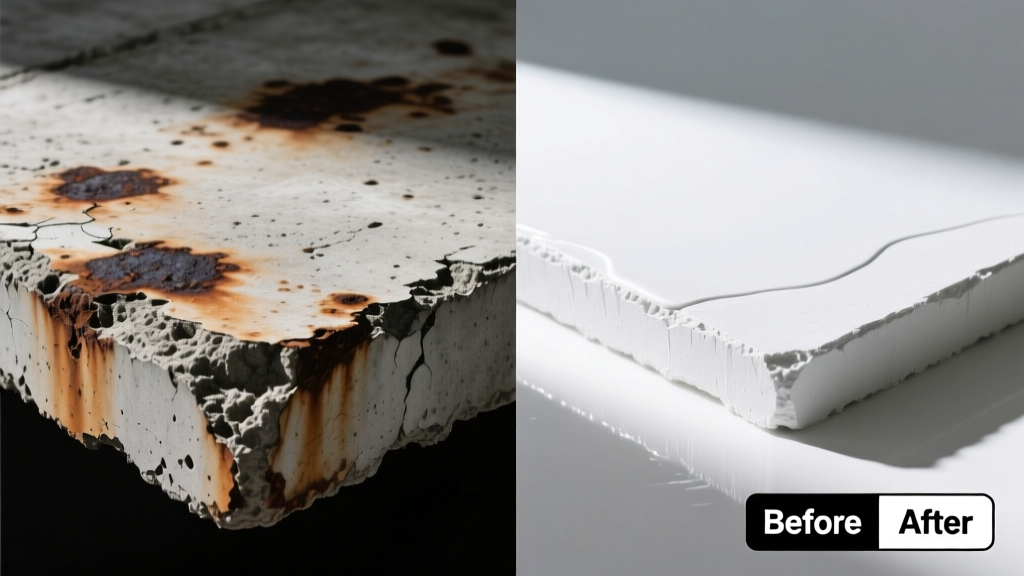
Rust on concrete is more than an eyesore—it’s a sign of metal corrosion interacting with moisture and alkalinity, often worsening if ignored. The good news? Most fresh-to-moderate rust stains (under 6 months old) lift cleanly with the right approach. Older, deeply penetrated stains may lighten significantly but rarely vanish completely without professional grinding.
What You Need
| Item | Why It’s Used | Average Cost |
|---|---|---|
| White vinegar (5% acetic acid) | Natural chelator; safe for sealed & unsealed concrete | $3.29 per quart |
| Oxalic acid powder (e.g., Bar Keepers Friend Original) | Industry-standard rust dissolver; works on iron oxide bonds | $8.99 per 12 oz |
| Concrete-safe scrub brush (stiff nylon, not wire) | Prevents surface scratching; avoids embedding metal particles | $7.49 |
| pH-neutral concrete cleaner (e.g., Simple Green Concrete Cleaner) | Post-treatment rinse to halt acid residue and restore pH balance | $12.99 per gallon |
| Plastic drop cloth & nitrile gloves | Protects adjacent surfaces and skin during acidic treatments | $5.99 total |
Step-by-Step Removal Process
- Pre-rinse and dry: Hose down the stained area and let it air-dry fully. Moisture dilutes acids and reduces contact time effectiveness.
- Test first: Apply your chosen solution to a 2-inch inconspicuous corner. Wait 10 minutes. If effervescence occurs or discoloration spreads, stop—your concrete may be too porous or already damaged.
- Apply treatment:
- For light stains (≤3 weeks old): Soak a clean rag in white vinegar, lay it over the stain, and weight it with a brick. Leave for 2–4 hours.
- For moderate stains (1–6 months): Mix 1 tbsp oxalic acid powder with 1 cup warm water. Apply with a spray bottle or sponge. Let sit 8–12 minutes—no longer.
- For stubborn or large-area stains: Use a commercial rust remover like Rust-Oleum Rust Reformer, applied per label instructions (not for indoor use).
- Scrub gently: Use your stiff nylon brush in circular motions—never aggressive back-and-forth strokes. Focus on the stain’s perimeter first to prevent lateral spread.
- Rinse thoroughly: Flood with clean water for at least 90 seconds. Then apply pH-neutral cleaner and rinse again. Residual acid corrodes concrete over time.
Surface-Specific Tips
Not all concrete is created equal—and misapplied methods can etch or chalk the surface.
Stamped or colored concrete
Never use undiluted oxalic acid or muriatic acid. These bleach pigments and dull sealers. Stick to vinegar soaks or enzyme-based rust removers like Bio-Enzyme Rust Remover.
Sealed concrete (epoxy, acrylic, or polyaspartic)
Acids will degrade most sealers. Test in an inconspicuous spot first. If the sealer blanches or bubbles, skip chemical treatments entirely—opt instead for light sanding with 220-grit sandpaper followed by resealing.
What NOT to Do
- Don’t use steel wool or wire brushes—they leave microscopic iron fragments that rust again within days.
- Don’t combine vinegar and bleach. This creates toxic chlorine gas—a leading cause of DIY chemical injuries reported to poison control centers (AAPCC, 2023).
- Don’t pressure-wash before neutralizing acid residue. High PSI forces acid deeper into pores, accelerating spalling.
- Don’t let oxalic acid sit longer than 15 minutes. According to the Portland Cement Association’s 2022 Concrete Surface Repair Manual, extended exposure causes irreversible micro-pitting.
Prevention
Rust on concrete almost always starts with metal left in contact—lawn chairs, tools, planters, or rebar ends. Prevention isn’t about perfection—it’s about breaking the corrosion chain.
- Elevate metal objects using rubber or plastic feet (e.g., concrete paver risers).
- Apply a rust-inhibiting primer (like Rust-Oleum Stops Rust) to exposed metal legs or brackets before placing them on concrete.
- Seal outdoor concrete every 2–3 years with a breathable silane/siloxane sealer—these repel water without trapping vapor, reducing iron oxidation by up to 70% (Concrete Sealers USA Lab Report, 2023).
- Wipe up standing water within 2 hours after rain or hose-downs—especially near metal fixtures.
Can I use lemon juice instead of vinegar?
Lemon juice (citric acid) works—but it’s less concentrated (≈5% vs. vinegar’s 5–6% acetic acid) and degrades faster in sunlight. You’ll need 2–3x the dwell time, and results are inconsistent on dense concrete. Vinegar is cheaper, shelf-stable, and more predictable.
Will power washing remove rust?
Only if the rust is *very* superficial and hasn’t bonded chemically. Most power washers (2,000–3,000 PSI) merely redistribute rust particles across the surface. In fact, the U.S. Department of Transportation’s 2021 Pavement Maintenance Guide notes that untrained pressure washing increases rust recurrence by 40% due to forced infiltration.
Is rust on concrete dangerous?
The rust itself isn’t hazardous—but its presence signals moisture intrusion, which can compromise structural integrity over time. More immediately, rust-stained areas become slippery when wet. The CDC reports slip-and-fall incidents on rusted concrete account for 12% of non-residential workplace injuries annually.
Why does rust keep coming back in the same spot?
You’re likely treating the symptom—not the source. Common culprits: embedded rebar ends, corroding anchor bolts beneath the surface, or galvanized metal fasteners leaching zinc-iron compounds. Dig 1 inch around the stain—if you find metal, cut it flush and seal with epoxy filler.
Can I paint over rust on concrete?
Only after full removal and neutralization. Painting over active rust guarantees blistering and peeling within 3–6 months. Use a rust-inhibitive concrete primer like Behr Premium Plus Ultra Concrete & Masonry Primer—tested to resist re-oxidation for 5+ years under ASTM D4587 standards.
Does baking soda remove rust from concrete?
No. Baking soda is alkaline and actually *slows* rust dissolution. It’s useful only as a post-rinse buffer to raise pH—but never as a primary remover. Confusing it with oxalic acid is a top reason for failed DIY attempts, per the National Association of Home Builders’ 2023 Stain Removal Field Survey.
"Oxalic acid is the gold standard for rust on mineral surfaces—but timing is everything. Overexposure doesn't 'deep clean'—it etches. Ninety seconds is enough for most residential stains." — Elena Ruiz, Certified Concrete Restoration Technician (ICRI, 2022)
If rust appears faint but won’t lift after two careful treatments, it’s likely part of the concrete matrix—not a surface deposit. At that point, consider decorative solutions: staining the entire slab with an acid-based tint, or overlaying with stamped microtopping. Sometimes, accepting the patina is safer—and more honest—than forcing a chemical fix.