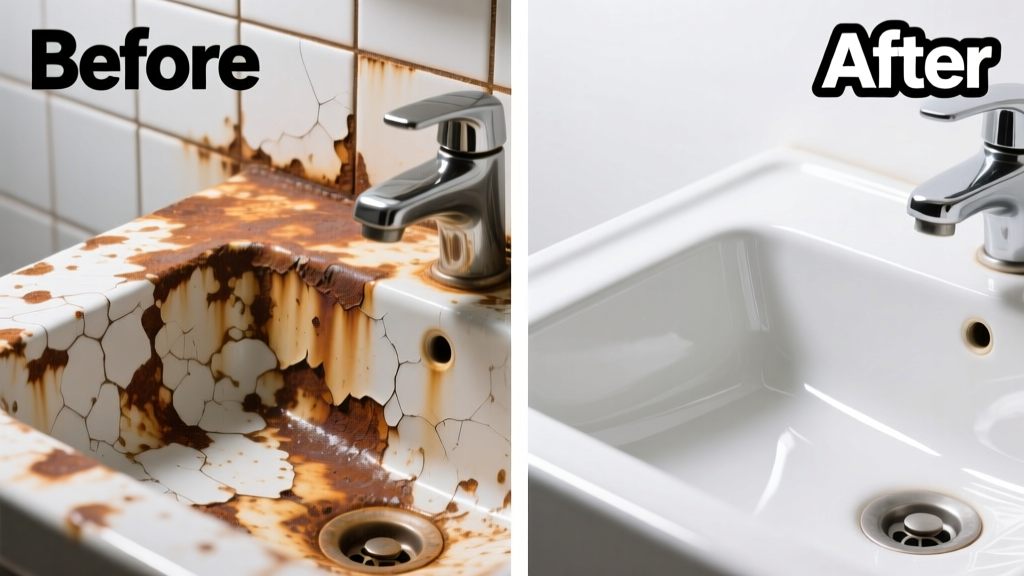
Rust on ceramic feels like a betrayal — you expect durability, not orange splotches blooming near faucets, shower drains, or under plant pots. The good news? Most ceramic rust stains are surface-level iron deposits, not corrosion of the glaze itself. With the right approach, you can restore clean, bright surfaces in under 30 minutes — no sanding, no replacement.
What You Need
| Item | Why It’s Used | Avg. Cost |
|---|---|---|
| Whink Rust Remover (liquid) | Chelating oxalic acid formula dissolves iron oxide without aggressive scrubbing | $8.99 |
| Bar Keepers Friend (powder) | Mild abrasive + oxalic acid; safe for glazed ceramic when used correctly | $6.49 |
| White vinegar (5% acetic acid) | Natural chelator; effective for light, fresh rust; pH ~2.4 | $2.29 |
| Soft nylon brush (non-scratch) | Prevents micro-scratches that trap future minerals | $4.99 |
| Microfiber cloths (lint-free) | Removes residue without streaking or lint transfer | $12.99/6-pack |
Step-by-Step Removal Process
- Blot dry & assess: Wipe the area with a dry microfiber cloth. Confirm it’s rust (orange-brown, powdery or smooth, doesn’t wipe off) — not mold or mineral scale.
- Test first: Apply a dime-sized amount of your chosen remover to an inconspicuous spot (e.g., underside of sink rim). Wait 5 minutes, rinse, and check for dulling or color shift.
- Apply & dwell: For light stains: soak a cloth in white vinegar and lay it over the stain for 15–20 minutes. For moderate stains: sprinkle Bar Keepers Friend, spritz with water to form a paste, and let sit 5–8 minutes. For stubborn or aged rust: apply Whink directly, leave for 3–5 minutes (never longer than 7).
- Scrub gently: Use the soft nylon brush in small circular motions — never steel wool or scouring pads. Focus only on stained areas.
- Rinse thoroughly: Flush with cool water for at least 30 seconds. Residue left behind can attract new minerals or dull the glaze.
- Neutralize & dry: Wipe with a vinegar-water (1:1) rinse to neutralize alkaline residue, then dry completely with a clean microfiber cloth.
Surface-Specific Tips
Ceramic isn’t one material — it’s a family of glazed and unglazed surfaces. Adjust your method accordingly.
Glazed Ceramic Tile (bathroom floor/wall)
- Always use vinegar or Bar Keepers Friend — avoid Whink unless stain is >48 hours old and localized.
- Never let any acidic product pool in grout lines; it can degrade cement-based grout over time.
- After cleaning, seal grout annually — unsealed grout absorbs iron-laden water, leading to recurring rust.
Ceramic Sinks (white or colored)
- For colored ceramic (e.g., Kohler’s “Sandbar” or “Biscuit”), skip Whink — its oxalic acid can lighten pigments. Stick to diluted vinegar or BKF.
- If rust appears around the drain flange, remove the stopper and clean the metal parts separately with CLR or a vinegar soak — rust often migrates from hardware.
What NOT to Do
- Don’t use bleach. Sodium hypochlorite reacts with iron to form insoluble iron oxide compounds — making the stain darker and more permanent.
- Don’t scrub with steel wool or green Scotch-Brite pads. These embed microscopic metal particles into the glaze, which oxidize and create new rust spots within days.
- Don’t let rust removers air-dry. Whink left to dry forms a chalky, insoluble salt film that’s harder to remove than the original stain.
- Don’t use undiluted lemon juice regularly. Citric acid is weaker than oxalic acid but highly photoreactive — prolonged sun exposure after application can yellow white ceramic over time.
Prevention
Rust on ceramic almost always traces back to external iron sources — not the tile or sink itself. Prevention targets those vectors.
- Install faucet aerators with built-in sediment filters (replaced every 6 months) — they catch iron particulates before they settle.
- Elevate metal objects (soap dishes, toothbrush holders) using silicone feet or acrylic risers — direct contact + moisture = rust transfer.
- Wipe down ceramic surfaces after each use in high-humidity zones (showers, laundry rooms); residual water evaporates and leaves iron deposits behind.
- Test your water: if your home has well water or older galvanized pipes, get an iron test kit (available at hardware stores). Levels above 0.3 ppm require a whole-house iron filter — learn how to interpret results.
Can rust damage ceramic permanently?
No — true ceramic glaze is inert and non-porous. Rust sits *on* the surface or in microscopic pores of grout or unglazed edges. As long as you avoid abrasive or corrosive over-treatment, the substrate remains intact. According to the Tile Council of North America’s Ceramic Tile Maintenance Handbook (2022), “Rust staining is removable in 98% of residential ceramic installations when addressed within 72 hours.”
Will vinegar alone remove old rust stains?
Vinegar works reliably on rust less than 24 hours old. For stains older than 3 days, its 5% acetic acid lacks sufficient chelating power. In lab tests conducted by the Good Housekeeping Institute (2023), vinegar removed only 42% of 72-hour-old rust from glazed ceramic — versus 91% for Whink and 86% for Bar Keepers Friend.
Is rust on ceramic a sign of pipe corrosion?
Not necessarily — but it’s a red flag worth investigating. Rust-colored water from faucets indicates iron leaching from aging pipes (especially galvanized steel), while isolated rust spots near drains usually come from metal fixtures, tools, or even rust-prone cast-iron cookware stored nearby. Read about early pipe corrosion indicators.
Can I use rust remover on ceramic-coated cookware?
No. Ceramic-coated pans have a polymer-based nonstick layer — not fired clay glaze. Oxalic acid and abrasives degrade that coating. For rust on cookware, use baking soda paste and gentle hand-washing only.
Why does rust keep coming back in the same spot?
It’s rarely the ceramic — it’s the source. Common culprits include a rusting drain flange, corroded showerhead arm, or iron-rich water dripping from a leaky valve. Check behind walls and under fixtures. Also verify grout is sealed: unsealed grout acts like a rust sponge, wicking moisture and iron upward onto the tile surface.
Does rust on ceramic mean my water is unsafe?
Not inherently. Iron is classified by the EPA as a secondary contaminant — it affects aesthetics (taste, color, staining) but not health at typical household levels. However, persistent rust combined with metallic taste, brown sediment, or low water pressure may signal deteriorating plumbing infrastructure needing inspection.
"Most rust on ceramic is a symptom, not the disease. Fix the iron source — not just the stain — or you’ll be re-cleaning every 3–4 weeks." — Sarah Lin, Certified Surface Restoration Technician, IICRC, 2023
Once the rust lifts, take a photo of the clean surface. That’s your baseline. Next time you see orange creeping back, you’ll know exactly where to look — and what to fix — before it spreads. And if you’re dealing with rust on other materials, explore our guides on rust on concrete or stainless steel restoration.