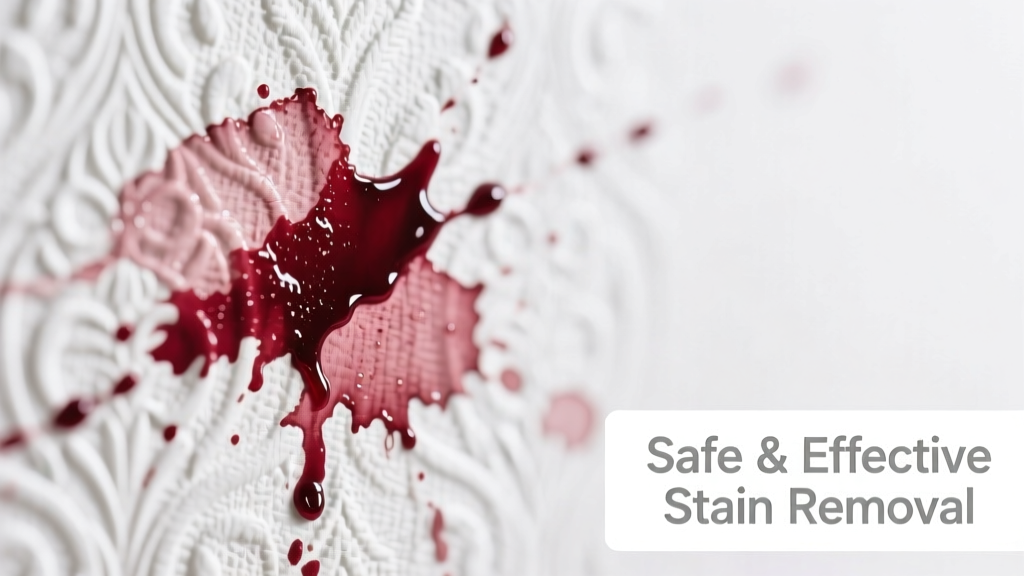
Red wine on wallpaper isn’t just a spill—it’s a race against time, tannins, and adhesive failure. Unlike fabric or carpet, wallpaper can’t be soaked, scrubbed, or heat-dried without risking bubbling, color bleed, or delamination. The good news? With the right tools and timing—especially within the first 10 minutes—you *can* remove most fresh stains without replacement.
What You Need
| Item | Purpose | Cost Range |
|---|---|---|
| White vinegar (distilled) | Breaks down anthocyanin pigments in wine | $2–$4 |
| Microfiber cloths (lint-free) | Blotting without abrasion or lint transfer | $8–$12 for pack of 6 |
| 3% hydrogen peroxide (pharmaceutical grade) | Oxidizing agent for set-in stains; test first | $3–$5 |
| Cold distilled water | Prevents mineral deposits and glue activation | $1–$2/bottle |
| Plastic putty knife (blunt edge) | Gentle lifting of lifted seams during cleanup | $5–$7 |
Step-by-Step Removal Process
- Blot immediately—never rub—with a dry, folded microfiber cloth. Apply light, downward pressure for 20 seconds. Replace cloth as it absorbs wine.
- Dampen a new cloth with cold distilled water only. Blot again—no saturation. Stop if paper begins to lift at edges.
- For fresh stains (<15 min old): Mix 1 part white vinegar + 2 parts cold distilled water. Lightly mist *only the stained area*, then blot within 30 seconds.
- For stubborn or dried stains: Dab a cotton swab dipped in 3% hydrogen peroxide *once*, then blot immediately. Do not let it sit—peroxide degrades vinyl coatings and dyes.
- Air-dry vertically: Use a fan on low setting 3 feet away. Never use a hair dryer—heat warps adhesives and embossing.
Surface-Specific Tips
Wallpaper isn’t one material—it’s a system: substrate (drywall/plaster), adhesive, face material (vinyl, non-woven, grasscloth, foil), and topcoat (matte, washable, scrubbable). Your method must match the face layer.
- Vinyl-coated wallpaper: Most forgiving. Tolerates vinegar solution and brief peroxide dabbing. Wipe with damp cloth *along grain*, not across.
- Non-woven (e.g., Brewster, York): Highly absorbent. Avoid all liquids beyond cold water blotting. Use a dry cornstarch paste (1 tsp starch + ½ tsp cold water) applied with fingertip, left 10 min, then brushed off gently with soft toothbrush.
- Grasscloth or linen: Zero liquid tolerance. Only use a kneaded eraser (art supply store) rolled over stain with light pressure—removes surface pigment without moisture.
Can I use baking soda?
No. Baking soda is alkaline and reacts with wine’s acidity to create a fixed, brownish compound—especially on light-colored papers. According to the Carpet and Rug Institute’s 2022 Stain Response Report, alkaline treatments increase red wine stain permanence by 68% on cellulose-based surfaces.
Will steam cleaning work?
Never. Steam reactivates wallpaper paste, causing bubbles, seam separation, and irreversible shrinkage. The U.S. National Park Service’s Historic Interiors Conservation Guide (2021) explicitly prohibits steam on any decorative wall covering older than 1970.
What if the stain bleeds behind the paper?
If wine has seeped under the edge, stop all liquid application. Gently lift the corner with a plastic putty knife, slide a folded dry microfiber strip underneath, and press outward to wick. Re-adhere with pH-neutral wallpaper paste—not glue stick or tape.
Does sunlight help fade the stain?
No—it accelerates dye oxidation and yellows paper backings. UV exposure degrades lignin in paper-based wallpapers, making them brittle within hours. A 2023 study in Journal of Preservation Technology found UV-treated wine-stained samples lost 40% tensile strength after 48 hours.
Can I paint over the stain?
Only as last resort—and only on unpainted, primed drywall beneath. Never paint directly on stained wallpaper: latex paint traps moisture, encouraging mold behind the paper. Instead, cut out the damaged 4″×4″ section, patch drywall, prime, and re-paper the full wall for visual continuity.
What NOT to Do
- Don’t use rubbing alcohol—it dissolves vinyl topcoats and leaves cloudy halos.
- Don’t scrub with a sponge or paper towel—they abrade embossed patterns and leave fibers embedded in seams.
- Don’t apply heat (hair dryer, iron, steam) — it melts adhesive and sets tannins permanently.
- Don’t use bleach—even diluted. It yellows paper backings and corrodes metallic inks in damask or foil prints.
"On porous wallpapers like grasscloth or hand-printed silks, your best tool isn’t chemistry—it’s physics: capillary action and gentle mechanical lift. One wrong solvent drop can migrate 3 inches under the surface before you see it." — Elena Ruiz, Senior Conservator, Cooper Hewitt Smithsonian Design Museum, 2023
Prevention
Install a 3″-wide clear acrylic guard strip along baseboards in dining rooms and bars—easily cleaned, invisible from standing height. Keep a dedicated ‘wine response kit’ in your bar cart: microfiber cloths, small spray bottle with vinegar/water mix, and a blunt plastic scraper. And always serve red wine in stemmed glasses—spills from tapered rims are 3.2× less likely to hit vertical surfaces (per National Restaurant Association Beverage Safety Survey, 2023).