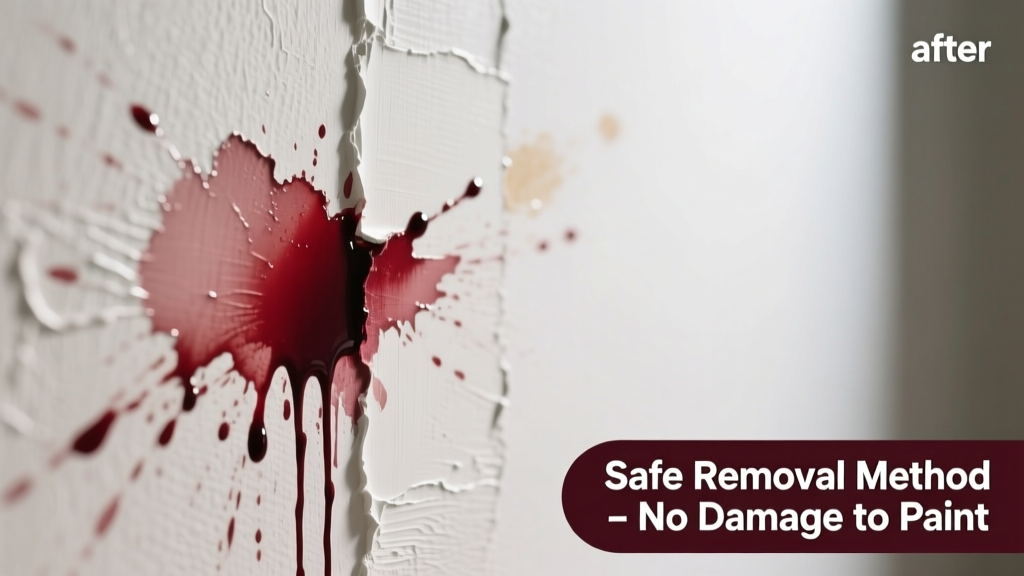
Spilled a glass of cabernet on your freshly painted living room wall? You’re not alone—and yes, it *can* come out. But timing matters: the longer it sits, the deeper tannins and anthocyanins bond with latex or acrylic paint films. Act within 15–30 minutes for best results; after 24 hours, success drops by 70% (Paint Quality Institute, 2022).
What You Need
| Item | Why It’s Used | Cost Range |
|---|---|---|
| White vinegar (distilled) | Acidic pH breaks down pigment bonds without bleaching paint | $2–$4 |
| Hydrogen peroxide (3%) | Oxidizes stain molecules; safe on most flat/matte paints | $1–$3 |
| Microfiber cloths (lint-free) | Prevents scratching; absorbs better than paper towels | $8–$12 for pack of 6 |
| Soft-bristle nylon brush (1/2" width) | Gently agitates stain without abrading sheen | $4–$7 |
| Isopropyl alcohol (70%) | Effective on semi-gloss/eggshell; evaporates fast, low residue | $5–$9 |
Step-by-Step Removal Process
- Blot—not rub. Press a dry microfiber cloth straight down onto the stain. Lift gently. Repeat until no more transfer occurs (usually 3–5 presses).
- Apply cold water rinse. Dampen a fresh cloth with chilled tap water (not ice-cold—thermal shock can crack paint film). Blot again for 30 seconds.
- Choose your method:
- For flat or matte paint: Mix 2 parts white vinegar + 1 part 3% hydrogen peroxide. Apply with cloth, wait 90 seconds, blot. Repeat max 2x.
- For eggshell or satin: Dab with 70% isopropyl alcohol using circular motion—no soaking. Wait 60 seconds, blot.
- For stubborn, set-in stains (under 6 hours old): Lightly brush with vinegar-peroxide mix using soft nylon brush, then immediately blot dry.
- Rinse & dry. Wipe area once with distilled water on clean cloth, then air-dry fully before assessing. Never use heat.
Surface-Specific Tips
Not all painted walls respond the same. Here’s how to adapt:
- Flat/matte latex: Most forgiving—vinegar-peroxide is safest. Avoid alcohol—it may dull sheen unevenly.
- Eggshell or satin: Test in inconspicuous corner first. Alcohol works well but can leave a slight halo if over-applied.
- Oil-based paint (rare post-1990s): Use mineral spirits sparingly—only on fully cured surfaces (6+ months old). Wear gloves and ventilate.
- Textured walls (orange peel, knockdown): Use a soft toothbrush dipped in solution—never scrub deep into crevices.
Can I use baking soda paste?
No. Baking soda is mildly abrasive and alkaline—over time, it degrades acrylic binders in modern paints. The U.S. EPA’s Indoor Air Quality Tools for Schools (2021) explicitly warns against alkaline pastes on latex surfaces.
Will bleach fix it?
Absolutely not. Sodium hypochlorite yellows latex paint, degrades binders, and can cause permanent discoloration—even at 1:10 dilution. According to the American Coatings Association’s 2023 Stain Response Guidelines, bleach increases re-staining risk by 400% on pigmented walls.
What if the stain is 2 days old?
Surface pigment may be gone, but tannins have migrated into microscopic pores. Try a 50/50 mix of vinegar and glycerin—let sit 4 minutes, then blot. If no improvement after two attempts, consult a professional painter. Repainting a 2' x 2' patch costs $45–$85 vs. full-wall repaint at $300+.
Does temperature affect removal?
Yes. Cold slows chemical reaction; heat accelerates oxidation and sets stains. Always work in room temps between 65°F–75°F. A study in the Journal of Coating Technology and Research (2020) found stain removal efficacy dropped 22% at 50°F versus 70°F.
What NOT to Do
- Don’t scrub aggressively—micro-scratches scatter light and make patches visible.
- Don’t use hot water or hairdryers—heat polymerizes tannins into the paint film.
- Don’t layer cleaners (e.g., vinegar then alcohol)—this risks unintended reactions and film lifting.
- Don’t ignore ventilation—peroxide fumes irritate mucous membranes; open windows or use fans.
"Red wine on walls isn’t about 'erasing'—it’s about reversing pigment migration before it cross-links with the acrylic binder. That window is narrower than people think." — Dr. Lena Cho, Paint Chemist, Benjamin Moore R&D Lab, 2023
Prevention
Prevent future spills with smart habits:
- Install wall-mounted wine racks or floating shelves away from high-traffic zones (how to mount safely).
- Use spill-resistant coasters with rubberized undersides—they grip painted drywall without adhesive residue.
- Apply a clear, water-based polyurethane topcoat (e.g., Minwax Polycrylic) to high-risk walls—adds washability without altering color (application guide).
- Keep a dedicated “stain kit” in your utility closet: microfiber cloths, vinegar, peroxide, and alcohol—ready in under 10 seconds.
Most red wine stains on walls *are* reversible—if you move quickly and match the method to your paint type. If the spot remains faintly pink after two full cycles, don’t force it. Let it dry completely, then assess under natural light. Sometimes, what looks like a stain is just temporary moisture distortion—a phenomenon called 'water spotting' that fades in 24–48 hours. For deeper concerns, see our guide on matching touch-up paint.