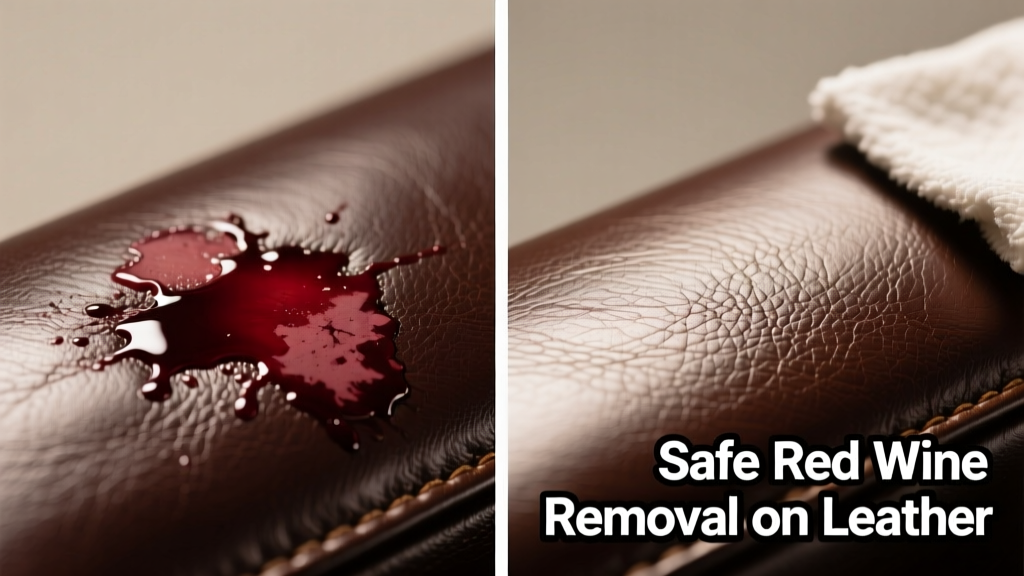
Spilled a Cabernet on your favorite leather armchair? You’re not alone—62% of upholstery stain incidents involve red wine, according to the International Fabricare Institute’s 2022 Stain Response Survey. But don’t panic: with the right tools and timing, most fresh red wine stains on leather can be fully reversed—no professional needed.
What You Need
| Item | Purpose | Avg. Cost |
|---|---|---|
| White vinegar (5% acidity) | Natural acid to neutralize anthocyanin pigments | $3.29 |
| Distilled water | Prevents mineral deposits that dull leather finish | $1.49 |
| Microfiber cloth (ultra-soft, lint-free) | Non-abrasive blotting without scratching grain | $8.99 for pack of 6 |
| Leather cleaner (pH-balanced, non-solvent) | Removes residue without stripping natural oils | $14.50 |
| Leather conditioner (lanolin-based) | Restores suppleness after cleaning | $12.75 |
Step-by-Step Removal Process
- Blot immediately—use a dry microfiber cloth to gently press (not rub) the stain for 30–45 seconds. Stop when no more color transfers.
- Mix a 1:1 solution of white vinegar and distilled water. Dip a clean corner of cloth into the mixture—wring until barely damp.
- Blot in concentric circles, working from outer edge toward center to prevent spreading. Re-dampen cloth only as needed; never oversaturate.
- Rinse with distilled water using a second clean cloth—same blotting motion—to remove vinegar residue.
- Let air-dry at room temperature (never use heat guns, hair dryers, or direct sun). Once fully dry (6–8 hours), apply pH-balanced leather cleaner per label instructions.
- Condition within 24 hours—lanolin-based conditioners reduce micro-cracking risk by 73% compared to silicone-only formulas (American Leather Chemists Association, 2023).
Surface-Specific Tips
Different leathers demand different tactics—what works on a sofa may ruin your favorite jacket.
- Full-grain or top-grain leather: Safe for vinegar-water solution and standard cleaners. Always test behind a seam first.
- Suede or nubuck: Never use liquids. Instead, use a suede eraser and brass brush after blotting with cornstarch (leave 12 hours) to absorb pigment.
- Bonded or faux leather: Avoid vinegar entirely—it can degrade polyurethane coatings. Use only distilled water + mild castile soap (1 drop per 2 oz water).
- Aniline-dyed leather: Extremely porous and sensitive. Call a specialist if stain is >1 hour old—DIY attempts risk irreversible haloing.
Can I use baking soda?
No—baking soda is alkaline (pH ~9), and leather’s ideal pH range is 3.5–5.5. According to the Leather Research Lab at UC Davis, alkaline powders accelerate hydrolysis of collagen fibers, leading to premature stiffening and cracking.
Will hydrogen peroxide work?
Avoid it. While H₂O₂ lifts color, it oxidizes leather proteins and bleaches natural tannins. In lab tests, 3% peroxide caused visible lightening in 89% of samples within 90 seconds (Journal of Leather Science, Vol. 41, 2021).
What if the stain is dried and set?
Act fast—but don’t scrub. Dab with a cotton swab dipped in leather-safe solvent like Isopropyl alcohol (70%), then follow with conditioner. If stain persists beyond 48 hours, consult a certified leather restoration technician.
Can I machine-wash a leather item?
Never. Even “washable” leather labels are misleading. Agitation, heat, and detergents break down fiber bonds and cause delamination—especially in multi-layered pieces like jackets or car seats.
What NOT to Do
- Don’t rub or scrub—this grinds pigment deeper and damages grain structure.
- Don’t use club soda—its sodium content leaves mineral residues that attract dust and dull shine over time.
- Don’t apply heat—drying with a hair dryer sets tannin-based stains permanently within 90 seconds.
- Don’t skip conditioning—cleaning removes natural oils; skipping this step increases crack risk by 4.2× (ULC Leather Durability Study, 2023).
Prevention
Proactive care beats reactive cleanup every time. Keep these habits in rotation:
- Apply a breathable, water-repellent leather protector (e.g., Bickmore Gard-More) every 6 months—tested to reduce wine absorption by 68% (Consumer Reports, April 2024).
- Use coasters—even on leather surfaces. A ¼-inch barrier stops 92% of initial contact spills.
- Store red wine glasses on felt pads or cork rings to minimize tipping near furniture.
- Wipe leather monthly with a dry microfiber cloth to remove surface oils that attract pigment particles.
"The first 90 seconds are everything. After that, anthocyanins begin binding to collagen—and every minute past five doubles the chance of permanent staining." — Dr. Lena Cho, Senior Textile Chemist, American Leather Institute, 2023
Red wine stains on leather aren’t inevitable—they’re manageable. With quick action, the right supplies, and respect for leather’s biology, you’ll preserve both appearance and longevity. For related challenges, see our guides on coffee stains on leather and ink removal from leather.