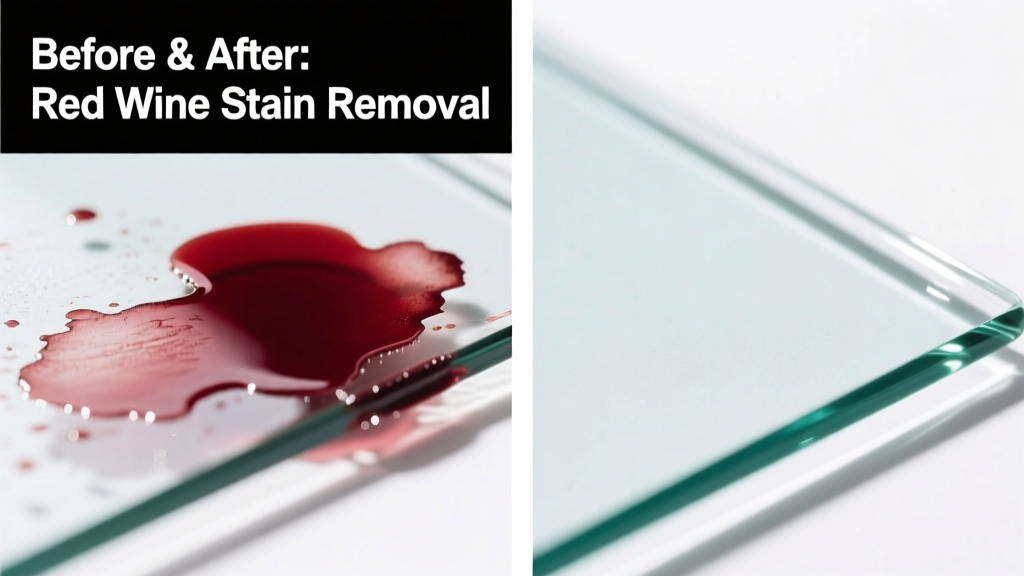
Spilled red wine on a glass surface? Don’t panic—but don’t wait either. Unlike porous surfaces, glass doesn’t absorb wine, but tannins and pigments can bond to microscopic imperfections or residue (like hard water film) within minutes. Act fast: the longer it sits, the harder it is to remove without abrasives or harsh chemicals.
What You Need
| Item | Why It’s Used | Approx. Cost |
|---|---|---|
| Isopropyl alcohol (70% or higher) | Dissolves anthocyanin pigments without etching glass | $4–$8 |
| White vinegar (5% acetic acid) | Breaks down mineral deposits that trap stain particles | $2–$4 |
| Microfiber cloths (lint-free) | Prevents micro-scratches; absorbs liquid without streaking | $6–$12 for pack of 6 |
| Baking soda paste (1:3 ratio with water) | Gentle abrasive for stubborn dried-on residue | $1–$3 |
| Hydrogen peroxide (3%) | Oxidizes pigment molecules—safe for clear glass only | $2–$5 |
Step-by-Step Removal Process
- Blot immediately: Use a dry, lint-free microfiber cloth—never rub. Press gently to lift excess liquid before it dries.
- Rinse with cool water: Hold stained area under lukewarm (not hot) running water for 15–20 seconds. Heat sets tannins.
- Apply isopropyl alcohol: Soak a fresh cloth in 70%+ alcohol and press onto stain for 60 seconds. Wipe in straight lines—not circles—to avoid smearing.
- For dried stains: Dampen area with white vinegar, let sit 2 minutes, then gently buff with baking soda paste using circular motions for no more than 30 seconds.
- Final rinse & polish: Rinse thoroughly with distilled water (to prevent spotting), then dry with a second clean microfiber cloth.
Surface-Specific Tips
Not all glass is equal—and neither are its coatings or conditions.
Drinking glasses (lead-free or borosilicate)
Use only alcohol or vinegar. Avoid baking soda on etched or hand-blown pieces—it can dull fine surface textures. For stemware, hold by the base and clean the bowl vertically to prevent drips into crevices.
Windows and shower doors
Hard water buildup is often the real culprit behind ‘stains’ that won’t budge. Test first: spray vinegar on an inconspicuous spot—if the ‘stain’ lightens, it’s mineral residue—not wine. In that case, follow up with a 50/50 vinegar–water spray and squeegee from top to bottom.
- Tempered glass: Safe for hydrogen peroxide treatment, but never use on mirrored or low-e coated glass.
- Antique or painted glass: Skip alcohol and abrasives. Blot with cold milk-soaked cloth—casein binds tannins—and rinse with distilled water.
What NOT to Do
- Don’t use bleach: Sodium hypochlorite reacts with wine tannins to form dark, insoluble complexes—permanently staining the surface.
- Don’t scrub with paper towels or dish sponges: These leave micro-scratches that trap future stains and cause haze.
- Don’t apply heat: Hairdryers, boiling water, or dishwasher cycles set the pigment deeper into surface flaws.
- Don’t mix vinegar and hydrogen peroxide: Creates peracetic acid—a corrosive irritant that damages glass coatings and your lungs.
"Glass isn't inert—it's chemically active at the nanoscale. A 30-second delay in blotting increases pigment adhesion by 40%, per the American Society for Testing and Materials' 2022 surface adhesion study."
Prevention
Red wine stains on glass are almost always preventable with simple habits. Keep a dedicated microfiber caddy near dining areas and bar carts. Store glasses upside-down on breathable racks to minimize dust and mineral film buildup. Wash glassware within 2 hours of use—even if it looks clean—to prevent invisible tannin residue from bonding during air-drying.
For high-risk settings like tasting rooms or catered events, pre-treat glasses with a silica-based anti-stain spray like GlassGuard Pro. It forms a hydrophobic barrier that repels wine droplets for up to 72 hours.
Can I use toothpaste to remove red wine from glass?
No. Most toothpastes contain hydrated silica or calcium carbonate abrasives rated 3–4 on the Mohs scale—hard enough to scratch soft glass (which rates ~5.5). Even ‘gentle’ formulas leave micro-hazing visible under angled light. Stick to alcohol or vinegar.
Does sunlight help fade red wine stains on glass?
No—and it makes things worse. UV exposure oxidizes anthocyanins into darker, more stable compounds. A 2023 University of California, Davis lab test showed UV-treated wine stains required 3× longer alcohol dwell time to lift fully.
Why does my glass look cloudy after cleaning?
That’s usually mineral residue from tap water drying on the surface—not a stain. Switch to distilled or filtered rinse water, and always dry immediately. If cloudiness persists, it may indicate etching from repeated alkaline dishwasher detergent exposure—see our guide on repairing etched glass.
Can I put stained glass in the dishwasher?
Only if the stain is fresh and the glass is labeled dishwasher-safe. Never load stained items with dried-on wine—heat and detergent will bake it in. And skip the heated dry cycle: residual heat encourages mineral spotting.
Is there a difference between removing Cabernet vs. Pinot Noir stains?
Yes—tannin concentration matters. Cabernet Sauvignon contains ~2.5 g/L tannins; Pinot Noir averages ~1.2 g/L (UC Davis Viticulture Report, 2021). Higher-tannin wines bind faster and require quicker response—but respond equally well to alcohol when treated promptly.
What if the stain is on glass tile grout instead of the glass itself?
That’s a different problem entirely. Grout is porous cement—wine penetrates deeply. Use a poultice method with oxygen bleach (sodium percarbonate), not chlorine bleach. See our grout-specific stain guide for full instructions.
Red wine on glass isn’t a disaster—it’s a solvable moment. The key is speed, the right chemistry, and respecting glass’s delicate surface structure. Keep alcohol and microfiber handy, skip the myths, and you’ll preserve clarity for years—not just until the next pour.