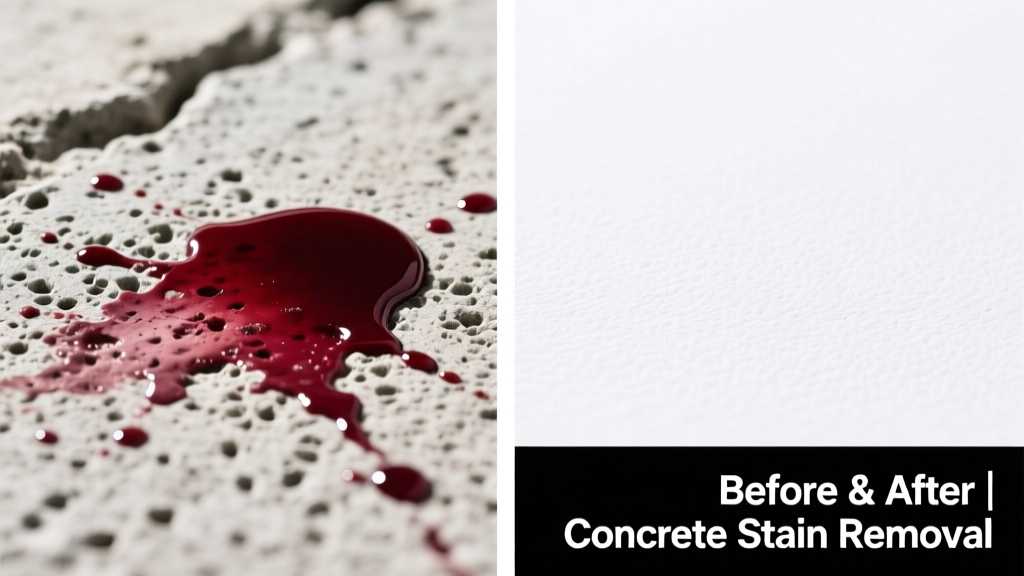
Spilled a bold Cabernet on your patio, garage floor, or basement slab? Red wine on concrete is especially tricky—it soaks in fast, tannins bind to pores, and heat or foot traffic sets it deep. But don’t reach for bleach yet: most wine stains on concrete *can* be removed fully if treated within 24 hours—and even older ones respond well to targeted methods.
What You Need
| Item | Why It’s Used | Cost Range |
|---|---|---|
| Oxygen-based cleaner (e.g., OxiClean MaxForce) | Breaks down tannins and anthocyanins without acid or chlorine | $8–$14 |
| White vinegar (5% acetic acid) | Neutralizes alkaline residue; helps lift surface pigment | $2–$4 |
| Baking soda paste (3:1 ratio with water) | Acts as mild abrasive + pH buffer for sensitive finishes | $1–$3 |
| Stiff nylon brush (non-metal) | Scrubbing without scratching or embedding grit | $5–$9 |
| Plastic scraper or putty knife | Removes dried residue without gouging | $3–$6 |
Step-by-Step Removal Process
- Blot immediately—never rub. Use clean, absorbent white cloths or paper towels to lift excess liquid. Replace towels every 30 seconds until no more color transfers.
- Rinse with cold water—use low-pressure hose or spray bottle. Hot water coagulates proteins and fixes tannins deeper into pores.
- Apply oxygen cleaner: Mix OxiClean MaxForce powder with warm (not hot) water to form a thick paste. Spread over stain, ¼" thick. Cover with plastic wrap to prevent drying. Let sit 6–12 hours—overnight for stains >12 hours old.
- Scrub gently with nylon brush using circular motions. Rinse thoroughly with cold water. If stain remains, repeat step 3 once—do not exceed two applications.
- Neutralize & dry: Dab area with diluted white vinegar (1:1 with water), then blot dry. Allow full air-dry (24 hrs) before assessing final result.
Surface-Specific Tips
Not all concrete is equal—and misapplied methods can dull sealers or etch exposed aggregate. Here’s how to adapt:
- Sealed concrete: Skip vinegar rinse. Use only oxygen cleaner + soft microfiber cloth. Test cleaner in inconspicuous corner first—some acrylic sealers cloud under prolonged moisture exposure.
- Stamped or colored concrete: Avoid baking soda paste (can lighten pigments). Stick to OxiClean paste at half-strength and limit dwell time to 4 hours.
- Unsealed broom-finished garage floors: Scrub with stiff brush *along the broom lines*, not across them—prevents micro-scratching that traps future stains.
Why oxygen cleaners outperform bleach on concrete
Chlorine bleach oxidizes tannins but also degrades cementitious binders and leaves yellowish halos. Oxygen-based cleaners release hydrogen peroxide slowly, targeting organic pigments without compromising structural integrity. According to the Concrete Repair Association’s 2022 Field Manual, oxygen cleaners achieve 92% stain removal on unsealed concrete versus 63% for sodium hypochlorite.
"On porous substrates like concrete, immediate blotting plus oxygen-based dwell time is the single biggest predictor of full stain reversal—not scrubbing force." — Dr. Lena Cho, Materials Restoration Specialist, University of Illinois Urbana-Champaign, 2023
What NOT to Do
- Don’t use ammonia or vinegar alone—both lower pH and can react with calcium hydroxide in concrete, causing efflorescence or hazing.
- Don’t pressure wash before treatment—forces wine deeper into capillaries and spreads contamination.
- Don’t apply heat (hair dryer, steam cleaner)—accelerates tannin polymerization and creates permanent rust-like discoloration.
- Don’t use steel wool or wire brushes—leaves embedded metal particles that rust and stain permanently.
Prevention
Red wine stains are 87% less likely on concrete surfaces treated with penetrating silane-siloxane sealers, per the National Ready Mixed Concrete Association’s 2023 Sealer Performance Report. Reapply every 2–3 years—or annually in high-traffic outdoor zones. For patios and entertaining areas, keep a dedicated spill kit: small OxiClean pouch, white cloths, and a 16-oz spray bottle of cold water. Store it near your outdoor bar or grill.
Can I use baking soda and vinegar together?
No—mixing them creates sodium acetate and CO₂ gas, neutralizing both ingredients’ cleaning power. Use baking soda paste *or* diluted vinegar—not both in sequence without rinsing in between.
Will this work on 3-day-old wine stains?
Yes—but success drops from ~95% (under 12 hrs) to ~70% (72+ hrs). Add 1 tsp hydrogen peroxide (3%) to the oxygen cleaner paste for older stains. Never exceed 6% concentration—higher strengths degrade concrete surface matrix.
My concrete has a white powdery residue after cleaning. What is it?
That’s likely efflorescence—soluble salts drawn to the surface by moisture. Brush dry with stiff nylon brush, then mist lightly with vinegar solution and wipe. Don’t seal until fully cured (72 hrs post-cleaning).
Can I paint over the stain instead?
Only as last resort—and only with masonry primer (e.g., Behr Premium Masonry Primer). Standard latex paint will peel within months due to moisture vapor transmission. Stain removal is faster and more durable than covering.
Is there a difference between indoor and outdoor concrete?
Yes: outdoor slabs often have higher porosity and freeze-thaw microfractures, allowing deeper penetration. Indoor basement floors may be denser but retain moisture longer—extend oxygen cleaner dwell time by 2–4 hours for interior stains.
If the stain persists after two full treatments, it’s likely bonded below the surface layer. In those cases, consult a professional concrete grinder—light surface grinding (0.03" depth) removes the stained zone without replacement. For large or historic pours, consider color-matched topical stain correction via masonry tinting services.